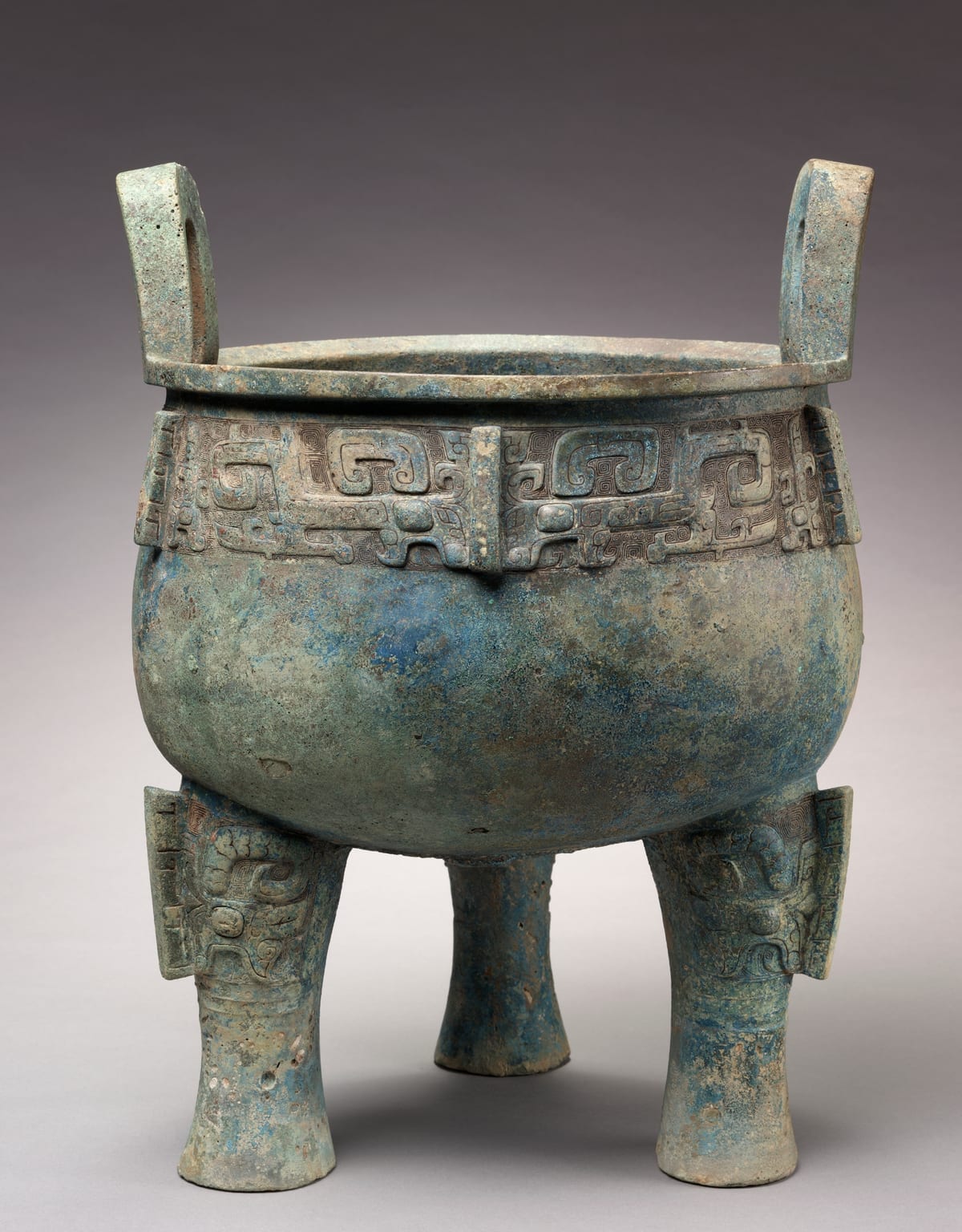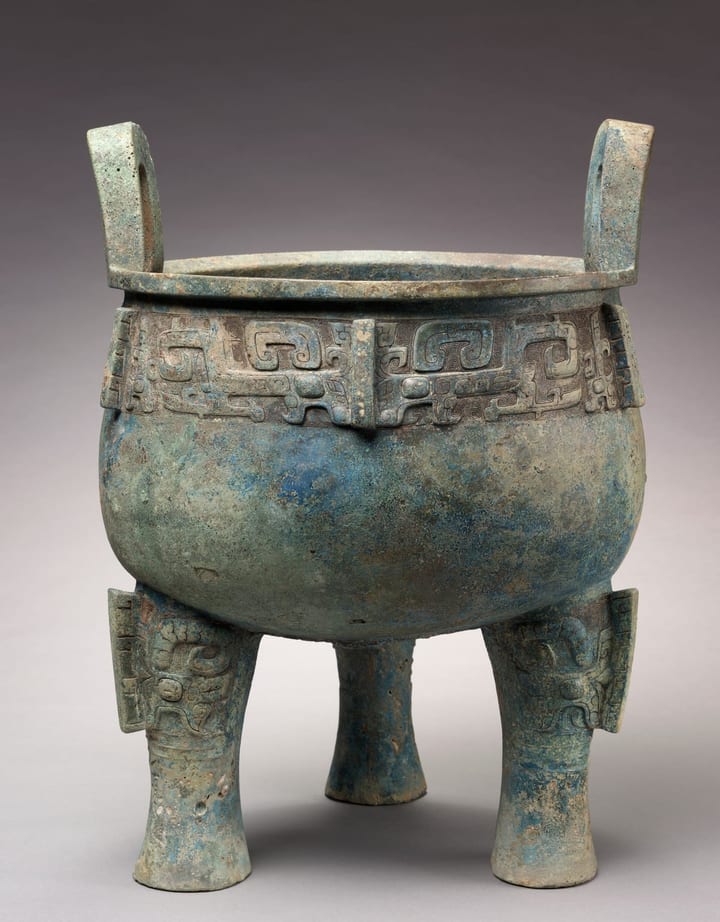
Begin with the bowl, handles and supports
Follow the rounded container down to its three legs, then return to the two upright handles. This sequence makes the vessel’s structure easier to read before attention moves to its ornament. Compare the spaces between the legs as well as the mass of the body; a frontal photograph reveals only one view.
Cleveland’s illustrated Tripod (Ding), 2003.2, is bronze and stands 57.4 centimeters high. The museum assigns it to the Western Zhou dynasty and prints its date as “1000s BCE.” Three animal masks occupy the decorative band, while ram imagery embellishes the legs. Keep those catalogue identifications beside the photograph rather than giving every projecting form the same name.
A food vessel differs from a wine vessel
The Met identifies ding as vessels for cooking and serving food offerings. Its bronze example 49.135.10 dates to the twelfth or eleventh century BCE. The museum traces the type from earlier ceramic vessels into Shang bronze production, and notes that later versions could also function as incense burners.
The word therefore carries a history of changing materials and uses. Our jue guide studies a spouted vessel associated with wine, while the zun guide compares other named container forms. When moving among them, begin with the catalogue’s vessel identification instead of treating every ancient bronze as an interchangeable ritual cup.
A lid changes the silhouette
LACMA’s covered ding, M.74.103a-b, is cast bronze from the ancient state of Jin in present-day Shanxi. The museum dates it to about 500–450 BCE. Its account describes overlapping relief, interlaced animal and geometric forms, and masks on the bent legs. The body and cover carry a dense pattern that differs from the broad bands of the Cleveland vessel.
Compare the contour with the open vessel in our photograph. Ask where a lid meets its rim, how the handles relate to that join, and which views the record supplies. A change in profile is visible evidence; the original sequence of handling or serving needs further documentation. Do not infer a universal ceremony from the presence of a cover.
An inscription opens another kind of record
Shanghai Museum dates Da Ke Ding to King Xiao’s Western Zhou reign, in the late tenth century BCE. It records a height of 93.1 centimeters and an interior inscription of 28 lines containing 290 characters. The text praises Ke’s grandfather and records rewards Ke received from the king.
The museum places its discovery at Famen Temple in Fufeng County, Shaanxi, during the Guangxu reign. Such a record joins a particular object to a find location and a written account. It does not make every ding equally well documented. An interior view, transcription and translation offer different evidence from the decorated exterior.
Molds explain a hollow cast form
The Met’s general account describes piece-mold casting: a clay mold is taken from a model, divided to release it, then fired and reassembled. A core reserves the cavity inside a vessel. Decoration can be carved or stamped into the mold’s inner surface before firing.
The essay also leaves the significance of Shang taotie imagery unresolved. Keep that uncertainty beside a catalogue’s visual identifications. Specific mold joints or repairs need an object’s technical record.
Images and credits
Tripod (Ding), China, Western Zhou dynasty, dated by the museum to 1000s BCE. Bronze. Cleveland Museum of Art, 2003.2; Severance and Greta Millikin Purchase Fund. CC0. Complete museum photograph, resized.