How to compare Chinese bronze incense burners
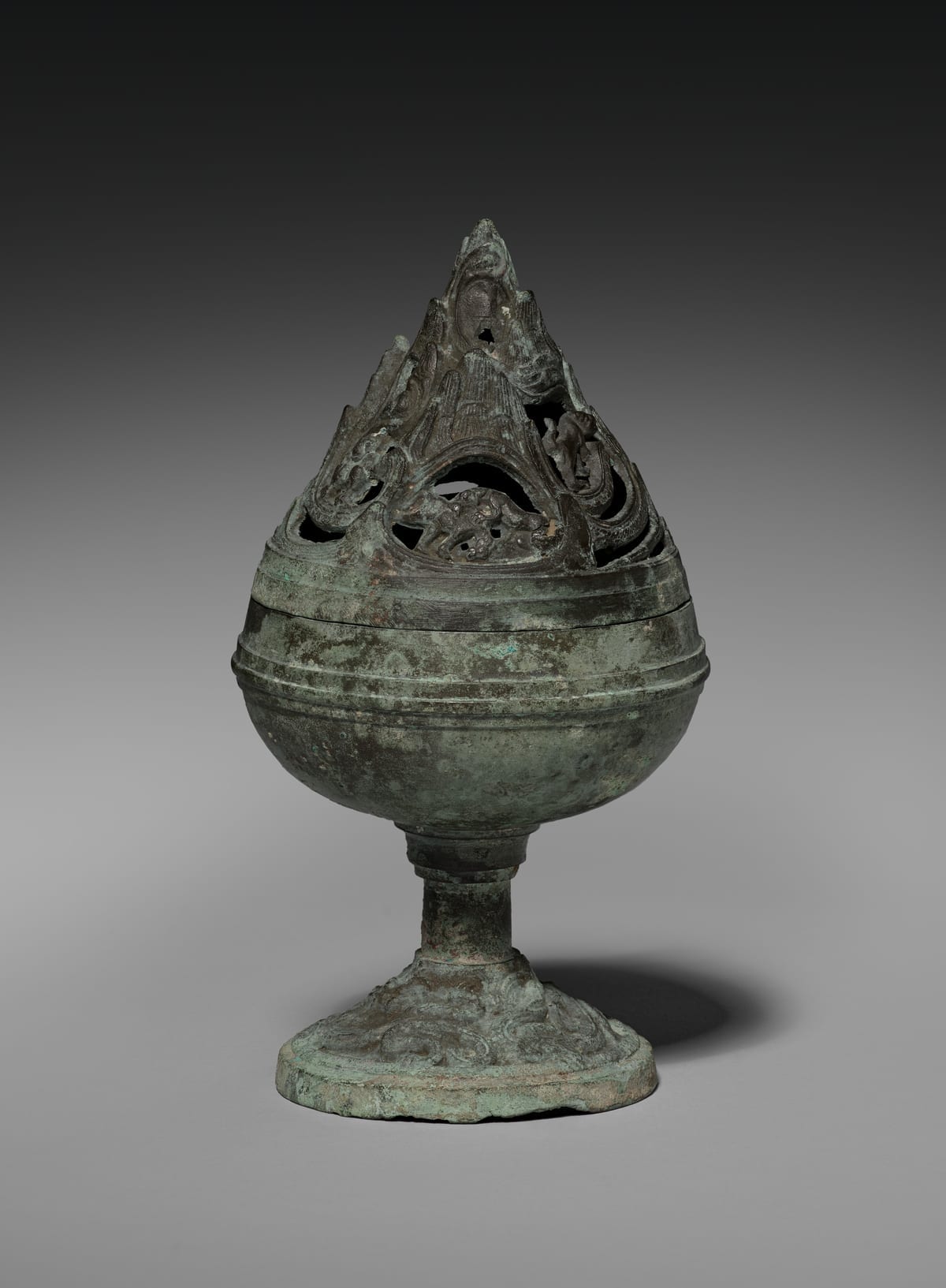
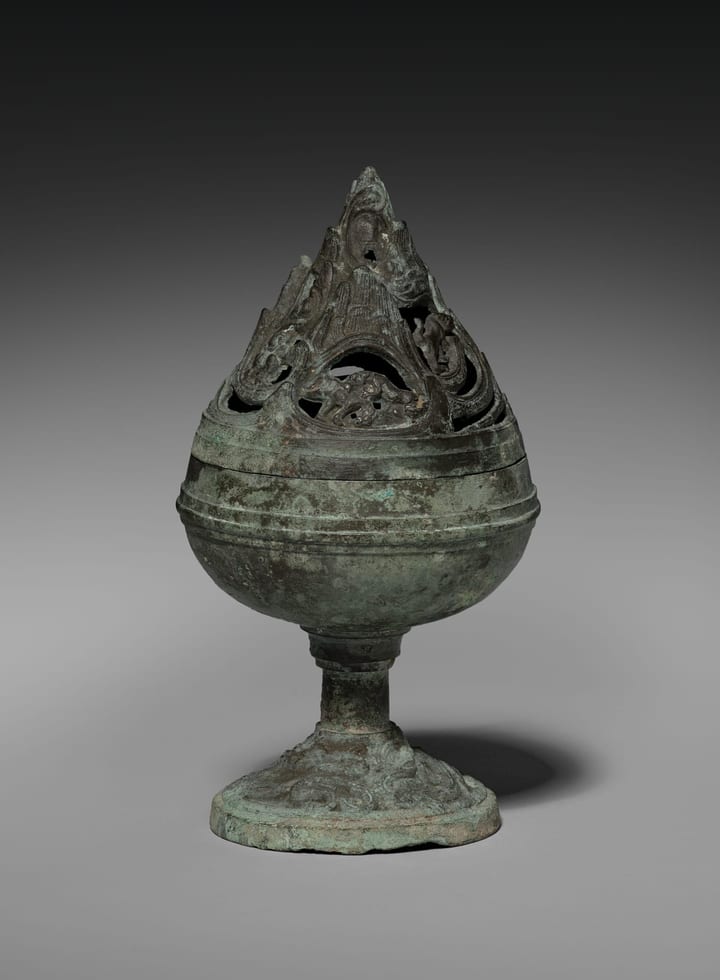
Cleveland’s photographed bronze burner, 1986.46, dates to 200–100 BCE. Its stem supports a bowl and pierced, mountain-shaped cover. The museum describes hunting scenes, with incense smoke emerging through the openwork when fragrant woods and herbs burned below. Relief and drifting smoke would have worked together.
An imagined landscape can include the support
Penn Museum’s Han censer, 39-27-1A, takes a different approach: a phoenix standing on a tortoise supports the bowl. Its separately numbered cover, 39-27-1B, carries animals on ledges, with slits below them for incense fumes. Here the support is part of the imagery rather than a plain vertical stem.
Penn interprets the hill as Penglai, one of the legendary islands associated with a substance that prevented death. Read this as an account of imagined immortality, not a claim about incense’s effects. It also belongs to Penn’s particular object. The Cleveland photograph illustrates another arrangement, so the bird and tortoise should not be transferred to its description.
Hill form and casting are separate observations
The Ashmolean explains boshanlu as an incense burner shaped like a hill. Its example, EA1956.901, is described as surmounted by a bird and dated between 200 BCE and 100 CE. At ten centimeters high, it also offers a reminder to check dimensions: a mountain-shaped object can be small enough to examine closely.
Bronze and casting identify a material and forming process for this object. The general word ‘cast’ does not establish one particular mould-making method or reconstruct a workshop.
A later vessel can have very different proportions
The Met’s burner 67.55.93 is catalogued to the Xuande period, 1426–1435, with bronze and gold listed as its materials. It measures 3.5 centimeters high and 11.4 centimeters across at the handles. Those measurements describe a much lower, wider object than a tall mountain-covered censer.
Width at the handles is not the incense chamber’s diameter. Check what each measurement includes before comparing vessels.
The equipment extends beyond the outer body
A Ming burner in the Palace Museum, 故00142731, has upright handles, three small feet and a gilded cover. Its record also lists a liner and a tin fire-assisting fitting. The museum distinguishes the liner’s separation of the fire from the fitting’s assistance to combustion. These are recorded components of this vessel, rather than a standard set to assume for every censer.
The same account notes that some burners were accompanied by a spatula, incense chopsticks, a tool vase and an incense box. This makes the surrounding equipment worth examining: the container, its interior fittings and the implements each contribute something different to the record of use.
Surface treatment gives another way to compare
An eighteenth-century Met burner and matching stand, 67.55.39a, b, are catalogued as bronze with a treated surface and gold splashes. The museum explains that the apparently irregular gold was carefully applied to create movement and depth. The distribution of color therefore contributes to the design, alongside the shape of the vessel and its stand.
This is a different emphasis from modeling a mountain in relief. Follow how the gold is spaced across the surface and then how the two objects relate as a pair. The catalogue’s wording identifies a finish; it does not make every gold-colored area on another burner the result of the same technique.
Later bronzes have their own historical setting
The Met’s Recasting the Past exhibition describes renewed bronze casting from the twelfth through nineteenth centuries. Ancient food and wine vessel forms acquired new roles as incense burners and scholarly objects. The exhibition treats later works as creative objects with their own functions.
Ask which parts of a form were retained, which changed and what the later vessel contained. An archaic appearance alone does not establish an early date.
Images and credits
Incense Burner (Boshan Lu), China, Western Han dynasty, 200–100 BCE. Bronze. Cleveland Museum of Art, 1986.46. Severance and Greta Millikin Purchase Fund. CC0. Complete institutional photograph, resized.