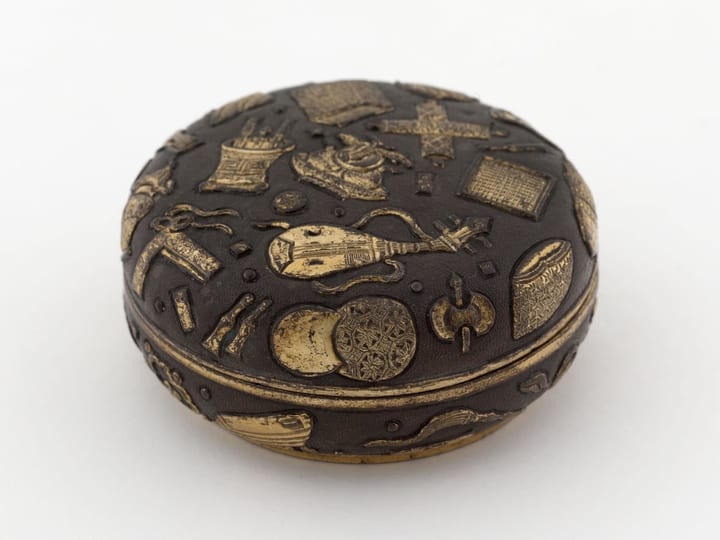
A bronze example of Chinese incense boxes
Musée Cernuschi identifies the pictured box as a work by the bronzier Hu Wenming, dated to the sixteenth or seventeenth century. It is 7.3 centimeters across and only 2 centimeters high. The museum describes its low, lens-like shape and identifies the relief motifs as precious objects.
In the angled photograph, a narrow seam separates the lid from the shallow base.
A related bronze box has a different lid
The Cernuschi collection also holds another incense box by Hu Wenming, M.C. 390, measuring 3.4 centimeters high and 7.3 across. The museum records a branch in blossom on its lid. On boxes this small, the cover can carry a single botanical design or a group of separate motifs.
An accession number helps keep the two boxes apart when both museum records call them incense boxes.
A wide ceramic cover carries its own design
A celadon-glazed stoneware incense box from Tongchuan, dated 1100–1127, is also 2 centimeters high but measures 12.5 across. Its cover frames a lotus and arrowhead plant with a double incised circle. The lid turns a compact storage form into a broad field for ornament.
A diameter and a height are especially helpful together. Compare the breadth of the two covers with their low sides. The proportions affect what a viewer can see when looking down at a box on a table.
A round shape can have several plausible uses
The same museum assigns several possible functions to an eleventh-century Yue stoneware box with a peony incised beneath its glaze. Its catalogue lists incense, cosmetics, ointment and medicine. The cover design helps describe this particular object. Its original contents remain open.
The underside can carry evidence of making
The Met identifies a fourteenth-century incense box as carved tixi lacquer. It records Yang Mao’s signature cut into the underside. The inscription and carved layers are evidence for a particular work, while the shallow box form can be compared with pieces made in bronze or stoneware.
A Qing jade box changes the proportions
The Met’s nephrite box 21.175.47a–c dates to the late eighteenth or early nineteenth century. The listed dimensions are 3.8 centimeters high, 5.7 wide and 4.8 deep. It supplies a compact example with unequal width and depth beside the round examples.
Our incense tool vase guide follows long implements and the vase that keeps them upright. The box answers a different need. Look for the cover, the space it closes and the evidence for what belonged inside.
Images and credits
Incense box (xianghe), Hu Wenming, China, sixteenth to seventeenth century. Cast and gilded bronze. Paris Musées / Musée Cernuschi, M.C. 389. Shown closed in an angled view. Complete museum photograph, resized. CC0.