A square pedestal and openwork cover
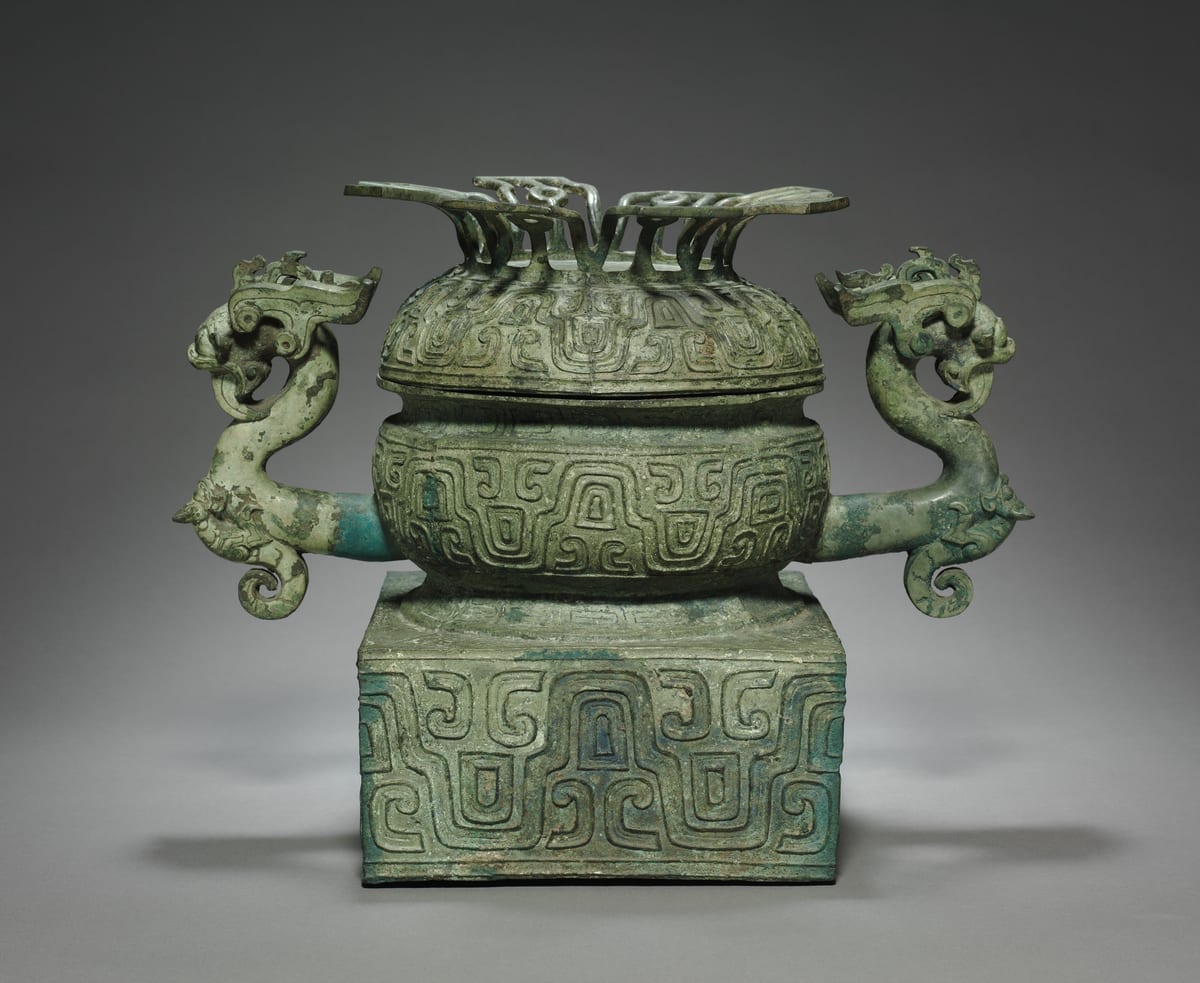
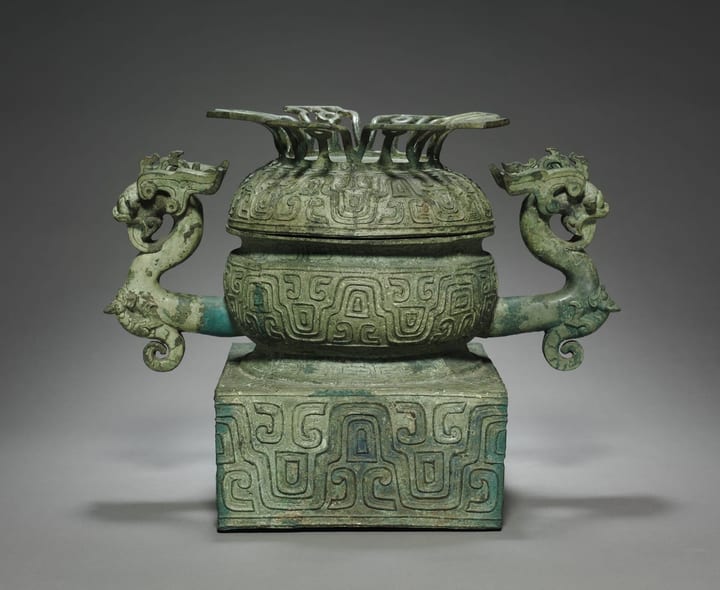
The illustrated Cleveland gui, 1974.73, dates to 600–500 BCE. Its rounded container rises from a square pedestal. The museum identifies lotus-petal openwork around the cover and dragons accompanied by felines in the arched handles. The object measures 34.3 by 44.5 centimeters overall.
Follow the outline before the surface pattern. A handle creates open space beside the bowl, while the pedestal establishes a different boundary underneath it. The upper openwork breaks the silhouette again. Compare these three areas without assuming that every gui has the same base or an equally elaborate cover.
Fluting can replace a dense decorative field
The Met’s 1988.20.3a,b, dated to the early ninth century BCE, makes another visual choice. Horizontal fluting organizes the surface, while animal heads remain on the handles. The museum records the same twelve-character inscription inside the bowl and lid. It names the Earl of San as the maker of a precious gui for Ji of Zhe and expresses a wish for its continuing use.
The exterior’s repeated flutes can be followed around the body, whereas the dedication requires an interior view and transcription. Check the separate views before comparing inscription and ornament.
A cast inscription belongs to an individual object
Princeton dates gui y1965-53 to the twelfth or eleventh century BCE and identifies its material as bronze with a cast inscription. It records a mark on the bottom interior, a height of 14.6 centimeters and a rim diameter of 18.4 centimeters. The museum classifies the object’s technique as casting.
Dimensions qualify the impression made by a large screen image. The inscription entry directs attention inside the container. The technique entry identifies a process without reconstructing its complete workshop sequence.
Check what the catalogue counts as a stand
The Smithsonian records F1924.14a-b as a ritual food vessel with a stand, from the late eleventh or early tenth century BCE. Its description notes relief decoration and an inscription inside the bottom. The catalogue dimensions are 14.1 centimeters high by 24.2 wide.
A display photograph may not explain a support’s relationship to its bowl. Follow the museum’s component description before deciding that all visible parts were cast together. Compare this record with the Cleveland pedestal.
A later lid can tell a later story
Montreal’s 1962.Ed.35a-b combines a tenth-century BCE bronze vessel with a seventeenth- to nineteenth-century lid. The museum identifies that lid as teak. Its account places the gui in the Qing collection of Prince Kong, where it was used as a censer rather than a food vessel. The record therefore preserves more than one period and function within the surviving ensemble.
This is a reason to read the dates beside the components. A fitted cover can belong to a later appreciation of an ancient form. Its existence does not establish the original lid of the bronze. When comparing museum examples, note which part each date describes and whether a later use is explicitly recorded.
Compare the support before comparing the name
Our ding guide follows three-legged food cauldrons. This guide follows gui containers through documented bases, handles, covers and inscriptions. The hu guide, in turn, concentrates on a different family of container profiles. Comparing these pages works best when the exact object record stays beside its photograph.
Find the opening, trace a handle and follow the bowl down to its support. Then check the documented cover, material and date. This viewing sequence leaves room for differences among the objects.
Images and credits
Food Container (Gui), China, 600–500 BCE. Bronze. Cleveland Museum of Art, 1974.73; Leonard C. Hanna Jr. Fund. CC0. Complete museum photograph, resized.