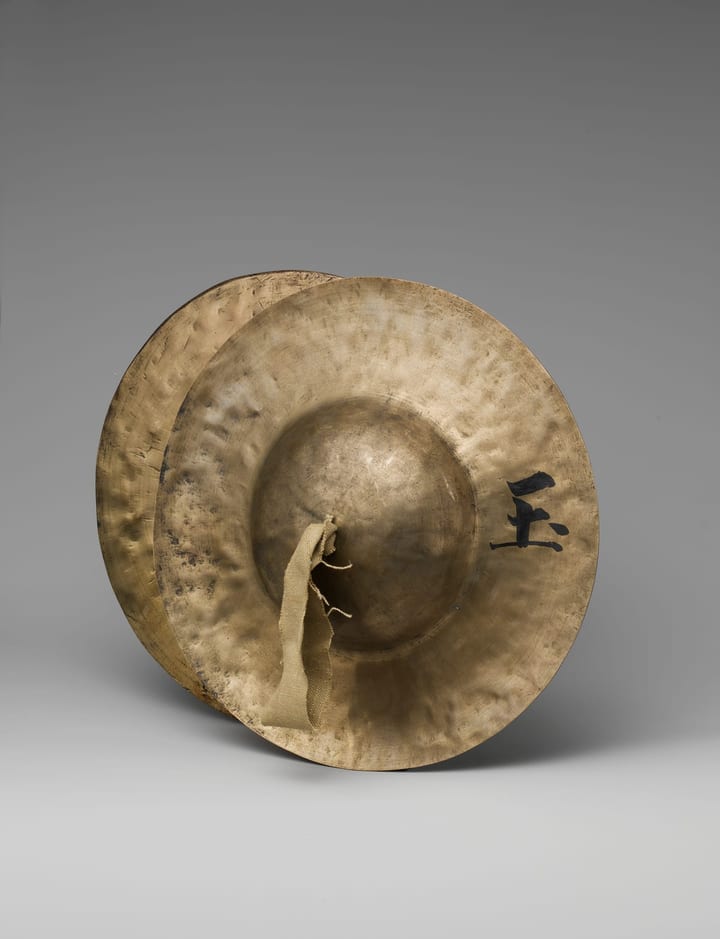
Read the shape of a Qing pair
The Metropolitan Museum of Art records the pictured pair, 89.4.11a, b, as a nineteenth-century Chinese instrument measuring 30.5 centimetres across. In the photograph the nearer disc has a cloth loop at the centre. The nearer disc partly hides the second. Follow the curve from the central dome towards the broad rim to see where the player holds the instrument and where the discs can meet.
The Met also has a nineteenth-century metal example catalogued as Po, 89.4.12. It carries the same Chinese character, 鈸, and is 56.5 centimetres across. Comparing the two records gives a sense of the scale variation a reader can encounter under this name. The second record gives the material and measurement, with its performance context unspecified.
A crash, a roll and a cut-off
On Grinnell College’s jingbo, or Beijing opera cymbal, rawhide loops pass through the raised centres. The player strikes the rims together, then can let the sound ring or stop it by pressing the rims against the body.
The Met describes a different motion for a longer sound. The player holds the cymbals horizontally and draws one disc across the other. In a demonstration, listen for when the sound begins and ends, then watch the hands. A ringing crash, a roll and a muted strike give the percussionist different ways to fill a moment.
Listen for the cue inside the percussion pattern
In Beijing opera, Grinnell places the jingbo alongside two gongs, the paiban clappers and the bangu drum. Together the instruments play named rhythmic patterns called luogudianzi (锣鼓点子). Grinnell gives entrances, combat and acrobatics as examples of action that these patterns accompany. Try following the entire pattern across a movement. The cymbal is one voice in the cue.
The Museum of Anthropology at the University of British Columbia documents a Cantonese opera pair, 2668/14 a–b, with raised centres and painted characters. Its catalogue places bo in a percussion group that includes gongs, drums and wooden instruments. The group can support speech and song, follow a movement or supply a sound effect. That is an account of the ensemble’s work. The catalogue describes the pair’s material as brass or bronze.
Read the instrument name in its setting
The bilingual Chinese instrument chart hosted by RISM uses bo, cha and nao for different shapes and grips. In its system, bo have large bowl-shaped centres with straps, cha have smaller rounded centres with straps, and nao are held by their conical centres. The chart also notes that everyday usage can overlap. The terms on a museum label or in a score are most informative when read alongside the object or the parts list.
The Singapore National Youth Chinese Orchestra describes xiaobo, zhongbo, shuibo and dabo among commonly used cymbals. Its account compares their relative sound and puts the small xiaobo with small gongs in some passages. The Hong Kong Chinese Orchestra's range chart lists Chinese cymbals, opera cymbals and crash cymbals separately in its unpitched percussion section. An orchestral score can call for several cymbal sounds.
Images and credits
Bo cymbals, Qing China, nineteenth century, bronze. The Met, Crosby Brown Collection of Musical Instruments, 1889, 89.4.11a, b. CC0. Full photograph, resized for display.