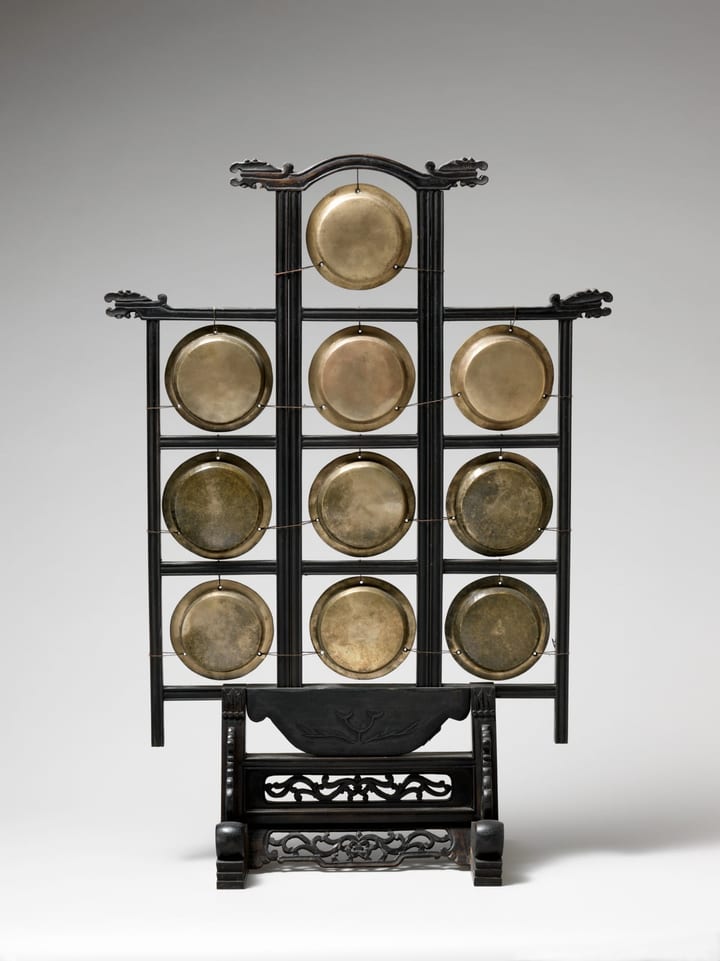
Read the frame as a map of ten separate gongs
The Met catalogues the pictured instrument, 89.4.15a, as a nineteenth-century example. Its frame is just over 71 centimetres tall. Start with the single gong beneath the curved crest, then count three rows of three. The cords visible at the rims connect the gongs to the frame.
The front view shows the number and layout clearly. It cannot tell you the note each gong sounds or the order in which the player strikes them. Those are questions to take to a performance or a record that identifies the tuning of that particular set.
Similar diameters can hide different pitches
Getty describes one familiar arrangement as nine or ten shallow bronze gongs without raised central knobs. Gongs of similar diameter differ in thickness and produce different pitches. Compare the bowls and their rims rather than assuming the largest-looking circle will always be the lowest note.
The ringing comes from the struck metal itself, which is why Getty classifies the yunluo as an idiophone. In a recording, try following the changes in pitch between attacks. A sequence of strikes can make a musical line even though each motion is a percussion stroke.
Double yunluo have a melodic part in Xi’an Guyue
Hong Kong’s Music Office groups double yunluo with the melodic instruments of Xi’an Guyue, alongside wind instruments and another small gong chime. Its recording of Song of the Blue Sky, played by the Du Chenghuang Miao Guyue Society, identifies the double yunluo at the left of the ensemble. The performer uses both hands on the two frames.
China’s national intangible heritage exhibition also documents paired yunluo among the instruments of Xi’an wind and percussion, alongside pipes, mouth organs, drums, cymbals and clappers. Read the gong part in that ensemble context: a metal instrument can contribute notes while other percussion provides rhythmic cues. The Xi’an performance and the Met photograph document different setups.
A musician’s record shows how the part was learned
China’s national heritage register describes how Shaanxi musician Zhao Gengchen began learning at fifteen. He studied winds with Dongcang musicians. Zhu Tong of Xianmi Temple taught him suite playing that included paired yunluo, drums and other metal percussion.
His training connects the gong part to a larger set of skills. Knowing which gong to strike is one task; learning how a part belongs in the music requires listening to the other players and following the shape of a suite. The account documents one musician’s apprenticeship in Xi’an practice.
The name carries across different orchestral setups
The Singapore National Youth Chinese Orchestra describes small gongs of fixed pitch played with mallets, with different gong counts, types and pitches in use. When comparing two instruments called yunluo, ask how many gongs are present, what pitches the set supplies and where it sits in the ensemble.
For another way of organising tuned metal percussion, compare the related bianzhong guide. There the suspended sound makers are bells; here they are shallow gongs. The frame is a useful clue, but the shape of each struck object is the clearer distinction.
Images and credits
Yunluo (cloud gong), China, nineteenth century, bronze and wood. The Met, Crosby Brown Collection, 89.4.15a. CC0. Complete photograph, resized for display.