Compare a grip at the rim with a rope handle
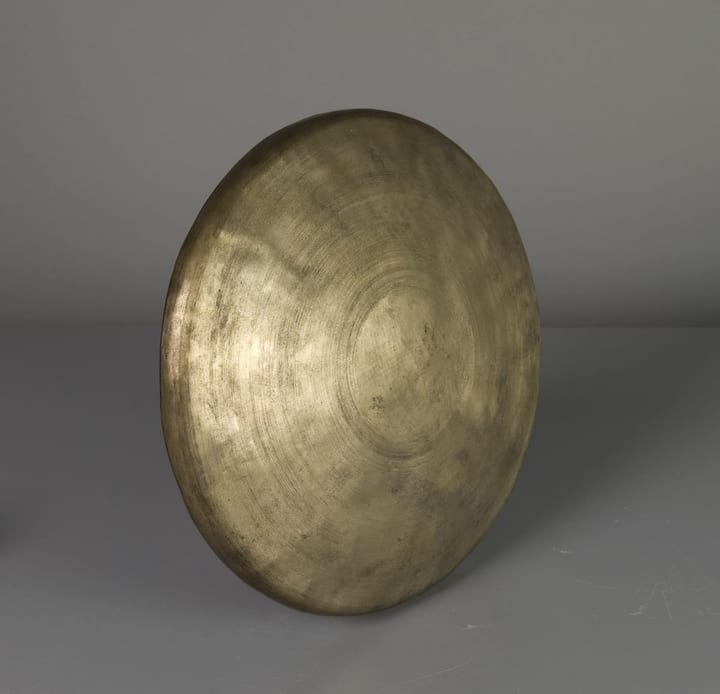
The Met’s nineteenth-century Xiao Luo, 89.4.7, measures 22.9 centimetres across. Its photograph shows the single disc at an angle, with the circular centre and outer contour visible. Grinnell College’s separate xiaoluo record describes holding the disc upright by its rim with the fingertips. The edge of a flat wooden beater meets the middle of the gong.
Grinnell’s daluo has a rope through two holes in its turned-back rim. A player suspends the face vertically by that rope and brings a padded beater to the broad central striking area. When watching a player, look first at the supporting hand. It shows how the small and large gongs are carried before you hear the difference in the blow.
A single strike can change pitch as it fades
Acousticians Thomas Rossing and Neville Fletcher measured six Chinese opera gongs in a 1983 study. The three small examples went up by as much as two semitones after impact. The three large ones went down by up to three. The researchers describe shallow curved centres in the small examples and flatter centres in the large ones. Their experiments relate the direction to how the shape and internal stress affect vibration.
For listening, separate the attack from the part of the sound that follows. One impact starts both. A rise or fall within that decay is a pitch glide. A yunluo player can change notes by striking different gongs in a tuned set, while a bo cymbal player sounds two discs by bringing them together. The glide here belongs to the sound of a single struck gong.
An entrance can use more than one gong pattern
In a scene from Wen Shao Guan, analysed by Lan Ying, a passage named Daluo Yuanchang (大锣原场) comes before the entrance. It leads into another percussion cue and then a small-gong entrance pattern as Dong Gao Gong steps forward holding a fan. The succession gives the audience a sense of the character’s arrival before and during his appearance.
Later in the scene a small-gong pattern accompanies Wu Yuan’s departure and another cues Huang Pu Na’s entrance. Following the change in pattern alongside the change in actor gives each sound a context. The passage illustrates why knowing that a gong is large or small tells you only part of what the percussion is doing.
Hear the strokes within a learned sequence
In a 2016 workshop with Sound of Dragon, musician and researcher Po-wei Weng taught how to recite and play Peking opera percussion patterns. The spoken notation, luogujing (锣鼓经), uses syllables to represent percussion sounds and playing techniques. Reciting a pattern lets players rehearse its sequence before transferring it to instruments.
The CompMusic research team catalogues eleven examples of xiaoluo duotou (小锣夺头), a named small-gong pattern used in aria introductions. The project shares written syllable sequences drawn from scores. The source recordings are available by request for non-commercial research. A sequence records what sounds follow each other; a stage example shows why a percussionist might play them at that moment.
Images and credits
Xiao Luo, China, nineteenth century, metal. The Metropolitan Museum of Art, 89.4.7, The Crosby Brown Collection of Musical Instruments, 1889. Public domain, CC0. Full photograph, resized for display.