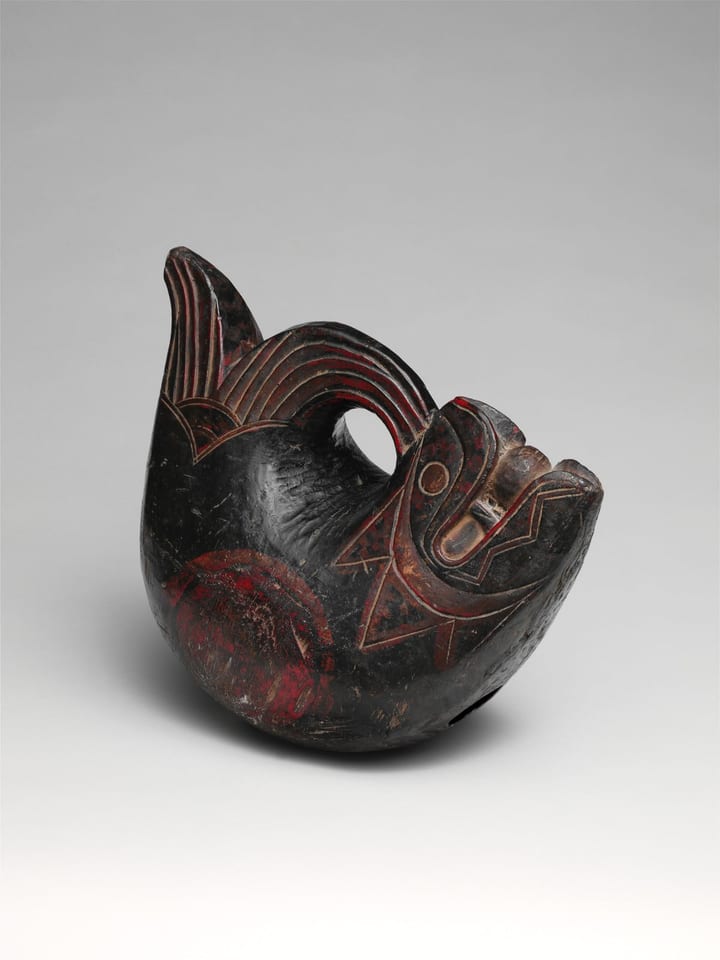
The red circle marks a place to strike
The Met dates the pictured painted wooden fish, 2006.494, to the early twentieth century and identifies it with Yunnan in southern China. The fish’s curled outline and painted red circle are visible in the photograph. The catalogue describes laying this object flat and striking that circle with a mallet.
Carving creates both a figure and a resonator
A National Museum of Taiwan History object, 2002.003.0069.0002, has eyes, scales and a tail, with head and tail joined. The catalogue describes the inside as hollowed to make a resonating chamber and records a wood mallet as the implement used to sound it.
Compare the size of a photographed object with the catalogue measurements before judging how it was handled. The Spurlock Museum’s carved and incised camphor example is 7.8 centimetres long and 7 centimetres wide. Its broad date range, 1900 to 1970, leaves room for several historical periods.
A long fish can be a signal
The Taiwan Folklore Artifact Dictionary distinguishes a straight, elongated fish board called yuban from the rounded instrument. The long type may hang by a monastery dining hall or storeroom corridor, where a strike can call people together or announce a meal.
The same entry describes rounded versions with a single fish, paired fish or a dragon-like form. In a photograph of a temple instrument, first notice how it is placed. A hanging signal and a rounded block at a recitation place suggest different jobs.
A repeated beat helps a group chant together
Chung Tai describes a steady wooden-fish beat as a way to bring voices into a common pace during recitation. The teaching note connects that regular sound with attention and the encouragement to keep practising. The watchful fish is a religious image associated with that purpose.
In a recorded recitation, listen for the shared beat as the voices move through the words. Then follow what happens at a pause or at the start of the next phrase. The recording supplies the actual pattern for that occasion.
A recitation set shows how instruments work together
The National Museum of Taiwan History records a group of recitation implements from Taoyuan, numbered 2004.025.1077. The group includes a wooden fish, a bronze chime and other hand percussion. The museum describes these instruments contributing to the pace of Buddhist rites and notes that Daoist practice also adopted several of them.
This documented grouping helps place a single wooden fish in an ensemble. Follow the repeated block sound and the separate ringing sound to hear two kinds of contribution. The related bianqing guide examines another percussion structure, a set of individually suspended pitched slabs.
The sound also has a place in ensemble music
The dictionary identifies smaller rounded wooden fish as rhythm instruments in nanguan and Chinese orchestras. The Met also mentions Guangzhou vocal and instrumental ensembles. Read the setting when you meet the name in a programme. A ritual instrument and an ensemble part can share a name and a method of striking.
Images and credits
Mu Yu, Yunnan, China, early 20th century. Painted wood. The Metropolitan Museum of Art, 2006.494, Purchase, Amati Gifts, 2006. Public domain, CC0. Complete photograph resized for display.