Locate the hooked head and the reverse fitting
The National Museum of China describes early metal and jade hooks with a curved head at one end and a round button on the back. These two projections belong to different sides of the object. Look for where the head turns back toward the body, then examine how the reverse fitting projects away from it.
The Asian Art Museum explains a common arrangement in which the back stud fits into a hole in the belt. The curved head provides the other attachment point. The shape of the fastening matters as much as the decorated surface.
Front and back can have different finishes
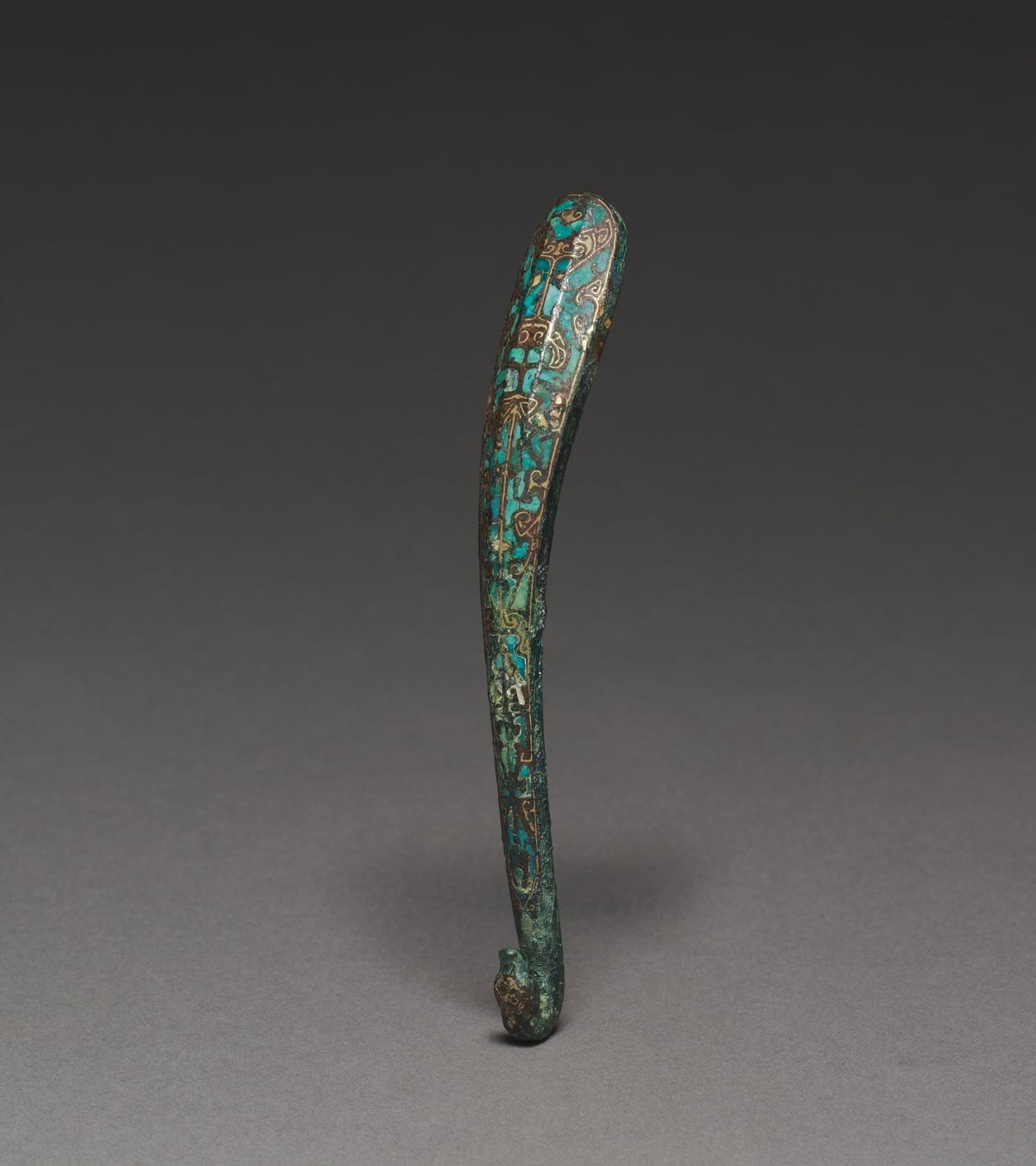
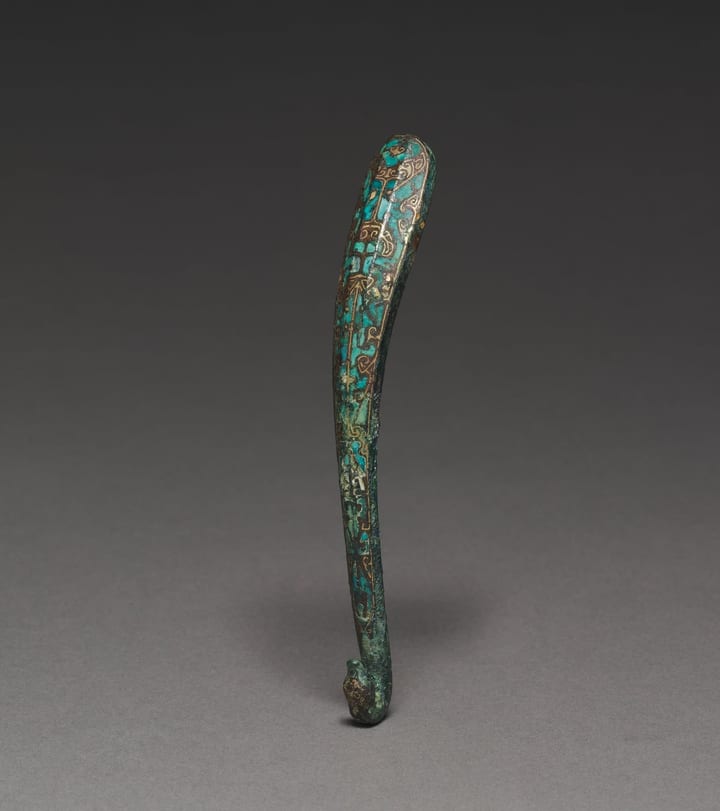
The photographed Cleveland hook dates to the Warring States period and measures 13.3 centimeters. Its catalog identifies bronze inlaid with gold and turquoise on the front, with gilding on the back. Follow the long body down to the small curled end. The photograph shows the decorated face, while the medium statement supplies information about the reverse finish.
A whole piece of jade or several assembled parts
A Han jade hook lent by Hebei Museum to the National Museum’s exhibition measures 5.8 centimeters. The record describes carving it from one piece of jade, including a flat dragon-like head, a pierced bird on the front and a round button. The curved outline and projecting attachment were worked within the same stone.
Henan Museum’s Qin hook offers another construction. Excavated in Biyang in 1978, it has ten segments around a reinforcing iron strip. Cloud designs extend along its body, and a round knob projects from the reverse. The museum describes the segments as separable, giving an assembly of distinct parts the outline of one long hook.
An attached textile can clarify the fastening
In a 2012 study, National Museum researcher Zhang Runping discusses jade hooks that could engage a textile loop directly. The article cites a Yuan tomb in Gansu where a hook was found at the waist with yellow silk still attached to its button. No separate ring was found. That association helps explain the proposed fastening arrangement for this type.
Later hooks can use channels for the belt
The Asian Art Museum’s Qing nephrite hook, B60J904, has two rectangular projections with slits beneath a dragon-headed body. The belt could pass through these openings. The museum connects this design with attachment to soft silk, giving the base a different relationship to the textile from a stud pushed through a hole.
Compare the openings and projections before comparing the dragons. Two similarly decorated hooks may have different attachment structures, and different materials can accommodate a related fastening task. A catalogue’s side or reverse view is especially valuable for this comparison.
Images and credits
Belt Hook, China, Warring States period, 475–221 BCE. Front view showing bronze with gold and turquoise inlay. Cleveland Museum of Art, 1950.248, Edward L. Whittemore Fund. CC0. Complete museum photograph, resized.