Begin with the individual plaque
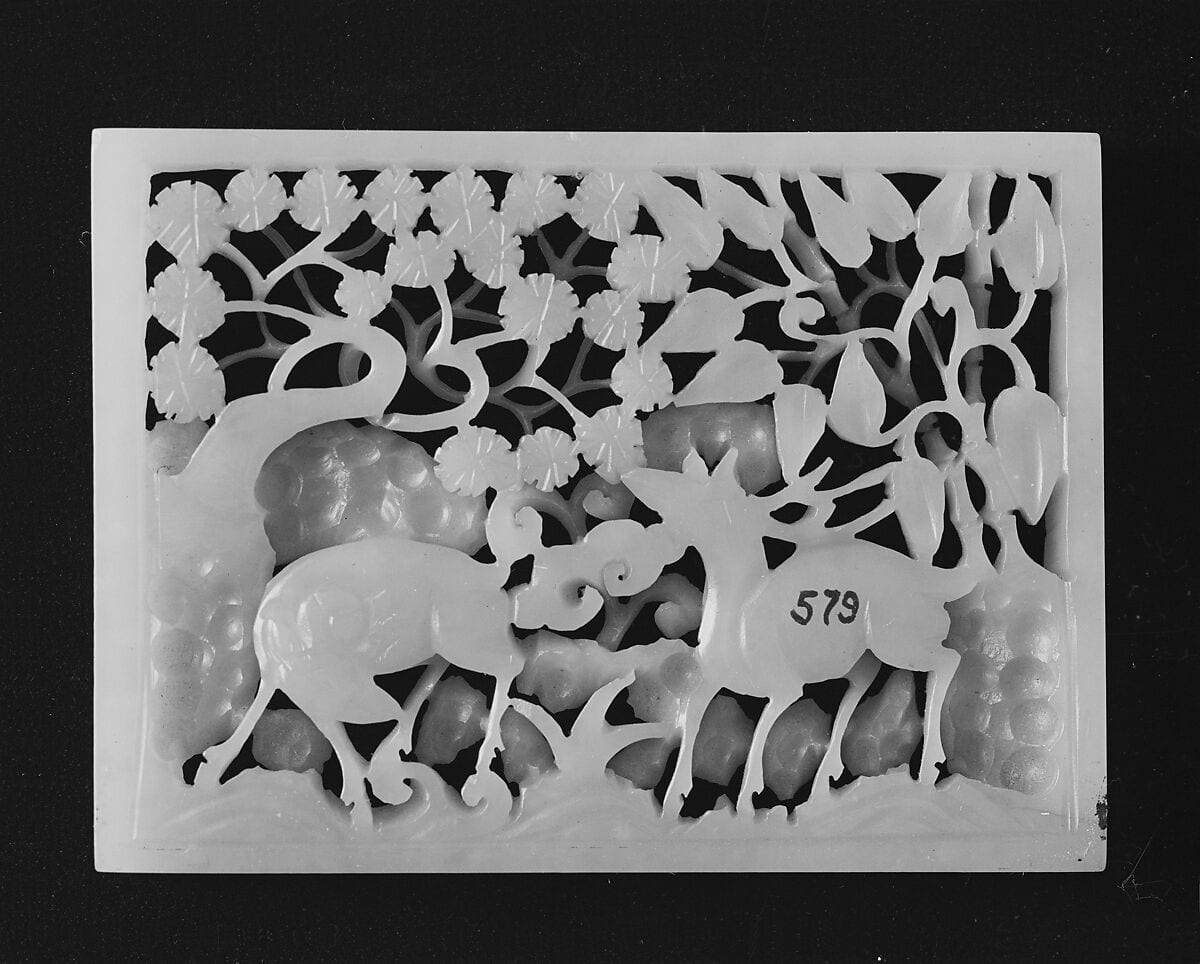
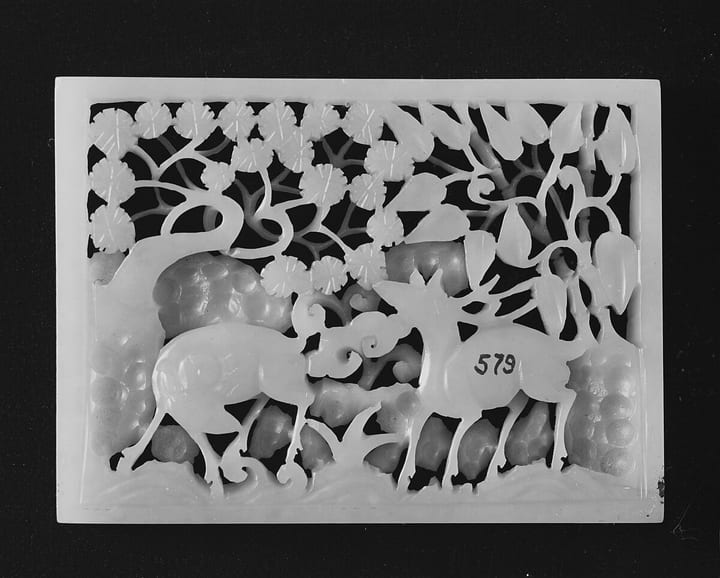
The illustrated Met plaque, 02.18.579, dates to the fourteenth or fifteenth century, across the late Yuan and early Ming period. It is nephrite, 7.2 centimeters high, 6.3 wide and 0.7 deep. A photograph can make this small dress ornament seem monumental.
In this museum photograph, openings separate animals, foliage and a surrounding rectangular frame. Follow the surviving connections between the forms before looking at their incised details. The black-and-white image also retains a collection number on the surface. Its tones should not be used to identify the stone’s original color.
A set makes room for a procession of images
The Met’s Tang set, 1992.165.22a–j, dates to the seventh or early eighth century. Its nephrite plaques carry a dancer and musicians in relief. The museum associates these performers with Central Asia, probably Kizil, and connects the availability of jade from Khotan with Tang ornaments. It also identifies belts of this kind with senior officials.
Look at the difference between an individual scene and a sequence. The catalogue lists square pieces measuring 5.7 centimeters on each side and an end piece 11.1 centimeters long. Comparing their outlines raises a useful display question: which pieces repeat, and which mark a change in the arrangement?
Arrangement and material need separate attention
A Ming glass set in the Met, 1994.605.104a–m, supplies evidence for how plaques could be organized. The museum explains that its forms follow jade ornaments stitched onto leather belts. It describes the largest components at the middle and ends of an established arrangement, and notes that the thirteen surviving glass pieces belonged to a larger set.
The same account connects Ming jade belts with grants to officials from imperial workshops. Its glass example is valued as a material in its own right. It is therefore useful for understanding an arrangement, while remaining a glass object: similar shapes do not turn its components into jade.
Openwork changes the relationship between ground and figure
Another Met plaque, 02.18.393, is dated to the sixteenth or seventeenth century. Its Chinese catalogue title identifies an openwork lion-and-embroidered-ball design, and the material is again nephrite. The record gives a height of 6.8 centimeters and width of 5.9 centimeters. Compare that identification with the earlier photographed plaque’s simpler English catalogue title.
Open spaces can help a viewer distinguish the surrounding frame from the scene it encloses. Work inward from the border, following a connected stem or contour, rather than assuming that every empty area has the same role. A named motif in one record does not identify every animal on another object.
Tools explain a process without dating a plaque
The Met’s twentieth-century jade drill records describe steel implements mounted on a rotating shaft, with sand and water applied as an abrasive. A separate polishing-wheel record describes a softer wheel carrying a fine abrasive paste. These records make shaping and finishing intelligible as different operations.
They are later tools, however. Their presence in a museum collection does not establish the equipment used to make a particular Tang or Ming plaque. For the belt ornament, return to its own record for date, material and attribution. Our belt-hook guide follows the hooked end and reverse fitting of a fastening; this guide follows plaques as decorated components and sets.
Images and credits
Belt Plaque, China, fourteenth–fifteenth century. Nephrite. Metropolitan Museum of Art, 02.18.579; gift of Heber R. Bishop, 1902. Public domain/CC0. Complete black-and-white museum photograph, resized; collection number retained.