A useful object beside the four treasures
The Palace Museum describes paperweights, also called yachi, as objects placed along the edges of paper and silk to keep them flat and extended. A weight can also help hold a book open for reading.
Consider that task before the ornament. Where does a weight meet the supporting surface, and how is its volume distributed? An upright sculpture and a long, low form present different outlines. A collection photograph can show those differences, while the object label supplies its stated function and material.
The illustrated Ming qilin
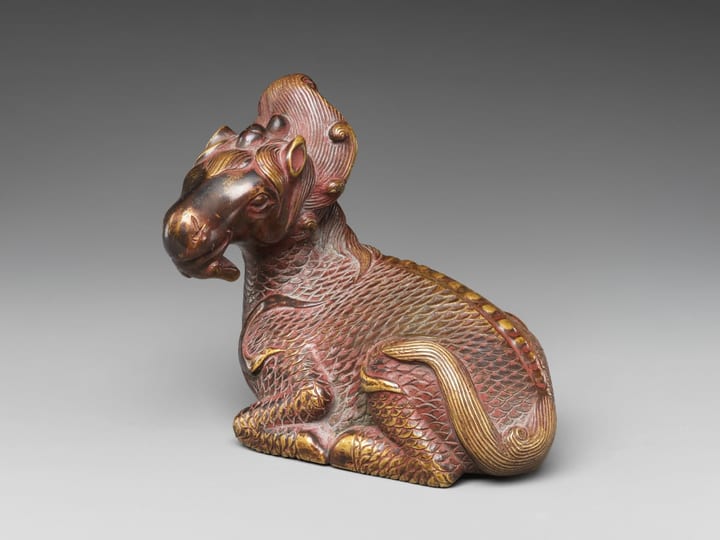
The Met’s Paperweight in the shape of a Qilin, accession 2016.243, is a Chinese copper-alloy work dated to the fifteenth–sixteenth century. The museum describes it as cast and says it served as an auspicious ornament or paperweight on a scholar’s desk. Those two roles can coexist.
The museum connects the mythical qilin with the appearance of a sage ruler in Confucian tradition. That gives this particular animal a cultural context.
A rabbit and a range of formats
Luoyang Museum’s teaching account introduces a Song-period reclining rabbit in white stone. It places paperweights among the additional study accessories beyond brush, ink, paper and inkstone. The same account describes single and paired formats and materials ranging from metals and stone to wood and ceramics.
The museum also notes increasing use of rectangular forms in the Ming and Qing periods. A bar-like weight and a small animal can thus belong to the same functional family, despite their different outlines.
A jadeite example with a precise catalogue label
The Met catalogues Paperweight, accession 02.18.514, as jadeite from China’s Qing dynasty, Qianlong period, 1736–95. Its dimensions are 7.3 centimetres high, 5.4 centimetres wide and 3.2 centimetres thick. The concise record provides a useful comparison with the copper-alloy qilin.
Keep the material name with the accession number. A green-looking surface in another photograph is not enough to establish the same identification. Reading two labels alongside one another allows a shared desk function to remain visible while their substances, dates and proportions stay distinct.
A crystal weight borrows the form of a qin
The Palace Museum’s Qing rock-crystal paperweight, 故00106047, takes the form of a qin. The record describes an arched face, carved circles representing string holes and pitch markers, and feet beneath. Its length is 12.4 centimetres. A familiar cultural form has become a small writing-desk accessory.
The miniature is a weight, rather than evidence of a playable crystal instrument. Compare its elongated outline with the animal examples and notice how the subject organizes the shape. The catalogue establishes the instrument reference; the musical association need not be reconstructed from a photograph alone.
A horse whose use remains qualified
The Met’s silver-and-lead horse, accession 2023.194, is dated to the thirteenth–fourteenth century, from the Southern Song to Yuan period. Its description says the cast figure may have served as a paperweight. Keeping that qualification preserves the difference between a suggested use and a firmly established one.
The horse measures 7.9 centimetres high and 9.8 centimetres long. Compare the recorded size with the object’s standing posture, then keep those observations separate from its possible use. A small animal sculpture does not acquire a certain desk function simply because another animal is catalogued as a weight.
Making methods follow the material
The Met’s hardstone study explains shaping through the gradual removal of unwanted material, followed by finer working and polishing. Abrasives do the cutting work, carried by tools; a rotating disk is part of the historical account. This provides a material-working context for stone objects, distinct from the casting recorded for the metal examples.
The related agate-carving guide examines the decisions involved in a patterned stone, including where colour falls within the finished design. Here the organizing question is the desk object’s function. Read shape, material and catalogue evidence together, so a shared use does not erase the different skills behind the objects.
Images and credits
Paperweight in the shape of a Qilin, China, 15th–16th century; copper alloy. The Met, 2016.243. Purchase, Friends of Asian Art Gifts, 2016. Public domain/CC0. Complete museum photograph, uncropped and resized for display.