Read the position of the table and chairs
The Beijing Opera Theatre describes a traditional set of red-painted wooden furniture with a rectangular table and tall-backed chairs. Satin covers can be embroidered or plain. A change in the way the furniture is arranged, or in the colour and pattern of its covers, helps indicate a change of setting.
In one customary sitting-room layout documented by the Koo Foundation, the chairs sit forward and at an angle on either side of the table. A chair behind the table can serve as a throne. Stagehands may shift the furniture in view of the audience. Watch where the next performer sits or stands, since that position tells you which part of the new space matters.
Look for the ride in the performer’s feet
The National Peking Opera Company teaches that an actor gives a horsewhip (mabian, 马鞭) meaning through movement. The whip establishes the mount. The rider’s rising, turning and falling suggest what the horse is doing and how the rider responds.
In the company’s example from the battle at Changban, Zhao Yun rides with a white whip. The actor makes a fall when the horse stumbles, then turns rapidly while working the whip as Zhao Yun tries to control the horse. Watch how the change in the actor’s balance turns a charge into a moment of danger.
Zheng Yan recalled a different use of the whip in Li Shaochun’s Xiang Ma Zhuan (响马传). Qin Qiong, scouting the enemy position at night, arrives with steady steps, eyes partly closed and whip raised. Here the steps and expression suggest a rider concentrating on what is ahead.
Follow the group when a vehicle appears
Wheel-patterned flags can mark the sides of a stage carriage. Zhang Jing of the Chinese National Academy of Arts describes the passenger between the flags, moving in step with the performers handling them. Follow the group when it starts or turns. Their shared pace gives the carriage its motion.
In Da Yu Sha Jia (打渔杀家), Xiao En and his daughter Xiao Guiying both paddle to show that they are out fishing. Zhang describes how coordinated changes of posture can suggest a vessel leaning or turning. On a bare stage, watch how the characters move together to imagine the water around them.
Notice what the object tells another character
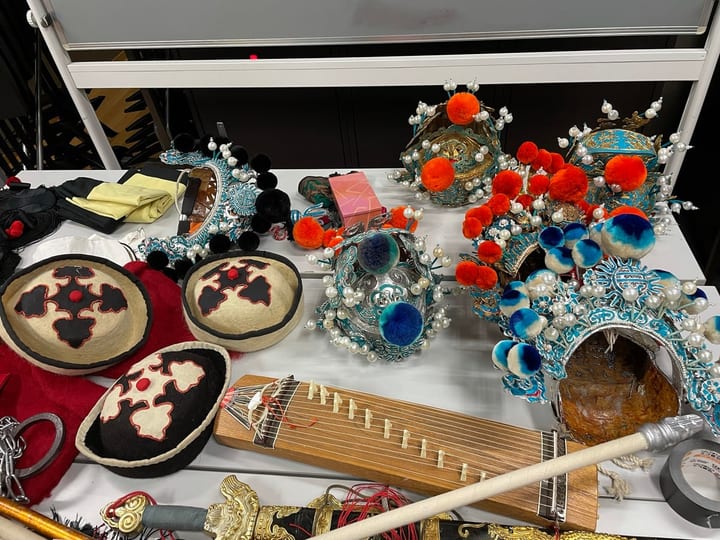
In Shincyo Theatre’s programme for the 2022 Tokyo production of The Empty City Ruse (空城计), Zhuge Liang opens the gates with too few troops to defend the city. As Sima Yi arrives with his army, Zhuge Liang takes his place above the gate and plays the qin. The calm action makes his opponent doubt what awaits him inside.
A backstage photograph taken at the production shows stage equipment laid out together. Onstage the qin belongs to a moment of deception. When you watch the scene, follow Sima Yi’s reaction to Zhuge Liang as well as the action at the instrument.
Images and credits
Headwear and stage equipment backstage at Shincyo Theatre’s Empty City Ruse, Seijo Hall, Tokyo, 6 August 2022. Photograph by WikiTaro, CC0 1.0. Full frame resized.
