A decorated framework begins with careful paper work
A Beijing government account follows maker Yang Yudong’s construction process. Six layers of window paper and yuanshu paper are pasted together and dried flat. A knife cuts through the laminated sheet vertically, following the design. The account describes a finished laminated sheet less than a millimetre thick.
The cut shapes then pass through further work, including wire edging and raised decoration. Yang’s documented sequence includes gold-coloured spraying and silk decoration. When you see the finished silhouette, remember that the maker has shaped and reinforced each small component before attaching the ornaments.
Soft headwear also has an internal structure
The Chinese Intangible Cultural Heritage website describes soft headwear made with silk, embroidered satin or felt. Many examples have a lining built from cloth, paper and paste. Wings and side pieces can contain both cardboard and wire to keep their shape.
Names preserve workshop history as well as construction. The site identifies the hard zhaijin kui alongside soft zhaijin examples. A small illustrated detail can therefore be more informative than the word jin alone. Look for the lining, the wire framework and the way the separate pieces join.
Recognize a specific character’s headwear
The National Peking Opera Company’s 2008 costume exhibition describes Guan Yu in Dan Dao Hui (单刀会) wearing a fuzi helmet with his long beard and distinctive armour. In The Drunken Concubine (贵妃醉酒), Yang Yuhuan wears a phoenix crown. The exhibition describes its fan-like front, phoenix ornaments and hanging bead strands.
Another example gives a closer view of construction. Huang Zhong’s zhaijin in Ding Jun Shan (定军山) has a round soft base, an upright rear panel and wire-supported pieces with pompons. Watch how the outline frames the face, then how its small decorations move when the character turns.
The dresser checks what the performer will wear
A 1996 backstage report in PAR Performing Arts magazine discusses the work of preparing and fitting headwear for Peking opera actors. The staff must find a secure, comfortable fit. A loose piece risks falling, while an overly tight one hurts. The report gives particular attention to fitting crowns and helmets.
It also records maintenance at the traditional year-end closing of the theatre season, including repainting equipment. Selecting the right piece for a scene and keeping it ready for use belong to the same continuing backstage work.
Read the craft designation at its stated scope
The national heritage register lists opera headdress making as a 2021 extension of the theatre costume and equipment craft project, declared by Beijing’s Xicheng district. Its account describes the Li family tradition of making both soft and hard headwear. Skills pass through family teaching and apprenticeship.
That record includes headwear for Peking opera, Kunqu and several other opera forms. A workshop’s craft vocabulary can travel across genres, while the requirements of the part determine the particular piece.
Look at the historical object in the photograph
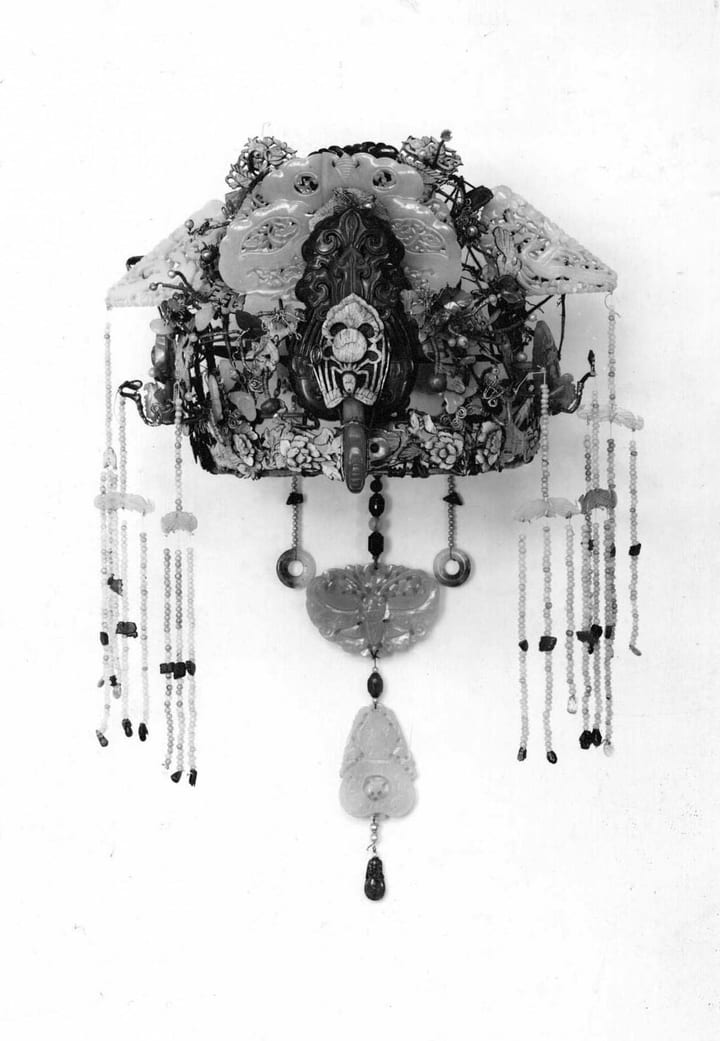
The Metropolitan Museum of Art dates its Chinese Theatrical Headdress, 35.140.1, to the eighteenth century. Its catalogue lists jade, amber, coral, carnelian, pearls, glass, feathers and gilt wire. In the full photograph you can follow the open framework and the bead strands hanging along its sides.
The image supplies an example of historical Chinese theatrical adornment. The named Peking opera characters above come from the performing company’s own exhibition. Together they offer starting points for looking at an object’s construction and its place in an actor’s appearance.
Images and credits
Eighteenth-century Chinese Theatrical Headdress, 35.140.1. The Metropolitan Museum of Art, Fletcher Fund, 1935. Public domain, CC0. Full museum photograph resized.