Start with the shape of the beard
Beijing Opera Theatre distinguishes several forms. San (三) divides the beard into three hanging sections and is common in laosheng roles. Man (满) makes a broad curtain covering the mouth and can serve both laosheng and painted-face characters. Zha (扎) leaves the mouth visible and is used for painted-face roles.
The same guide describes smaller comic forms, including narrow three-section beards and an arrangement with a small hanging tuft. These different outlines give you something concrete to recognize before considering colour or movement.
Preparation includes skilled handwork
He Yifan’s backstage reporting for PAR Performing Arts in October 1996 includes the making and maintenance of beards among the duties of headwear staff. The report describes weaving beards as skilled handwork and says that finishing three in a day was already a substantial achievement.
It places the beard in a working collection of equipment that staff prepare for the actors. Choosing the appropriate piece and keeping it ready belongs to the backstage work behind a finished stage appearance.
Compare characters within one play
The National Peking Opera Company’s 2008 costume exhibition describes Qiao Xuan in Long Feng Cheng Xiang (龙凤呈祥) wearing a white full beard. In the same play, Liu Bei wears a black three-section beard. The descriptions place each beard with its own headwear, robe and other items.
Comparing these two characters helps you read a whole stage appearance. First find the broad curtain or the separate hanging sections, then notice how the beard sits against the costume as the actor enters.
Follow the hand, the beard and the face
The National Academy of Chinese Theatre Arts includes beard work within dance-acting. Its teaching museum lists actions such as stroking, supporting, tossing, flicking and blowing the beard. It explains that these techniques work with the character and the dramatic situation.
The National Peking Opera Company likewise describes beard skills as a way to convey anger, fear or confusion. During a scene, notice whether the hand gathers the beard before a turn, whether the head sets it in motion, and what the actor’s eyes are doing. Follow the action through to the next sung or spoken phrase.
A shared beard form can serve different characters
In a 2012 essay on Zhou Xinfang, theatre critic Qi Zhixiang discusses the challenge of giving individuality to characters who all wear white full beards. His examples include Xu Ce, Song Shijie and Zhang Yuanxiu. The same type of stage beard can belong to several sharply drawn people.
Qi describes Zhou’s attention to each character’s particular actions and feelings. When watching two such roles, compare the pace of a turn, the handling of the beard and the moment the actor pauses. The interest lies in what that person is doing in that scene.
Read the photograph as one documented appearance
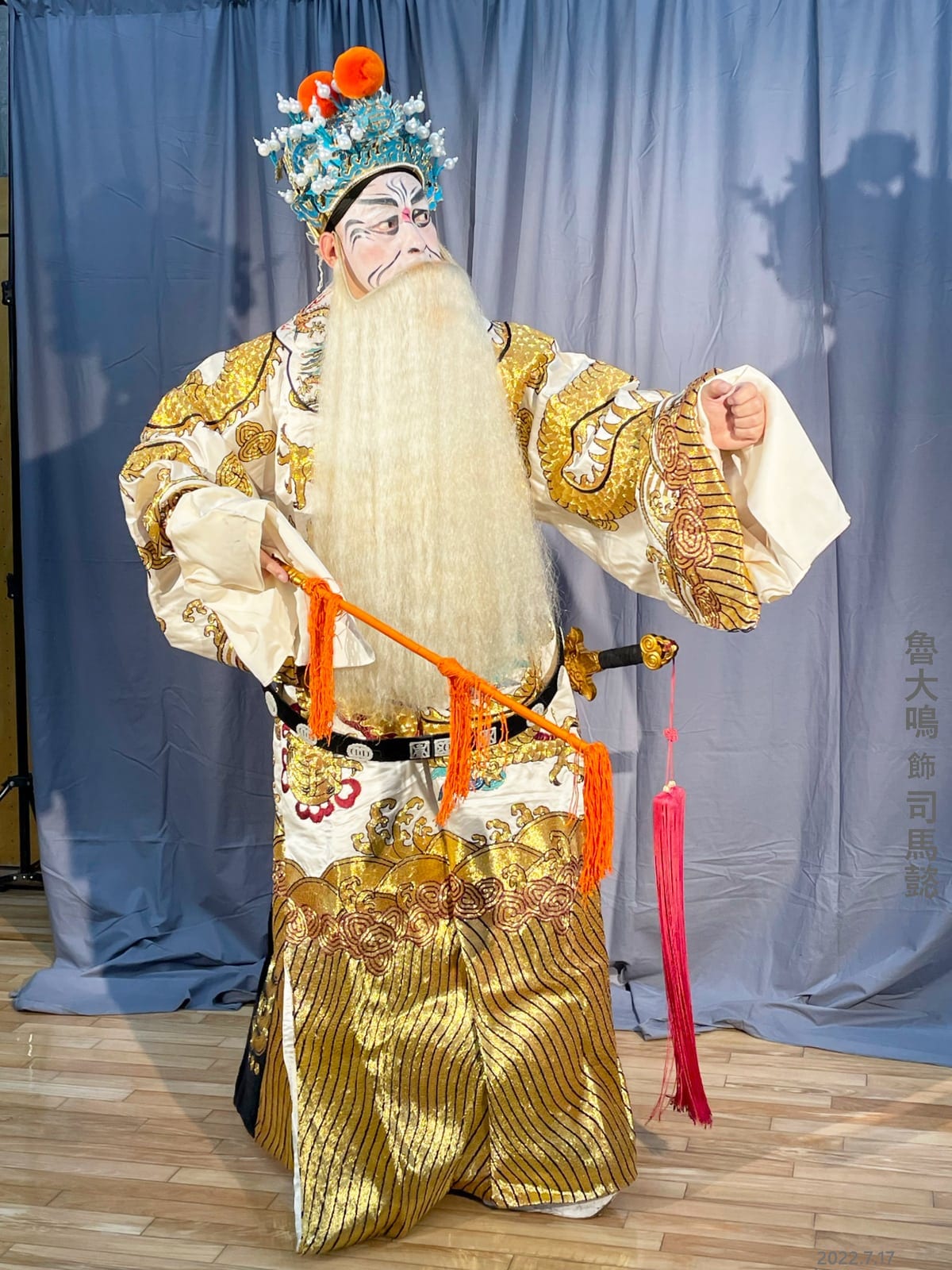
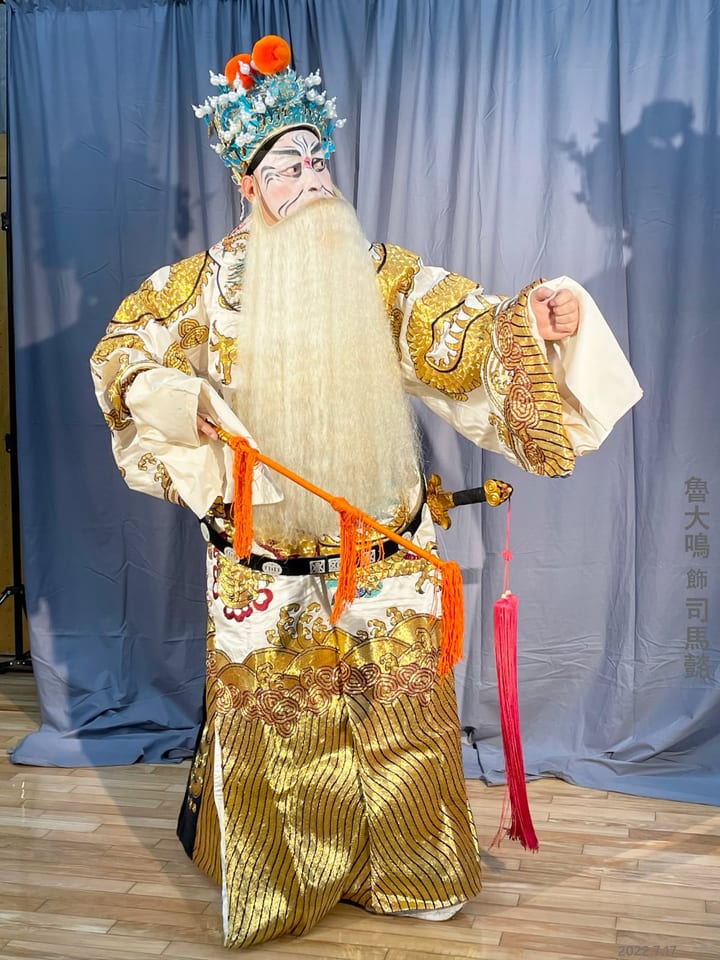
WikiTaro’s photograph identifies Lu Daming playing Sima Yi in The Empty City Ruse (空城计). The long pale beard reaches down the front of the embroidered robe. The image lets you study its outline at rest. Beard movement is easier to follow across a live passage or a recording.
Images and credits
Lu Daming portraying Sima Yi in The Empty City Ruse. Photograph by WikiTaro, CC0 1.0. Full frame resized. Original lettering retained.