A spiral jar from the Majiayao phase
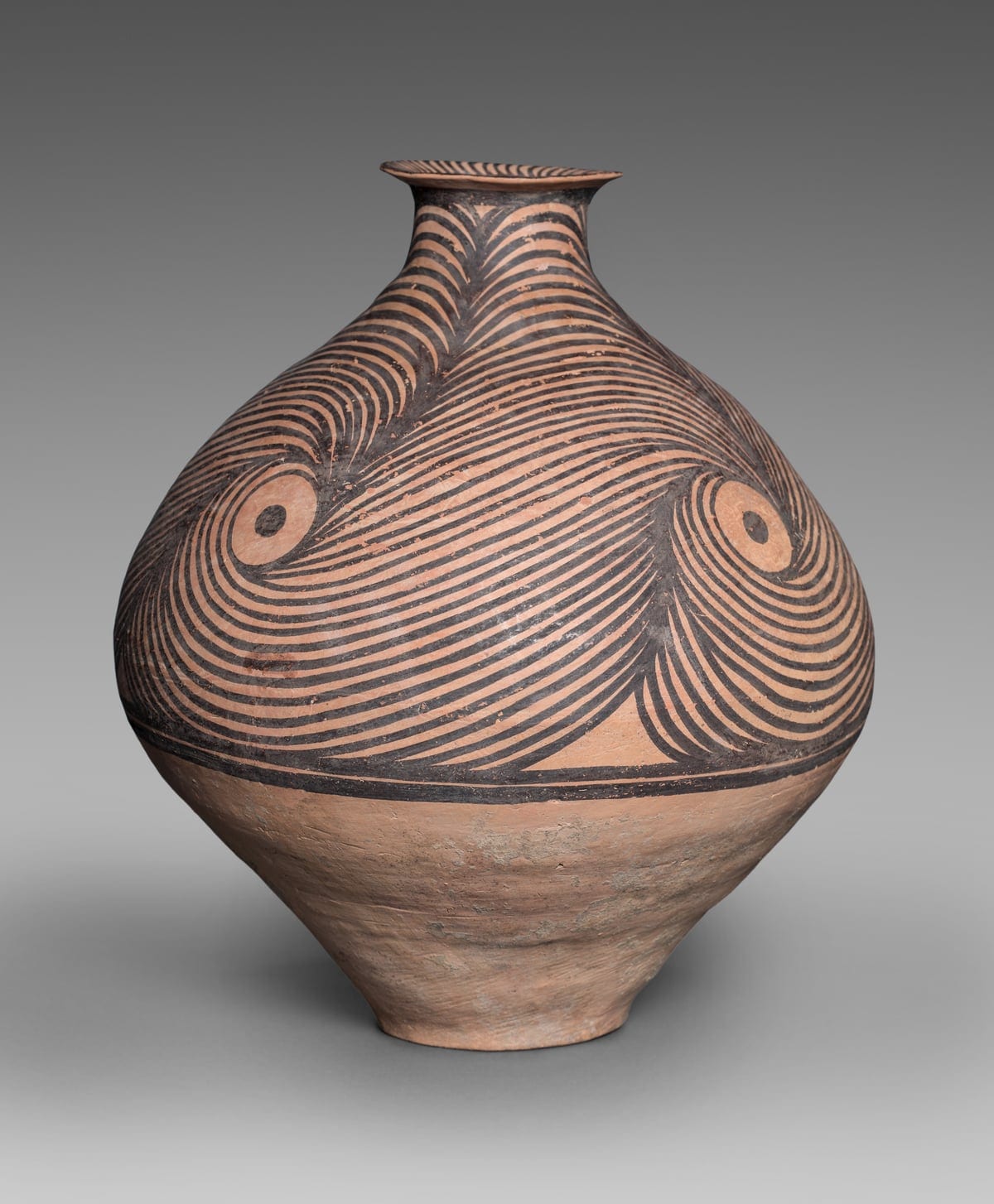
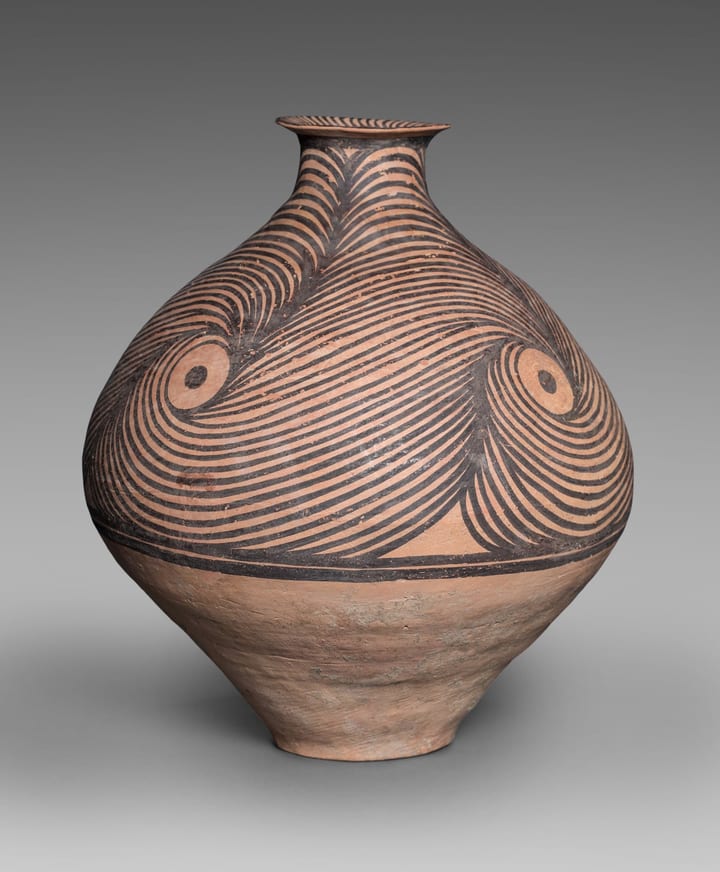
Cleveland’s photographed jar, 2004.64, is catalogued to 3300–2650 BCE and the Majiayao phase. It stands 45.2 centimeters high and uses slip-painted decoration. Dark bands spread over the rounded shoulder, while the lower body is plain. The photograph allows the eye to follow a line from a circular center outward into a broad sweep.
Read the whole profile as well as the painted field. The narrow neck rises above a much wider body, and the base contracts again below it. Trace where the bands change direction at the shoulder. This close-looking exercise describes the illustrated object; it does not establish what a Neolithic viewer understood by a spiral.
Banshan is a more specific catalogue identification
Princeton places its spiral-decorated jar in the Banshan phase, around 2600–2300 BCE. Its account describes large rounded pots and urns, with paired spiral arms painted across the shoulder in black and maroon. The date and phase belong alongside the design when comparing it with the earlier Cleveland example.
The Met identifies jar 1992.165.9 as Banshan and dates it to about 2650–2350 BCE. It is earthenware with painted decoration and measures 34 centimeters high. Its label encourages attention to the separate brushstrokes around the shoulder and mouth. Museum date ranges differ slightly; retain each catalogue’s range rather than make an exact year from a broad phase.
Small handles and painted borders organize the body
The Asian Art Museum’s B60P2272, from Gansu and dated approximately 2600–2300 BCE, has a tall neck, rounded body, flat base and two loop handles. The label describes a principal motif enclosed by undulating, serrated borders in black and red shades. Small ear-like features and a profile face appear near the mouth.
This is a helpful comparison because a jar can combine several kinds of marks. Locate the handle, the applied feature and the painted border separately. A painted curve does not become a handle simply because both break the outline of the decorated field. Examine the record’s other views before deciding how any feature connects to the body.
Building and finishing a clay vessel
Michigan’s account of Banshan jars describes building with clay coils, then refining the walls with a paddle and anvil. Scraping removed surface marks and reduced thickness. A watery clay coating, or slip, could precede drying, mineral-pigment painting and kiln firing. The account relates the reddish, purplish and dark colors to iron and manganese compounds.
Princeton also describes stacked coils smoothed before firing. These accounts explain why construction and surface decoration are separate questions. A finished photograph shows the external form; a technical discussion supplies evidence about how the wall was built. Do not infer a specific firing temperature or reconstruct a complete workshop from the finished surface alone.
Use and meaning require a separate question
Michigan notes that large jars occur in graves. It proposes provisions for the deceased by comparison with later practices, preserving that reasoning as an interpretation. The same museum acknowledges debate over the designs’ meaning. A modern resemblance to water or a net is not an ancient inscription explaining the image.
Cleveland similarly proposes, rather than establishes, a bird-derived source for its geometric imagery and a possible connection with clan or nature spirits. Keep that qualification when discussing symbolism. Looking closely can reveal a painter’s arrangement of lines without resolving every question about the people who made and used the jar.
Our Tang sancai guide covers a later glazed ceramic tradition. Compare how each record names its material and surface treatment. Here, the central questions concern prehistoric painted earthenware, phase identifications and patterns on a rounded vessel. Keep the individual object’s period with the photograph when comparing ceramic traditions across the site.
Images and credits
Jar with Spiral Designs, northwest China, Majiayao phase, 3300–2650 BCE. Earthenware with slip-painted decoration. Cleveland Museum of Art, 2004.64. Gift of Donna S. and James S. Reid Jr. in honor of Dr. Ju-hsi Chou. CC0. Complete museum photograph, resized.