A beaker supplies a clear catalogue starting point
The Met’s beaker 50.61.8 is catalogued as burnished black earthenware from China, within its Longshan culture range of approximately 3000–1900 BCE. It stands 18.6 centimeters high and measures 14.9 centimeters across the top. These are the dimensions of that beaker, not the stem cup in our photograph.
Begin a comparison by noting the opening and the way the sides narrow toward the base. Keep the museum’s vessel name beside the image being studied. A broad culture label can connect objects for comparison without making their outlines, dates or original uses identical.
Longshan pottery includes more than one kind of cup
The National Museum of China groups a double-handled cup, a single-handled cup and a box under Longshan culture, approximately 2500–2000 BCE. Its account associates the culture with central and eastern Shandong and the Huaibei area of Jiangsu. It identifies rapid wheel throwing for these neatly formed black vessels.
This grouping widens the question beyond the familiar tall stem cup. Compare the number and placement of handles and whether a vessel has a lid. Such differences can remain visible even when the surfaces share a dark color. The museum’s process statement belongs with its chosen examples; it does not prove a complete workshop sequence for every surviving pot.
A rounded jar raises different construction questions
Sainsbury Centre’s jar 1162 has a compressed, rounded body and attached lugs. Its account proposes that the body was thrown in two sections and joined before firing. Cords through the lugs, and suspension or wearing, are presented as possibilities rather than established uses.
The same record describes polished, extremely thin black wares as a small proportion of Longshan pottery. That distinction matters: the celebrated eggshell category should not replace the wider range of pottery. Look for the evidence behind a thickness claim instead of applying a measurement from one fine cup to a jar, box or fragment with a different construction.
A glossy black surface is not necessarily a glaze
Ackland’s Long-Stemmed Goblet, 2013.3.1, is dated to about 2500–2000 BCE. The museum identifies it as unglazed earthenware and explains its dark color through reduced oxygen during firing. It also notes brownish-gray traces, especially inside, which it interprets as probable burial deposits.
This is a useful reminder to separate the fired material from later traces on it. Compare sheen, texture and deposits in the available views rather than treating every bright or pale area as a decorative coating. The entry offers an object-specific explanation; the photograph alone does not supply a firing temperature or an exact kiln design.
Thin walls make making and handling related questions
The Asian Civilisations Museum’s guide records a Shandong stem cup, 1993-01536, at around 2400–2000 BCE. It links such thin-walled forms with fast-turning wheels, reduced-oxygen firing and burnishing for a glossy finish. Some walls are described as less than one millimeter thick. The guide suggests ritual use for these delicate vessels.
Thickness is therefore more than an impressive number: it affects how we imagine making and handling a cup. Preserve the guide’s suggestion as an interpretation. It does not identify a particular ceremony, tell us who held every cup, or establish that all black pottery was equally fragile.
A stem supports the cup without holding the drink
The Asian Art Museum’s educational packet discusses goblet 1998.30 from northeastern China, probably Shandong. It observes that only the upper cup could hold liquid. The very thin walls and examples buried beside tomb occupants with jade objects lead the authors to suggest that such vessels were prized, symbolic possessions rather than ordinary daily cups.
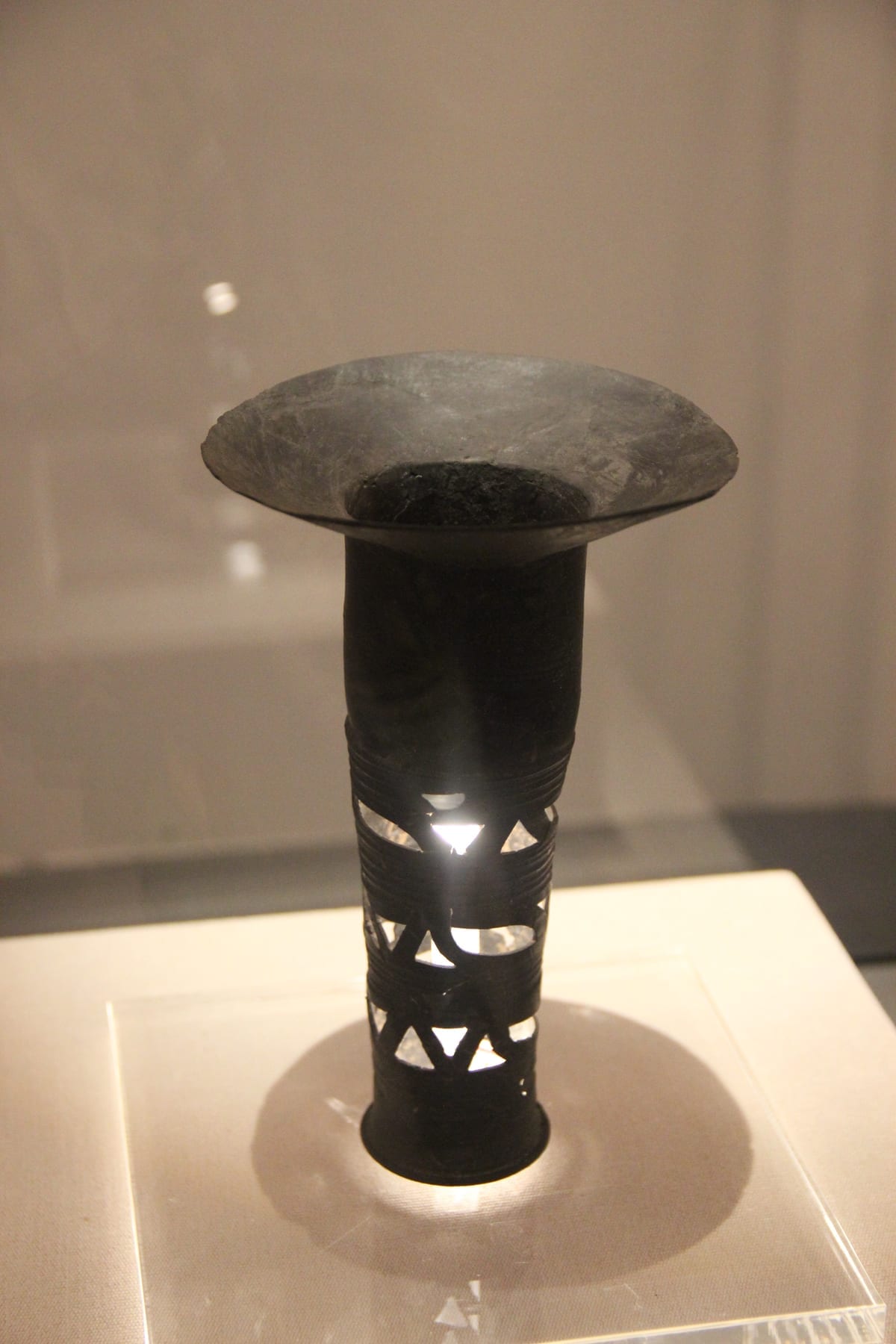
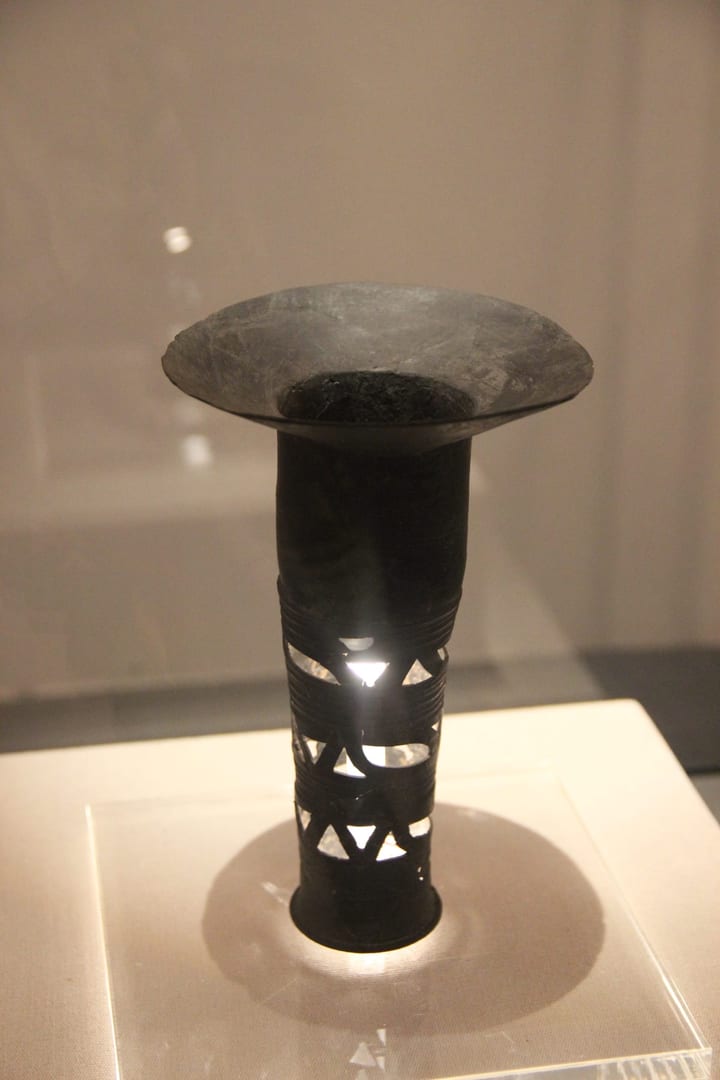
Our photograph shows a different stemmed cup displayed in the Shandong Provincial Museum’s Neolithic gallery, as identified by its photographer. Its whole profile remains visible, including the openwork stem and foot. Compare that shape with the museum records while keeping their accession numbers, dimensions and interpretations attached to their own objects.
Compare black surfaces with painted fields
Our Majiayao painted-pottery guide follows painted bands across rounded jars. Here the comparison centers on dark surfaces and changes in profile. In both guides, start with the complete vessel, then check the material description and the evidence for making. This keeps a visual comparison useful without merging distinct archaeological labels into one tradition.
Images and credits
Longshan stem cup displayed in the Shandong Provincial Museum, Jinan, identified in the photographer’s record. Photograph: Gary Todd, 19 June 2012, via Wikimedia Commons; CC0. Complete photograph, resized; display case and reflections retained. No accession number supplied.