Guqin notation combines actions into a character
Jianzipu means abbreviated-character notation. It uses reduced components of Chinese characters, recombined into compact blocks, rather than an alphabet of isolated pitch names. The Hong Kong Music Office explains that a block combines directions for fingering, position and the string to be played. Following those directions produces a musical sound.
This makes the method of sound production part of the record. A string indication is not sufficient by itself: the written action and contact position also matter. Reading only for an imagined equivalent note would leave out information about how that sound is made.
Separate the hands and the kinds of numbers
Hong Kong Memory describes a common arrangement in which the upper portion concerns the left hand and its position, while the lower portion concerns the right-hand technique and string. The components are read together as coordinated directions. The position reference and the string number answer different questions.
The Music Office offers one precise example: the left thumb presses at position 7.6 near the seventh hui marker, while the right middle finger plucks the fourth string inward. That is a reading of one combination, not a complete melody. It demonstrates why the player must identify what each component refers to before joining the actions.
The written action can continue after the pluck
A plucked attack is not the end of every instruction. Hong Kong Memory notes smaller signs between the main blocks that can direct left-hand movement as a tone continues, or indicate a pause. These signs help preserve the course of a gesture, rather than treating the music as disconnected attacks.
Look at a complete passage and its accompanying explanations. The main block, smaller directions and surrounding phrase belong to the reading. Isolating an attractive-looking symbol from its page can remove information needed to understand its function.
Timing needs more than a list of actions
Traditional tablature does not normally supply a complete scheme of durations, tempo and phrasing comparable to a modern performance transcription. Its limited timing information should not be confused with a performance having no rhythm. Pauses and movement directions can carry relevant cues, while teaching and interpretation shape how a phrase unfolds.
A 2026 lecture report from Sichuan Conservatory of Music connects the history of notation with changes in teaching. It discusses how combined scores add pitch, note-value and beat information while retaining the traditional fingering system. The question is what a particular edition records, rather than whether every qin score contains exactly the same information.
A qin handbook can contain more than pieces
Hong Kong Memory describes handbooks that include discussions of modes, theory, instrument construction and an editor’s views as well as the pieces themselves. Those surrounding materials help place instructions in a musical context. Identify the book and edition alongside the piece.
Harvard’s music-library exhibition supplies a concrete example: Yang Lun’s Boya’s Internal Method within Combined Qin Tablatures, dated 1609. The exhibited opening presents Flowing Water. Its notation records finger positions and stroke techniques. A compiler, collection, date and identified piece provide a more precise starting point than a title alone.
Parallel notation adds another view of the music
Jianzipu and jianpu are different terms. Jianpu is numbered musical notation; jianzipu uses the composite action characters described above. The Music Office shows how recent parallel scores place tablature beside numbered or staff notation. Their coexistence can preserve fingering information while making other musical features easier to follow.
The Sichuan lecture discusses earlier combinations with gongche notation and beat indications, followed by further forms of combined notation. This history cautions against dividing all scores into one timeless traditional type and one uniform modern type. Check what is actually printed beside the tablature and how the edition relates its different layers.
Dapu connects source study with playing
Dapu is the work of making a historical score sound again through study and performance. A Shanghai Conservatory workshop description from 2018 stresses reading the information through actual playing, bringing technique, musical understanding and interpretation together. Recognizing the symbols is one part of that work.
The 2021 national dapu meeting notice gives a practical research example. It asks contributors to compare versions when notation is missing or doubtful, mark adjustments, explain their decisions, and submit parallel notation with a recording. These requirements make the interpretation assessable: a written source, editorial choices and a sounding result can be considered together.
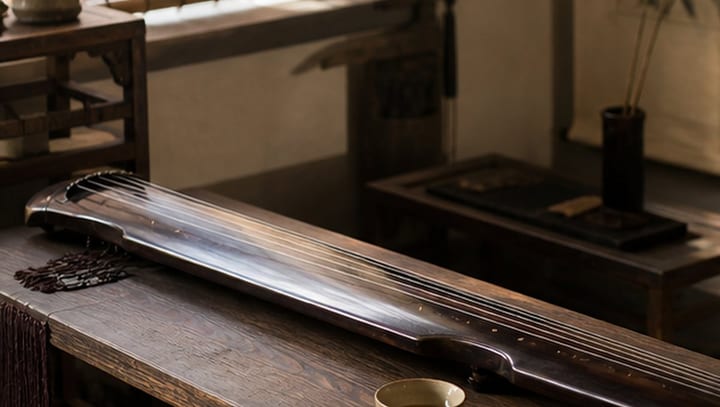
The project-created illustration provides instrument context only. It depicts no historical score, notation diagram or named musician; linked references supply the notation examples.
Images and credits
Project-created guqin illustration, Living Heritage China. Instrument context only; not a historical score, notation diagram, authenticated antique or named performance.