Chinese painted copper enamel starts with the support
The word copper identifies the body beneath the enamel. Painted enamel can also decorate porcelain or glass, so a similar palette does not establish the material underneath. The Palace Museum formally distinguishes porcelain-bodied painted enamel in its ceramic records. Begin with the catalogue medium, then consider how the maker organized the painted surface.
The Palace Museum describes a foundational sequence for copper: apply white enamel, fire it to fuse, paint the resulting smooth surface with colored enamels and, where used, gold, then fire again. The ground is itself a fired layer. This is why a finished object combines the demands of a metal support, a glassy coating and a painted composition.
Painting a wrapped cloth around a jar
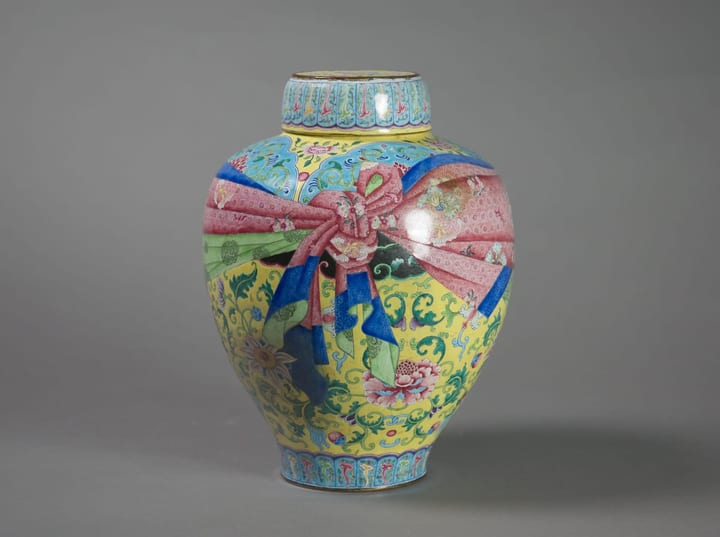
A mid-eighteenth-century jar at the Met, accession 14.40.162a, b, makes that composition especially clear. Catalogued as Chinese, with a Qianlong mark and period, it is painted enamel on copper. Its pink patterned band appears to gather into a knot, with blue and green folds hanging across a yellow floral ground. The cloth is a painted illusion on the vessel.
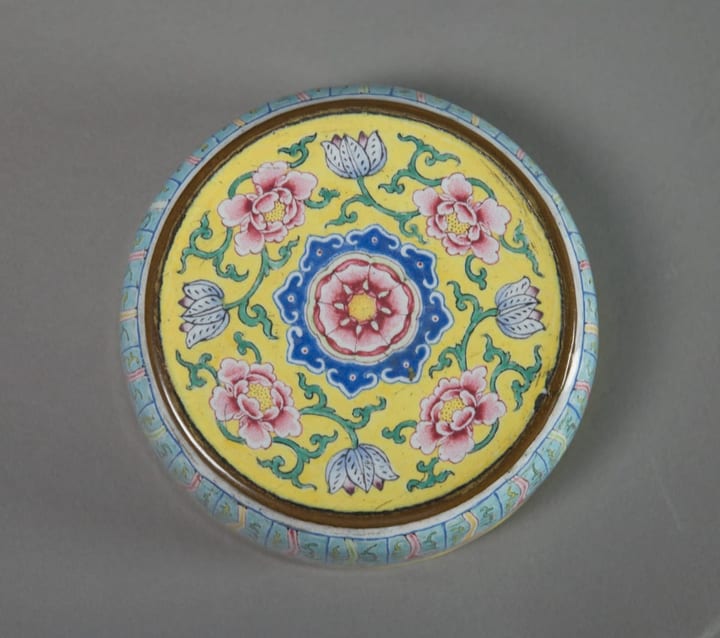
The Met connects this wrapped-cloth, or baofu, design with the East Asian practice of wrapping gifts in textiles. The design gives a rounded container a second apparent surface: a textile seemingly laid over it. In the accompanying top view, a central flower and surrounding blooms organize the lid radially. Body and lid ask the painter to solve different compositional problems.
Other forms offer separate framed scenes. A late-Qing kettle in the Palace Museum has a rectangular body with clipped corners and four reserved panels, each containing a different scene of European figures. These framed areas, called kaiguang, divide the decoration around the object rather than presenting one continuous rectangular picture.
Shaded color must survive the kiln
The Taft Museum explains that white enamel could be blended with colors to produce pastel tones, while layered light and dark colors created volume and shading. This helped turn enamel painting into more than the placement of flat colored shapes. Petals, clothing and faces could acquire changes of tone within a small area.
That painterly effect depended on firing. Copper and enamel expand differently when heated; the Taft notes risks of warping, cracking and color change, and explains that many colors required multiple firings. The sequence therefore involves the behavior of the materials as well as the appearance of the picture. A single firing temperature or fixed number of firings cannot describe every object.
Relief can be made in the copper itself
Painted decoration need not sit on an entirely flat support. The Palace Museum records a pair of mid-Qing copper hanging panels from the former imperial collection. Their landscape contours were first hammered into relief and then decorated with painted enamel. Trees, pavilions, cranes and deer form an auspicious landscape.
Here the three-dimensional effect belongs partly to shaped metal, whereas shading on a smooth surface creates volume through color. The distinction helps explain a compound technique without turning every raised detail into cloisonné. The panels also show why body preparation is part of the design, rather than merely a preliminary stage.
Court production, Guangzhou and continued teaching
The Taft connects the development of Chinese painted enamel with Kangxi-era court workshops and exchanges with European specialists. Guangzhou was another important production center. Tianhe district’s official collection account identifies work for court commissions as well as overseas markets and illustrates a lobed tea caddy and a round landscape-and-figure dish.
Canton enamel is consequently a useful historical label in context, but a European figure or a colorful surface alone cannot locate a workshop. The Met jar’s record identifies China and a reign period without assigning a Guangzhou factory. Museum descriptions preserve the difference between a documented production center and a particular object’s provenance.
Teaching provides a separately documented continuation. Guangdong Museum reported painted-enamel and cloisonné jewelry workshops held in January 2020 with a Guangzhou enamel practitioner. The account shows contemporary transmission through demonstration and making. The photographs on this page, however, show a finished Qing jar and its lid, not that event or a reconstruction of its production.
Museum photographs and credits
Jar with floral scrolls and wrapped-cloth design (one of a pair), China, mid-eighteenth century; Qianlong mark and period. Painted enamel on copper. The Metropolitan Museum of Art, Bequest of Benjamin Altman, 1913, 14.40.162a, b. Public Domain / CC0. Uncropped museum photograph of the finished jar and lid.
Lid of the same Chinese painted-copper-enamel jar, Met 14.40.162a, b, mid-eighteenth century, Qianlong mark and period. The Metropolitan Museum of Art, Bequest of Benjamin Altman, 1913. Public Domain / CC0. Complete separate museum photograph, not a crop from the hero and not a second object or a production stage.