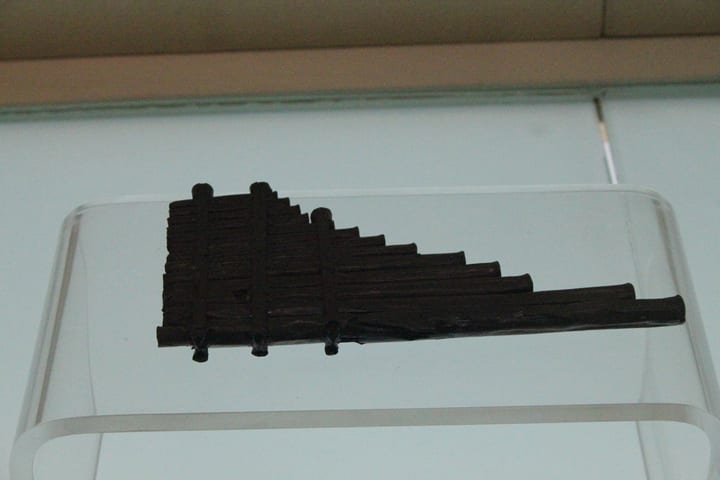
The photograph shows a museum display
Gary Todd photographed this paixiao display in the Tomb of Marquis Yi of Zeng gallery at Hubei Provincial Museum, Wuhan, on 3 December 2010. The complete view shows graduated pipes secured in a single assembly.
The photograph’s record identifies the gallery and subject. It does not establish whether the displayed piece is an excavated original or a reconstruction, so no ancient date or excavation number is assigned to the photographed item here.
Excavation evidence places the pipes within an ensemble
Hubei Provincial Museum’s research review describes the instruments unearthed from Marquis Yi’s tomb at Leigudun, Suizhou, in 1978. Panpipes appear alongside bells, stone chimes, drums, zithers, transverse flutes and mouth organs. Their archaeological setting contains more than one kind of musical work.
The review also discusses the panpipes’ differing tube diameters. This is useful evidence that length alone does not exhaust an instrument’s design. The museum studies physical objects together with imagery and inscriptions; an isolated photograph cannot supply all of those layers.
A stone example preserves the idea of joined pipes
Henan Museum catalogues a stone paixiao from Tomb No. 1 at Xiasi, Xichuan, excavated in 1978 and assigned to the Spring and Autumn period. Carved from one piece of stone, it has thirteen graduated pipe forms, level upper ends and a band represented across its upper section.
The museum records a longest pipe of 15 centimetres and a shortest of 3 centimetres. This is not the bamboo display in the photograph. It shows why material and construction should accompany the instrument’s name: a carved assembly and separately joined tubes preserve different making decisions.
Bone pipes provide another documented construction
A separate Henan Museum record identifies an early Western Zhou example from the Changzikou tomb at Taiqinggong, Luyi, unearthed in 1997. It consists of thirteen bird-leg-bone pipes, descending in length from 32.7 to 11.8 centimetres.
The museum describes binding traces and explains playing across the open tops, moving sideways between pipes. These observations concern this example; its count and dimensions are not universal specifications.
A material category does not replace an object description
The Met’s historical essay places bamboo panpipes within the varied ensemble found in Marquis Yi’s tomb. It also explains bayin, the eight-material classification that connects instrument categories with a wider cosmological framework.
A category such as bamboo records one way of organizing musical knowledge. The stone and bone objects described here still need their own material labels. Historical classification, a surviving object and the layout of an ensemble provide related information, but they should be read at their different levels.
Panpipes and reed instruments use different mechanisms
Hong Kong Chinese Orchestra’s wind-instrument introduction groups paixiao with flute-type instruments such as di and xiao. It places sheng in a reed-based group and suona and guan among double-reed instruments. A cluster of pipes does not, by itself, make a mouth organ and panpipes the same instrument.
For comparison, follow where the air enters and what produces the sound. The related xiao and sheng guides explore those instruments separately. This mechanism-based distinction is more useful than treating every bamboo wind instrument as one interchangeable type.
Images and credits
Paixiao display, Tomb of Marquis Yi of Zeng gallery, Hubei Provincial Museum, Wuhan. Photograph by Gary Todd, 3 December 2010, CC0. Complete image, uncropped and resized. Original-versus-reconstruction status of the displayed piece is unverified.
