A small screen can protect ink as well as display an image
The Palace Museum describes a yanping, 砚屏, as a small screen placed behind an inkstone. It shields the ink from wind, dust and sunlight, helping it remain moist. Its account includes jade, painted porcelain, bamboo, wood and ivory examples in Qing court furnishings.
That documented desk function explains one particular name. A museum object labelled table screen may instead be discussed through its material, picture or inscription. Read that individual record before assigning the same working use to every surviving screen.
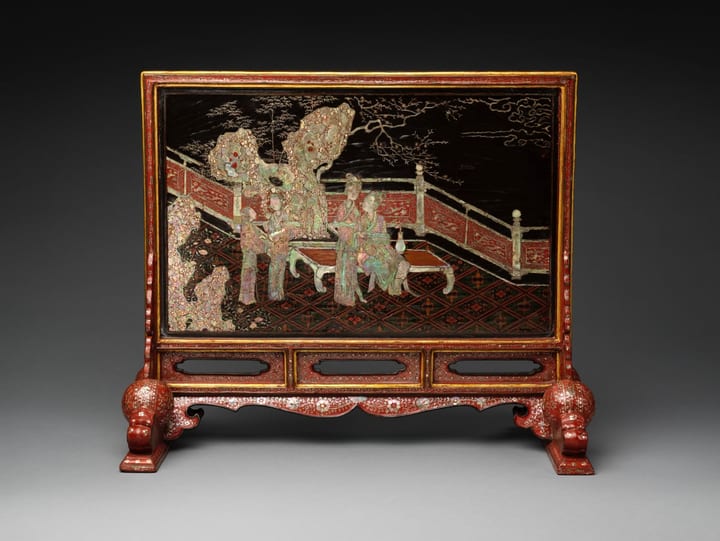
The photograph shows a lacquer screen with its stand
The illustrated table screen, The Met 1984.340, dates to the late sixteenth or early seventeenth century. The museum identifies its medium as lacquer inlaid with mother-of-pearl.
In the complete photograph, the picture sits above a decorated support with projecting feet. Figures, a railing and rock forms occupy the dark field. Follow the panel edge down to the feet: picture and support together make a freestanding furnishing.
Copper wire can turn enamel into a landscape
The Met’s 2022.10a, b is a Chinese table screen from the second half of the fifteenth century. Its medium combines cloisonné enamel on copper alloy with a wooden frame and stand. At 49.2 centimetres high, it presents a substantial object even within this tabletop category.
The museum places it among rare landscape pictures from the imperial Ming workshop. Blue and green tones recall Tang landscape painting, while copper wires suggest brushwork. Here an enamel technique carries pictorial design: do not describe those wire divisions as carved marble or the mother-of-pearl inlay shown in the photograph.
A jade panel brings its own colour and scale
The Met’s 02.18.628 is catalogued as a Qianlong-period table screen, 1736–1795. Its material is light-grey nephrite with darker grey clouding. The recorded height is 23.7 centimetres and width 19.1 centimetres.
This example changes both the material and the scale of comparison. Read the cloudy colour as part of the catalogue’s description of this stone. It does not establish that every jade screen used the same stone, date or carving arrangement. A small panel’s dimensions are more informative than treating table screen as one fixed size.
A later mounting can change the object’s presentation
The Met identifies 1995.421 as a nineteenth-century marble table screen inscribed and signed by Ruan Yuan, later converted into a wall panel. Marble remains mounted in a wooden frame.
The conversion belongs in the object’s description. A framed slab seen on a wall need not have begun as a wall picture. Conversely, the catalogue’s earlier identification is not evidence that its present frame and mounting preserve an untouched original tabletop assembly. Separate the surviving material, the inscription and the recorded change of format.
An inscription can make the panel a literary surface
Another Met example, 1995.181, is a veined-marble screen with a wooden frame, dated 1624 and associated with Li Mi. Its title identifies an inscription of the poem Lisao and again records conversion into a wall panel.
This is a useful counterpart to the landscape in enamel: words as well as pictures could occupy the upright surface. The catalogue provides a dated object and an identified text. It does not require translating every natural vein into an intended painted scene. For another approach to displaying stone at the desk, follow the related guide to scholars’ rocks.
Images and credits
Table screen, China, late sixteenth–early seventeenth century; lacquer inlaid with mother-of-pearl. The Met, 1984.340; Gift of Mr. and Mrs. Nathan L. Halpern, 1984. CC0. Complete museum photograph, uncropped and resized for display.