Where Chinese roof tile ends met the eaves
Oberlin’s Allen Memorial Art Museum explains a covering of alternating concave and convex tiles. The overlapping rows created channels for rainwater. A circular piece closed the end of a convex row and could conceal a securing pin. Reading that arrangement helps place a detached disk in a much larger roof.
The museum’s glazed dragon example dates to the fourteenth through seventeenth centuries. Its reported association with the Ming tombs remains a proposed provenance in the record. The color and dragon design form part of the museum’s reasoning.
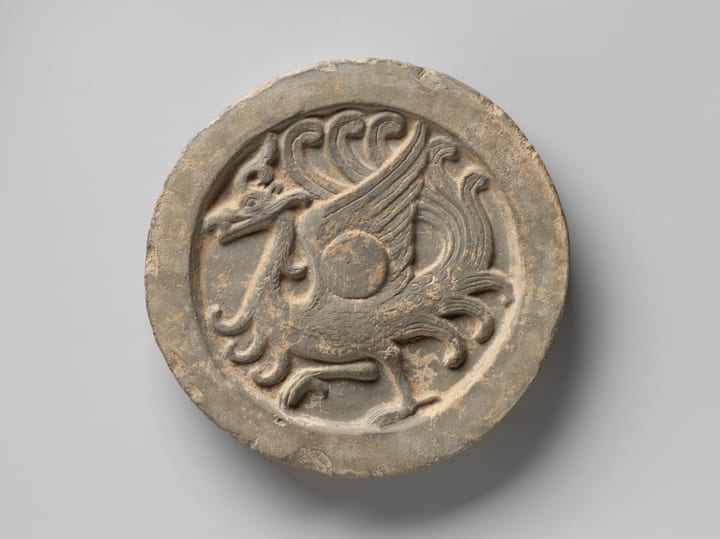
A bird fills the circular field
The Met’s pictured Western Han tile, 18.56.31, measures 18.4 centimeters across. Its bird has raised wings and a long curving tail that follows the border. The museum discusses this tile alongside a second animal tile as images of the Red Bird of the South and White Tiger of the West.
Begin at the outer rim and follow the narrow spaces between the body, wings and tail. The design keeps the animal legible while fitting its movement into a round frame.
Molded lettering can organize a face into rows
Henan Museum’s Qin-period tile has twelve seal-script characters in three lines, with raised dividers separating the writing. Clouds occupy the area outside the text. The record identifies molding in gray terracotta. The process and the arrangement belong together here, since raised text and borders share the same face.
Princeton’s Han tile y1956-20 instead places two animals in relief. Its catalogue likewise records molded earthenware. A single ceramic process could carry different arrangements of figures, borders and writing.
Similar inscriptions need their own object dates
The Palace Museum holds a separate twelve-character tile that it dates to the Western Han. Its seal-script inscription begins wei tian jiang ling and asks for enduring years and peace under heaven. Curator Fang Bin relates the wording to ideas about favorable signs and the stability of the dynasty.
Keep the accession and date beside an inscription when comparing museum records. Similar wording can appear on separate objects with different catalogue histories.
A rubbing carries the surface onto paper
The National Palace Museum, Taipei, exhibited a rubbing from a tile excavated at Zhuti, present-day Zhaotong in Yunnan. Its inscription dates the tile to 100 CE. A fish and a heron flank the central text. The museum identifies the paper work as a rubbing donated by Yeh Kung-chao.
Our Chinese ink rubbings guide explains how a patterned surface becomes a paper record. Compare the information carried by that impression with the thickness, edge and relief visible in the photographed ceramic tile.
Images and credits
Roof Tile End, China, Western Han dynasty, 206 BCE–9 CE. Earthenware. The Metropolitan Museum of Art, 18.56.31, Rogers Fund, 1918. Complete institutional photograph of one tile, resized. Public Domain, CC0.