Read Chinese paper cutting symbols as a composition
UNESCO’s description of Chinese paper-cut connects motifs with both their region and their purpose. It includes household decoration, celebrations and prayers. The same broad category therefore contains designs made for different people, spaces and moments. Begin by asking where the cut was used and what occasion it accompanied.
Then identify what appears together. Are there written characters, a pair of birds, a fish beside a flower, or smaller forms inside a larger figure? The official account of Zhuanghe paper cutting distinguishes metaphor, sound-based wordplay and direct use of Chinese characters. These are different routes from a visible form to a meaning.
A written character can state the message directly
A Smithsonian account of its 2018 Lunar New Year celebration records a Chengdu paper cutter making the character chun, 春, meaning spring. This is a useful starting point: the cut is a word as well as a shape. Its meaning comes from readable writing and the setting in which it is displayed.
A character may sit among flowers or other ornament, but it still needs to be identified accurately. Follow the overall structure before interpreting the surrounding decoration. A complex red design should not be assigned a specific written message merely because its center resembles a character. The Smithsonian event also involved the maker explaining stories and meanings to visitors, showing the value of asking rather than guessing.
Lotus and fish: how an auspicious rebus works
The official Zhuanghe account gives lotus and fish together as a design expressing lian nian you yu, 连年有余: a wish for surplus year after year. A rebus uses an image’s spoken name to suggest another word. In this reading, lotus, lian, evokes continuity, while fish, yu, evokes surplus or abundance.
Smithsonian teaching material on Chinese decorative art explains these Mandarin sound associations: 莲 and 连 share lian, while 鱼 and 余 share yu. That museum resource concerns cloisonné and related symbolism; the Zhuanghe record provides the specific paper-cutting example. Together they clarify the mechanism without treating every fish or lotus as an identical message.
The combination points toward an auspicious phrase. It is more helpful to recognize that relationship than to search for one separate pictured object for every syllable. Read the pair and any accompanying inscription together.
Bats, blessings and the meaning of a combination
Bat imagery offers another example of sound-based meaning. The Smithsonian’s symbolism worksheet explains that bat, 蝠, and good fortune, 福, share the Mandarin reading fu. Paper-cutting scholar Qiao Xiaoguang specifically includes the motif wufu pengshou, 五蝠捧寿, among paper-cut designs that join auspicious images with spoken expressions.
This example also shows why the combination matters. A group of bats and a longevity theme carries more information than the isolated outline of one animal. Identify the forms and their arrangement before adopting a named interpretation. A museum label, a maker’s explanation or a regional account can supply the missing context.
Flowers can carry wishes for a couple or family
Zhuanghe’s official description associates the peony with wealth and honor, and names mandarin ducks and lotus as images of marital harmony. These examples use familiar subjects to express a desired relationship or condition. The flowers and birds form part of a social message rather than a botanical or zoological diagram.
Qiao’s account also discusses fish playing among lotus in a Shaanxi marriage context, linked with a local saying about a couple’s bond. This gives the fish-and-lotus theme another documented setting alongside the surplus wish above. Keep the occasion and regional explanation attached to the reading: a motif can participate in more than one related wish.
The intended use may extend beyond a window
The official Shui paper-cutting record distinguishes ritual, practical and decorative uses. Joined human figures appear in a particular worship context, while paper patterns also serve clothing decoration. Decorative works can center on stories, legends and migration narratives. Their function helps explain what a viewer should ask about the design.
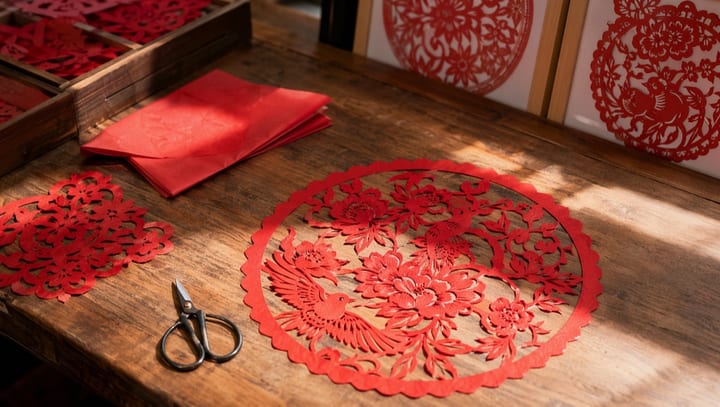
The making sequence below follows the Shui record’s pattern preparation and cutting stages. For the broader craft, see the introductory guide; for folding, freehand work and connected-paper structure, use the methods guide. The image on this page is a project-created illustration of a worktable. It does not document a named maker or verify the meanings of the specific motifs discussed here.
Images and credits
Project-created illustration, reused from the site’s approved paper-cutting imagery. This worktable scene is illustrative; it is not an authenticated historical paper cut, a documentary photograph of a particular maker or region, or evidence for every symbolic interpretation discussed in the article.
