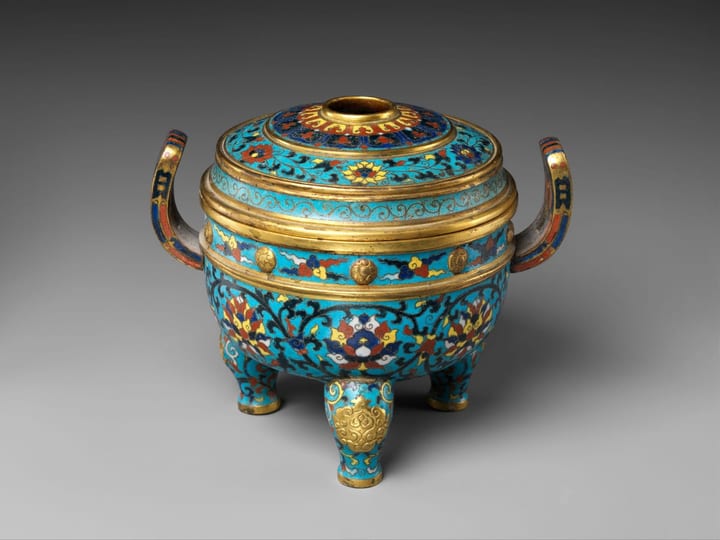
Recessed metal, rather than an added wire network
The V&A explains champlevé through beds cut into copper to receive enamel, which heat fuses onto the prepared metal. The coloured area lies in a hollow; surrounding metal remains available as its boundary. This relationship between support and filling is more informative than a palette of blue, green or red.
Its process demonstration recreates part of a medieval French reliquary. That is useful for understanding the structural principle, but it is not documentation of a Chinese workshop. A shared technique name must not turn a European demonstration into evidence for every Chinese maker’s tools or sequence.
The Palace Museum’s account of zantai falang
The Chinese term 錾胎珐琅, zantai falang, foregrounds work on the metal body. The Palace Museum describes outlining a design, removing metal around its contours, placing enamel in the lowered areas, then firing, polishing and gilding. The raised-looking lines result from lowering adjacent areas rather than necessarily adding separate wires.
The museum’s mid-Qing domuhu, 新00125093, carries repeated dragon ornament on a sky-blue ground. Its account connects this vessel form with Mongolian and Tibetan butter-tea containers, while explaining that elaborate Qing court versions could serve display. That recorded change of use matters as much as the borrowed shape.
A Ming burner combines techniques component by component
The Met’s early-fifteenth-century Tripod incense burner with lid, 2015.500.6.32a, b, has cloisonné on its body and champlevé on its handles. The catalogue explicitly explains the handle enclosures as carved into metal. It therefore supplies a precise comparison within one small object.
Follow the handles separately from the vessel’s rounded body. Calling the whole piece simply champlevé would erase the wire-based work; calling it only cloisonné would conceal another construction. Its broad collection classification is Cloisonné, demonstrating why the fuller medium and curatorial description should also be read.
An enamel inscription can be only one part of a jar
The British Museum’s covered jar, 1957,0501.1, is catalogued to the Xuande mark and period, 1426–1435. The technique fields distinguish cloisonné enamelling from a champlevé inscription. Dragons and clouds cover the large vessel, but a small inscribed area carries a different technical description.
This example suggests a practical reading order: locate the named feature, read the technique assigned to it, then return to the object as a whole. A technique listed in a record need not describe every decorated surface. Neither a reign name nor a dragon motif is a substitute for that component-level evidence.
A later bird burner separates body and enamelled cover
Powerhouse identifies its Chinese bird-shaped incense burner, 222A, as bronze with champlevé enamel, dating it approximately 1880–1930. The hollow bird stands on three legs, while two decorated wings form a removable cover. Its account locates the coloured geometric and scrolling decoration on those wings.
The record calls the bronze body cast; it does not describe how each enamel recess was produced. Keep those statements separate. Casting an object’s overall form does not by itself establish that its cells were cast, carved or otherwise prepared. The maker remains unidentified, rather than supplied through comparison with a better-known workshop.
Read technique, place and purpose on their own evidence
The Palace Museum’s collection overview includes champlevé alongside cloisonné, painted, hammered-body and transparent enamels, as well as objects using more than one method. Its holdings connect court workshops, Guangdong production and exchanges with Europe. Such collection-wide contexts do not assign an unproven manufacturing centre to an individual vessel.
Compare this guide with our painted-copper-enamel and cloisonné comparison pages. Ask what supports the colour, how the dividing areas were constructed, and whether the description concerns an entire object or a selected component. Those questions support closer looking without making a photograph stand in for technical examination.
Images and credits
Tripod incense burner, China, early fifteenth century. Cloisonné body, champlevé handles. The Met 2015.500.6.32a, b. Florence and Herbert Irving gift. CC0; uncropped and resized.