How Chinese inside-painted snuff bottles are painted
The brush enters through the bottle’s mouth. Seattle Art Museum explains the use of a thin brush with a hooked tip and presents studio footage of Ye-family painters. The angled end reaches a sideways wall despite the narrow entry.
Hong Kong Museum of Art describes painting in reverse on the inside wall. The action relates the working surface to the outside view, especially for lettering. It does not simply mean turning the bottle upside down, nor establish a universal order for every brushstroke.
Preparing the surface and composing through glass
The National Palace Museum’s account of a Zhou Leyuan bottle describes shaking abrasive material inside to roughen the wall slightly, helping paint adhere, then inserting a curved fine brush. This explains preparation and access without prescribing one recipe for every historic vessel.
The bottle is both support and viewing window. A composition has to fit its available wall, with room for imagery and any writing. Turning a two-sided example can change what comes into view. Looking at both faces is therefore useful.
A glass bottle with a cautious attribution
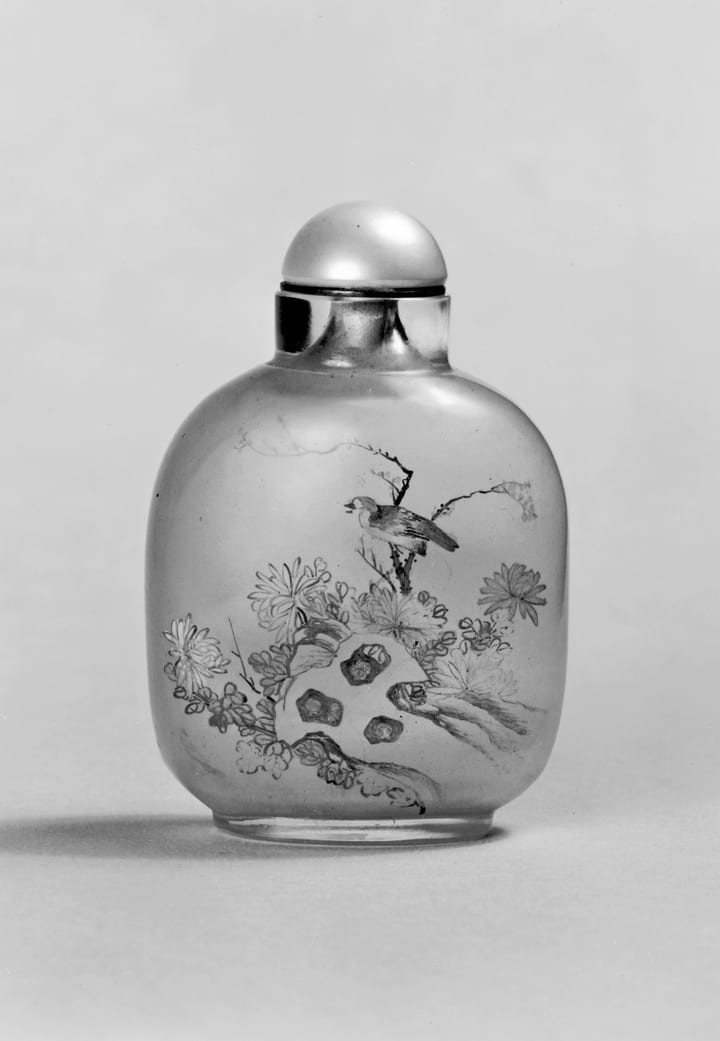
The Walters Art Museum’s Snuff Bottle with Birds and Flowers, accession 47.586, provides a firmly identified glass example. The current record dates it to 1892–1912, gives China as its origin, and specifies glass with interior painting. These details establish the relevant material and technique without asking the photograph to prove them.
The same record places a question mark against the artist name Ye Zhangsan. The bottle can illustrate the craft while its attribution remains uncertain. Its title identifies the subject; its museum record supplies the evidence for material and technique. The photograph here is a monochrome reproduction; it does not establish the original colours of the painting.
Landscapes and portraits around the end of the Qing
The Palace Museum preserves a landscape-and-figures bottle by Zhou Leyuan, accession 故00106668. Its inscription dates it to early autumn 1892. The museum describes a landscape extending across both faces and relates it to the work of the Qing painter known as Xinluo Shanren. This is a particular example of miniature painting drawing on an existing pictorial tradition.
A different subject appears in Hong Kong Museum of Art’s 1907 portrait bottle of the official Duanfang, made by Ma Shaoxuan. Its material is rock crystal, not glass. The museum connects Ma’s portrait treatment with photography. Together, these examples show a range extending beyond generic scenery, while their documented dates provide firmer anchors than a sweeping claim about a single inventor.
A technique that continued in workshops
Seattle Art Museum connects inside painting with workshop and family transmission and includes twentieth-century studio documentation. The medium did not end with the Qing dynasty. Individual artists, family production, and later works should nevertheless be distinguished.
Compare Chinese overlay glass for a contrasting process that removes outer glass to create relief. Chinese calligraphy provides context for the writing seen on many bottles. The photograph accompanying this guide shows a finished museum object.
Museum photographs and credits
Snuff Bottle with Birds and Flowers, China, 1892–1912; glass with interior painting. The Walters Art Museum, 47.586; Gift of Edward Choate O’Dell, 1977. The museum lists the artist as Ye Zhangsan (?). Attribution is uncertain. CC0; black-and-white source photograph, resized.