A covered example of Chinese lacquer food boxes
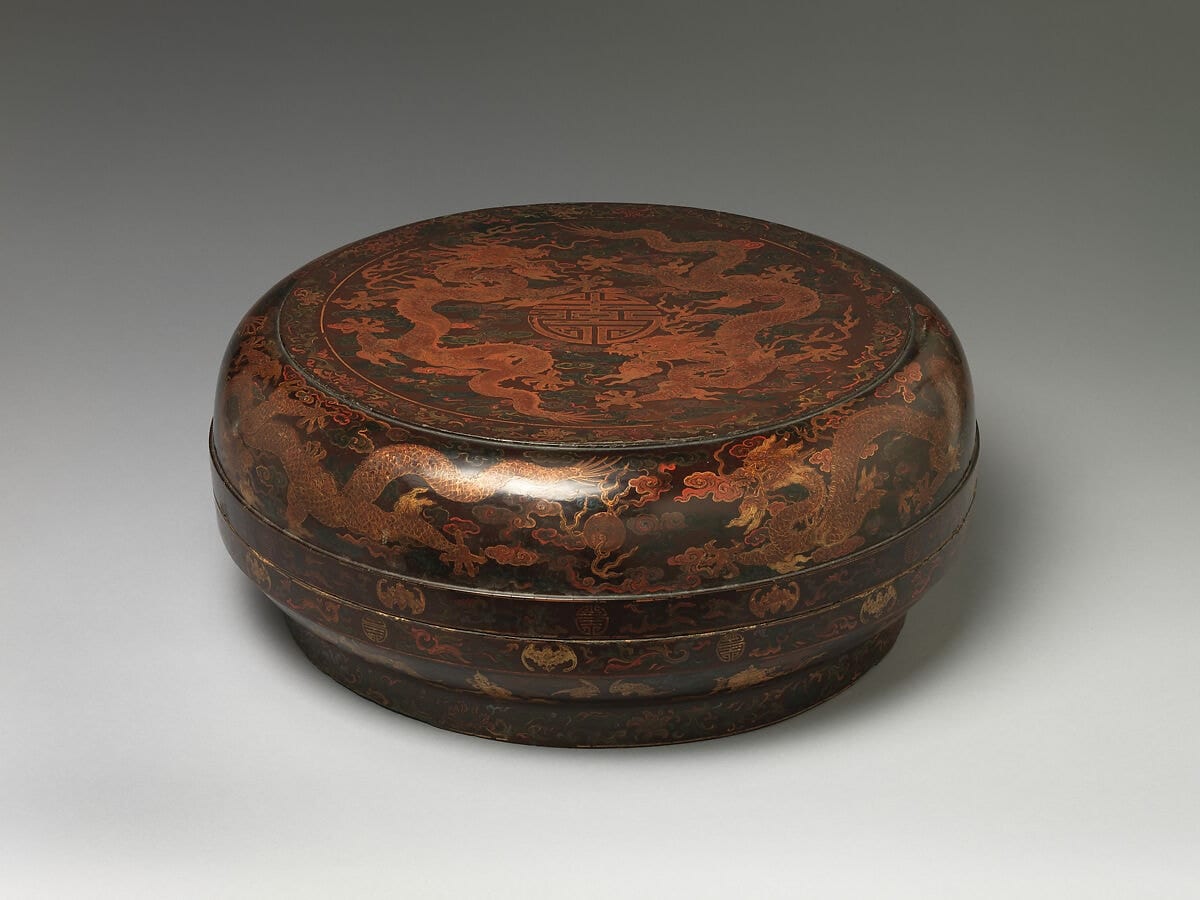
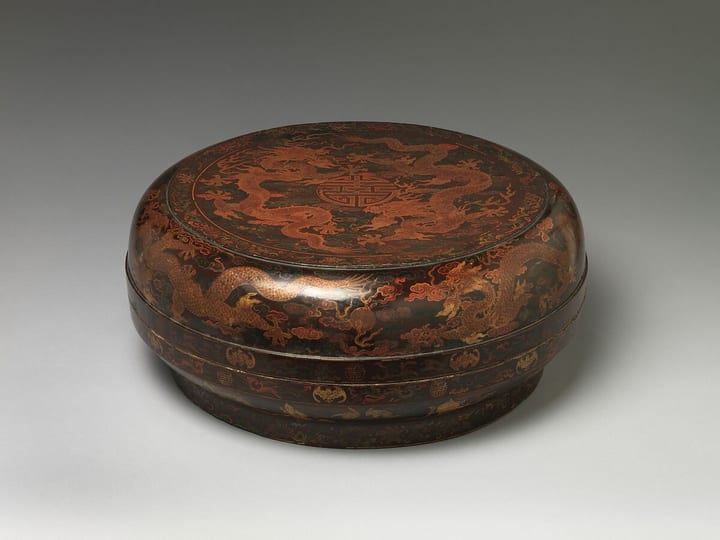
The Met’s circular food box 2015.500.1.64a, b dates to the eighteenth–nineteenth century. At 57.5 centimeters across, it gives the lid a broad field for imagery. Its recorded decoration uses gold, lacquer and oil colors on black and red lacquer.
The photograph shows the complete box closed. Follow the lid’s edge around the body, then compare its broad top with the narrower side bands. This view helps explain the exterior design; it does not reveal the original contents or internal fittings.
Stacked tiers create another structure
LACMA’s octagonal food box M.82.207a–c is catalogued as three-tiered and dated to the Yuan dynasty, 1279–1368. It measures about 26 centimeters in each direction. Its title identifies flowers and cartouches containing scholars in landscapes.
Birmingham Museum of Art holds a much smaller Chinese three-tiered box, 1973.116a–d, measuring 12.4 centimeters high. Its eighteenth-century Qing record identifies cinnabar lacquer and wood. The title names peonies and the Pole Star deity Kui Xing within a four-lobed silhouette.
Read tier count together with shape and dimensions. Three levels can belong to substantially different designs, and a shaped outline changes how decoration turns around the sides.
Compartments and drawers answer different needs
The Hong Kong Palace Museum’s Qing compartmented box combines red lacquer, gold, glass and jade. Its lid has glass inlay, while small jade trays divide the interior. The exhibition relates this kind of snack presentation to Lunar New Year gatherings.
A separate Qianlong-period portable box, dated 1736–1795, has a handle and drawers sized for teapots, cups, tea canisters and trays. This is a carrying case for equipment, rather than evidence that every lacquer food box was a picnic set.
Check whether a catalogue describes the outer container, removable dishes or a case holding other vessels. These relationships are useful when a photograph shows several components spread out beside one another.
Decoration can tell a story without identifying the contents
The National Museum of Asian Art’s food box F1968.76 dates to 1488–1505, in the Hongzhi reign. Carved black and red lacquer covers a wood core. Its Moon Palace scene includes Chang’e, a rabbit preparing an elixir and a three-legged toad. The museum records Wang Ming’s signature on a palace column.
The depicted gathering supplies a story to read across the lid. It does not establish the particular food served from the object or the occasion on which someone used it.
Making the surface follows the chosen technique
The Met distinguishes carving accumulated lacquer from engraved-gold decoration, or qiangjin. For the latter, lacquer adhesive goes into incised lines before gold foil or powdered gold is pressed into the grooves. That definition helps explain LACMA’s gold-filled material description without treating every golden mark as the same technique.
The carved-lacquer guide follows the building and cutting of layers. The incense-box guide supplies another comparison of lids and contained materials. Here, documented food use and the organization of the container guide the comparison.
Images and credits
Circular Food Box with Dragons and the Character Shou (Longevity), China, eighteenth–nineteenth century. The Met, 2015.500.1.64a, b. Gift of Florence and Herbert Irving,2015. Photograph: Lee Oi-Cheong. Public domain/CC0. Complete institutional image retained; JPEG encoded without cropping or enlargement. Resized for display.