Look around Chinese embroidered children’s hats
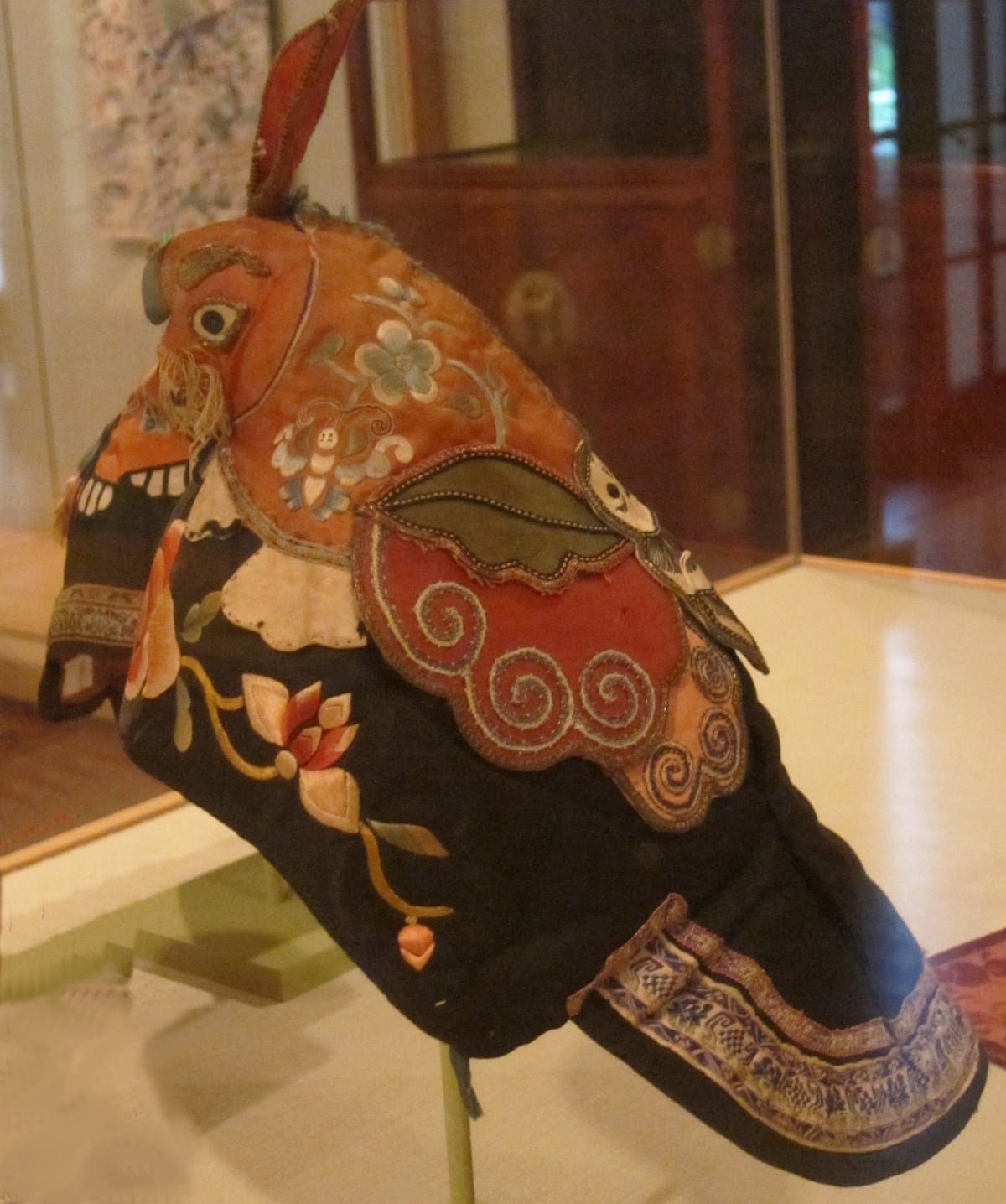
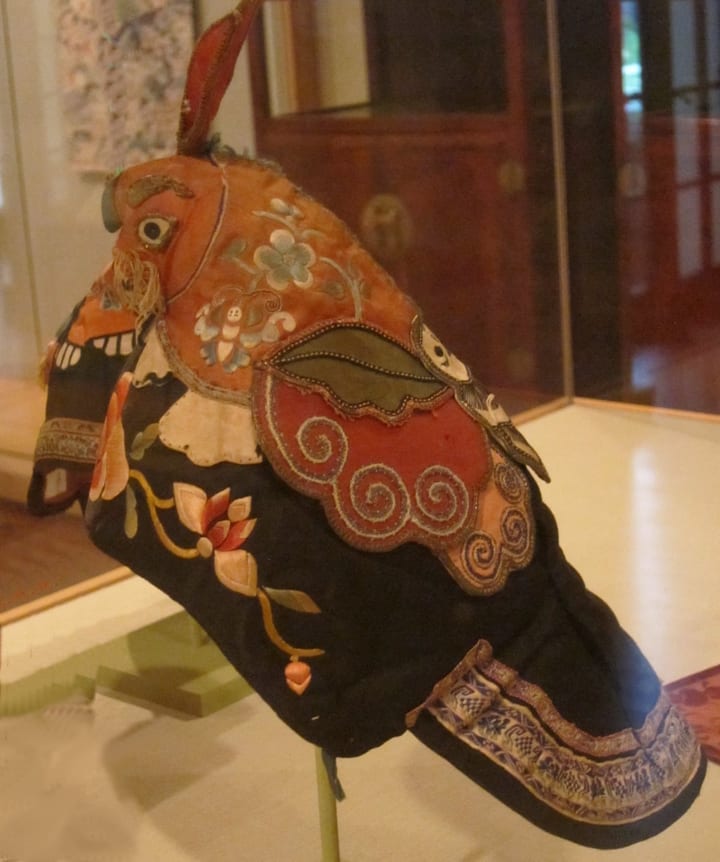
Hiart’s photograph records a child’s hat from early-twentieth-century China displayed at the Honolulu Museum of Art. The photographer’s description identifies silk and cotton, satin weave, appliqué and embroidery.
The side view shows flowers above layered, curved panels and a broad black hanging section. A patterned band follows the lower edge. Looking from the upper decoration down to that band helps you see how several surfaces contribute to the finished outline.
A crown can contain both cloth and supporting layers
Powerhouse catalogues a Chinese festival hat dated 1900–1950 with a six-panel openwork crown lined in brown waxy paper. Its red silk carries floral embroidery. Gold paper edging is held with black silk thread, and braid finishes the rim.
A small stuffed figure holding a lotus sits at the top. Separate crane figures project from the sides, and a carved jade plaque is stitched onto the front. The back has a three-tiered hanging with mirror inlays, beads and tassels. This record distinguishes the embroidered ground from the many objects attached to it.
The top and sides can carry different motifs
The China National Silk Museum’s black-satin floral-and-butterfly child’s hat measures 12 centimetres in diameter. Its description places two dragons around a pearl on the crown, with a taiji design inside the pearl. Flowers and cranes decorate the top, while flowers and butterflies cover the body.
The museum also records animal-patterned copper ornaments near the bottom and techniques including straight stitches and couched goldwork. Read the placement alongside the technique: stitched imagery and attached metal occupy different parts of this small surface.
The back piece is also a working surface
In its 2023 exhibition about embroidered hat tails, the silk museum explains that a long back piece could shelter a child’s neck in cold weather. Some continue directly from the hat body; others are separate pieces sewn onto the back. Larger examples extend over the shoulders and back.
The exhibition includes Qing examples with floral and tiger designs, couched decoration, built-up silk ornament and embroidered theatrical figures. A hat tail gives the maker room for a larger composition. Follow its outline and attachment before looking at the scene within it.
A shaped hat can carry wishes on both front and back
San Antonio Museum of Art’s late-nineteenth-century Chinese child’s hat, 88.19.5, combines silk, silk-floss embroidery and leather. Its petal-like form and pod-shaped top evoke a lotus. The museum connects the lotus with purity.
The same label interprets books and a sword at the front as wishes for scholarly and martial achievement, and coins at the back as a wish for wealth. The meanings become easier to follow when you keep each motif beside its recorded location.
Small attachments can add movement
Bowers Museum describes a dragon-form festival hat with flowers and other projecting ornaments intended to bounce as the child moved. Its discussion places such elaborate hats in celebratory settings and compares several late-Qing examples.
This adds movement to the way a hat is read. Alongside the stitched surface, notice the elements that rise from it or hang below. Their outline can change as the wearer turns.
Images and credits
Child’s hat from China, early twentieth century, displayed at Honolulu Museum of Art. Photograph by Hiart, 2012, CC0 1.0. Complete photograph resized; museum-case reflections retained.