Douban and gonghua printing do different jobs
In douban, parts of a design are distributed among small wooden blocks for different colours and areas. Successive impressions assemble the image on the same sheet. The National Library of China explains the preparation as dividing the full drawing into portions according to its printing needs.
Gonghua changes the paper’s surface. The library describes complementary recessed and raised blocks pressed together to produce relief, including details such as flowing water, feathers and the edges of objects. A coloured area and a raised area therefore answer different questions: what was transferred to the sheet, and how was the sheet shaped?
Colour separation begins before printing
The design must be considered as a sequence of printable parts. A small block may carry only one portion of the final composition. Its usefulness lies in the control it gives over where colour appears and how successive areas relate.
This differs from colouring a completed outline by hand. It also differs from movable type, whose separate characters can be rearranged into a new text. Douban’s divided image blocks serve a planned composition. The related guides explain those broader printing systems; here the central task is bringing the colour separations back together.
Layered impressions can suggest brush painting
The Huntington explicitly identifies douban in the Ten Bamboo Studio Manual. Its explanation describes separate colour blocks printed in layers, with overlapping hues producing further colours. Wiping away some ink and printing repeatedly can develop a softer, watercolor-like effect.
The effect depends on printing decisions as well as carving. A gradient should not automatically be read as colour brushed onto the finished page. Conversely, a photograph’s soft tones alone cannot prove which method was used. A collection record and a technical account provide stronger evidence than resemblance to painting.
Two Ten Bamboo Studio books have different identities
The Ten Bamboo Studio Manual of Painting and Calligraphy, Shizhuzhai shuhuapu, is associated with Hu Zhengyan’s publishing work in Nanjing. The Met describes it as both a luxury object and a guide for aspiring painters. Its catalogue gives the first edition as 1633 and explains the use of multiple blocks and carefully developed shading.
Shizhuzhai jianpu, the Ten Bamboo Studio collection of letter papers, is a separate publication. Shanghai Museum catalogues its Nanjing example to the seventeenth year of Chongzhen, 1644, and explicitly identifies both douban and gonghua. Distinguishing the titles prevents a painting-manual leaf from being casually relabelled as a page of embossed letter paper.
The displayed leaf documents colour printing
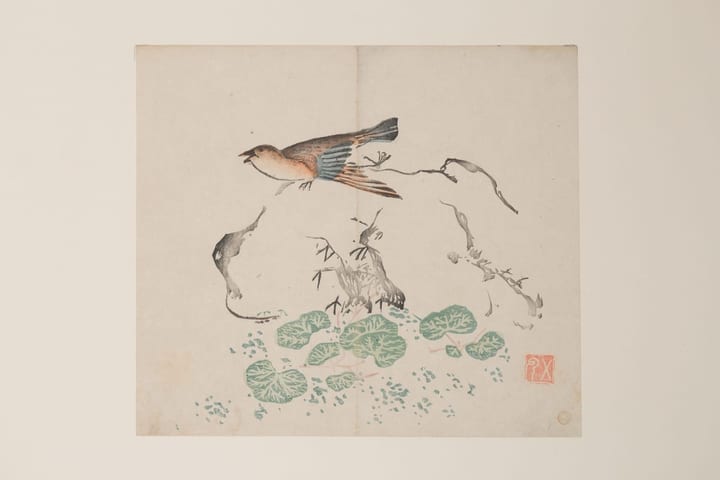
Our photograph shows The Met’s CP54, a leaf from the painting and calligraphy manual, catalogued as ink and colour on paper. It provides an actual book-print example within the multiblock tradition discussed here. The image is the complete official museum photograph.
The catalogue does not identify embossing on this particular leaf. It should therefore be used to discuss the documented colour-printing context, rather than as proof of gonghua. Subtle relief can also be difficult to judge in a frontal photograph; the technique’s identification must come from reliable documentation.
Edition and material study matter
A 2019 Smithsonian Libraries account describes two copies attributed to an 1879 edition of the manual. Initial comparison revealed differences in compositions and printed details, requiring further study. A familiar title does not mean that all surviving copies have identical images or printing histories.
The National Palace Museum likewise places version attribution and conservation at the centre of its research on the manual’s bird volume. Its summary identifies mature use of douban and gonghua in the collection. These are book-level findings; they do not establish that every leaf combines both methods.
Colour, alignment and pressure are taught together
A May 2026 Nanjing government report documents a public workshop covering drawing, carving, colour printing and embossing. Participants adjusted colour strength, aligned impressions and controlled pressure while making decorated papers. The account offers a specific example of contemporary teaching, alongside the historical books.
Those tasks clarify why the result depends on coordination. Blocks carry the divided design, colour application shapes the impression, and paper placement brings the parts together. Where embossing is included, pressure adds a surface effect. No fixed block count or universal sequence is needed to understand the distinction.
Images and credits
Leaf from the Ten Bamboo Studio Manual of Painting and Calligraphy, China, ink and colour on paper; catalogue date: first edition printed in 1633. The Metropolitan Museum of Art, CP54, Rogers Fund, 1924. Public domain/CC0. Complete official photograph; no crop. The museum documents multiblock colour printing in the manual. This leaf is not presented as a confirmed example of gonghua embossing.
