Woodblock printing vs movable type: what stays together?
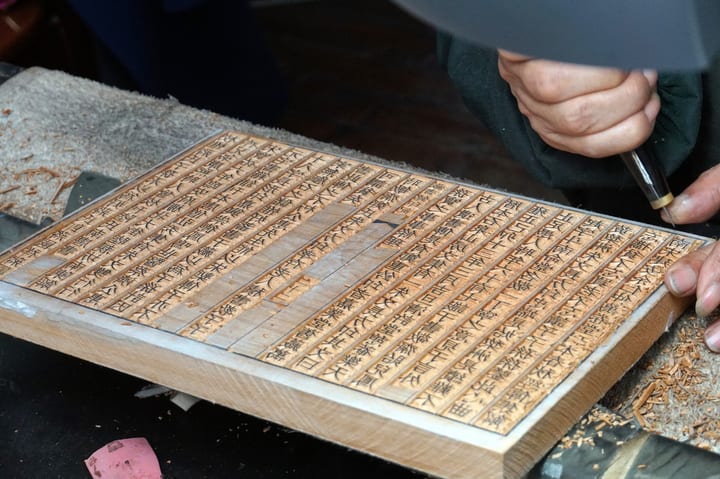
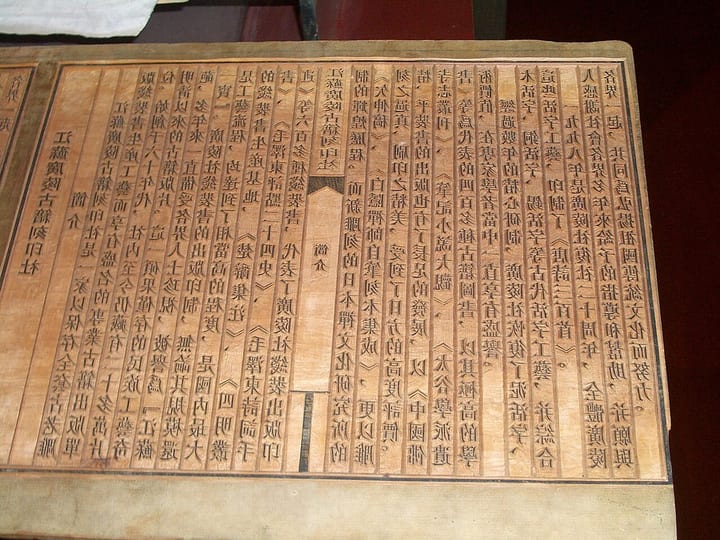
In block printing, characters, borders, and any illustration form a fixed layout carved into wood. The prepared block can print further impressions of that arrangement; it is not discarded after printing one page.
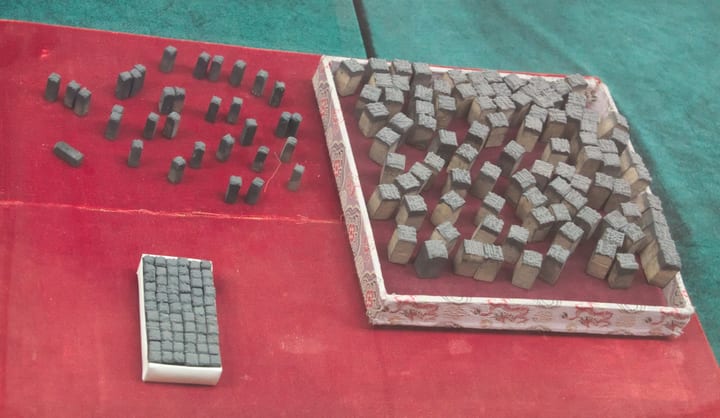
With movable type, separate pieces are selected and arranged for the required text. After printing, the page can be dismantled and its characters returned for later use. Both methods can reuse material: the distinction is a retained layout versus reusable units that can be recomposed.
A carved page begins with writing and checking
UNESCO’s engraved-block account describes preparing fine-grained wood, checking a design on thin paper, transferring it, carving, testing, and correcting. The Asian Art Museum explains the face-down transfer: the draft guides the reversed printing surface so the impression reads correctly.
The carver removes background material, preserving raised strokes to carry ink. Paper laid on the inked surface is rubbed or brushed to take an impression. The result connects handwriting, carving, ink, paper, and pressure.
Separate characters create another kind of preparation
The China ICH portal describes Rui’an wooden type with raised, reversed characters. Printers need an organized stock, not a tray of arbitrary symbols. The account explains mnemonic methods for finding characters and arranging them for a manuscript.
Composition also needs spacing, support, and a stable printing surface. The portal describes a wooden tray, bamboo divisions, leveling pieces, and wedges securing the assembled type. Reading and checking the text remain essential; a neatly filled tray is not proof that the page is correct.
Chinese heritage gives the comparison a social setting
The national heritage entry for Yangzhou describes four connected areas of block printing: preparing materials, engraving, printing, and binding. It explicitly states that movable type did not replace block printing. These crafts are better understood through their actual tasks than as a simple story in which one makes the other obsolete.
UNESCO’s wooden-type record centers on Rui’an, Zhejiang, where printers compile and print clan genealogies in community settings. Preparing such a book includes understanding and organizing family records. This is one documented living practice, not the purpose of every movable-type tradition.
Compare the job without declaring a universal winner
Ask what changes between pages, whether a layout needs retaining, and how the printer will prepare and check it. These questions follow from the structures. They do not establish one method as always faster, cheaper, sharper, or more valuable.
Paper matters in both methods. The Xuan-paper comparison clarifies its names and materials.
Photograph credits
Chinese wooden movable type at the China Printing Museum in Beijing. Photo: Popolon, Wikimedia Commons, CC BY-SA 4.0; resized. Responsive JPEG versions remain available under CC BY-SA 4.0; source and license links are below. No museum or photographer endorsement is implied.
Woodblock carving demonstration at the China Block Printing Museum in Yangzhou. Photo: 三猎, Wikimedia Commons, CC BY-SA 4.0; resized. Responsive JPEG versions remain available under CC BY-SA 4.0; source and license links are below. No museum or photographer endorsement is implied.
Book-printing woodblock in the China Block Printing Museum collection, Yangzhou. Photo: Vmenkov, Wikimedia Commons, CC BY-SA 3.0; resized. Responsive JPEG versions remain available under CC BY-SA 3.0; source and license links are below. No museum or photographer endorsement is implied.