What Chinese incense tool vases held
The National Palace Museum’s ribbed jade vase 中玉000155N000000000 has a long neck above a rounded, flattened body. A pair of copper chopsticks and a gilt copper spatula accompany it. The museum identifies the vase as the holder for these implements within a set.
The Palace Museum explains the division of work for its white jade ensemble. The chopsticks picked up sandalwood, and the spatula handled ash. The burner received the incense, while the lidded box stored the sandalwood. Those three tasks help explain why the pieces have such different openings.
A narrow porcelain mouth sets the scale
The National Palace Museum’s Yongzheng tool vase is 11.5 centimeters tall, with an opening only 1.2 centimeters across. The neck rises from full shoulders, and a white glaze with a blue-green cast covers a subtle dragon design. A blue Yongzheng mark appears on the underside.
Catalogue measurements are useful here. A side view shows a long, apparently spacious neck, while the mouth measurement gives the clearance available for an implement. Compare the opening and overall height before judging how much the body alone tells you about the vessel.
A small jade set may have served as display
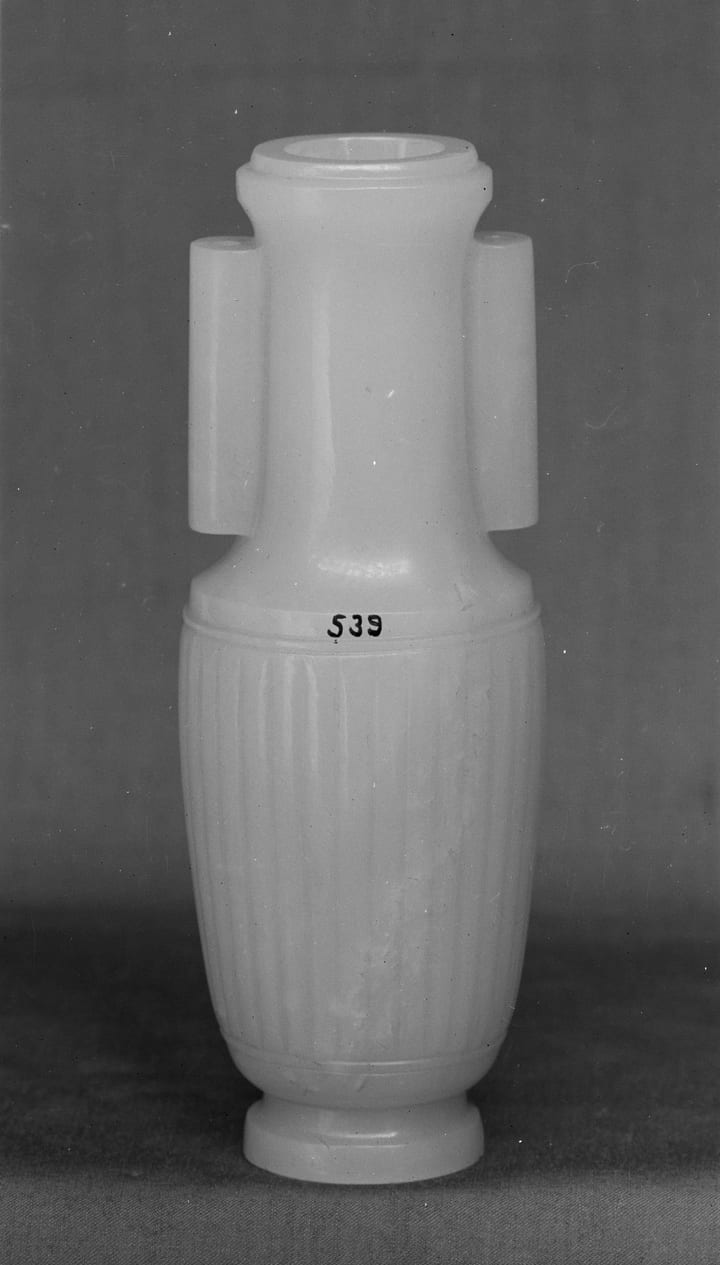
The Met’s photographed vase belongs to an eighteenth-century nephrite set with a covered box and a burner. The vase is just over eleven centimeters high. The museum proposes that the scale of the ensemble suited desktop display.
The monochrome photograph shows the vase alone. Two tubular handles flank its neck and shallow flutes run down its body. The other objects named in the catalogue supply the context for this otherwise self-contained silhouette.
A porcelain set designed to sit against a wall
A Qianlong set in the National Palace Museum has a partly cut-away bottle body so it can sit close to a wall. The ensemble is porcelain. Its bronze-like finish combines a speckled glaze, gold decoration and green coloring.
Wooden fittings hold the pieces in place. The museum records that a hidden compartment below the display could hold the small implements. That detail gives the tools a second documented place within this particular ensemble.
Metal could carry the same kind of implements
The National Palace Museum’s Southern Branch describes a gilded copper-bodied vase with cloisonné chrysanthemums. Its square spatula and pair of copper chopsticks survive. The museum presents it alongside the practice of burning incense before playing the qin.
For a closer look at the open vessel used for burning, see our guide to Chinese celadon censers. The tool vase is easiest to understand alongside its companions and any implements that survive with it.
Images and credits
Vase from an incense set, China, Qing dynasty, eighteenth century. Nephrite jade. The Metropolitan Museum of Art, 02.18.539. Gift of Heber R. Bishop, 1902. Complete monochrome photograph, resized. Collection number visible. Public Domain, CC0.