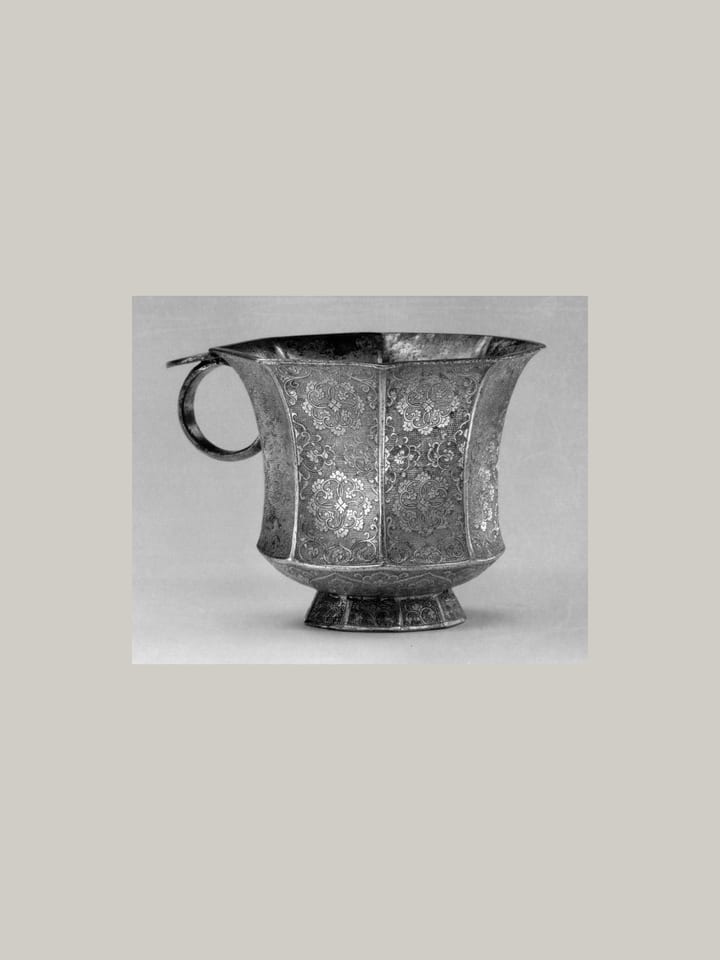
How a ring-handled cup was put together
The Met dates the photographed octagonal cup to the eighth century. It stands 6.2 centimeters high. Begin with the ring at the side, then follow the profile from the brim down to the short, spreading foot. The photograph gives you the whole outline and a view across part of the rim.
The museum’s acquisition study describes an assembly of hammered silver sheet. The side wall, rounded bottom and foot are separate components, as are the ring and the thumbpiece above it. Solder joins them. The museum compares the form with Sasanian silverwork, a comparison of shape that helps place this Chinese object in a wider history of metal vessels.
Forming the vessel and decorating its surface
A cup can preserve evidence of more than one way of shaping metal. The Smithsonian’s late seventh-century wine cup, attributed to the Xi’an area with some uncertainty, combines cast and hammered silver. Its catalogue also identifies chasing, ring punching and gilding. The birds, animals and vines belong to the surface design, while the projecting handle changes the vessel’s profile.
These labels describe separate operations. Hammering can give sheet metal the shape of a bowl. Chasing works the face with small tools to adjust contours or textures. The V&A explains soldering as a way to join metal parts by melting a filler at their meeting point. Those distinctions give a useful order for reading a catalogue description.
A high foot or a shallow body directs the eye
Cleveland’s early eighth-century stem cup stands nine centimeters high. Its pedestal raises a rounded bowl with an incised and chased exterior and a gilded interior. The museum notes that similar vessels could serve tea or wine and points to the popularity of the stem profile in Sasanian Iran.
A second Met cup, accession 1991.159, has a long, low outline that places the interior in view. Two ducks occupy the floor of the vessel. The museum reads them as a Chinese motif of marital happiness. Its illustrated study describes gilding on the decoration and rim and a relatively plain exterior.
What a find spot adds
The Shaanxi History Museum displays a high-footed silver cup with hunting decoration and a gilded silver winged cup from the Tang hoard excavated at Hejiacun in 1970. Both belong to a documented archaeological group from Xi’an. That shared find context lets readers compare cup shapes alongside other precious metal objects recovered together.
Images and credits
Octagonal cup with ring handle, China, eighth century, Tang dynasty. Silver with parcel gilding. The Metropolitan Museum of Art, 1985.214.17, Gift of Ernest Erickson Foundation, 1985. CC0. Complete monochrome photograph, resized. Display adds a neutral border.