Reading the folded leaves of Chinese thread-bound books
The British Library explains why a page number can appear in the middle of an unfolded sheet. Once folded, that number lies at the outer edge. Prefaces, contents and chapters can have separate pagination sequences. Counting physical leaves and understanding their order therefore belong together.
When looking at a digitized book, check whether the scan shows one printed face, an unfolded sheet or two facing pages. Those views expose different parts of its construction.
Two fastenings can do different jobs
The Bodleian describes an inner fastening, usually two or three paper twists, that holds the textblock together. Outer silk sewing then attaches separate covers. Its Sinica 379, dated 1803, has two such twists. Two much thinner volumes, dated 1864 and 1904, instead depended entirely on outer stitching.
This distinction makes a damaged binding easier to read: broken outer thread does not tell you whether another fastening survives inside. The construction needs examination rather than a diagnosis from a cover photograph.
Covers, cases and collecting histories
Vanderbilt calls this structure pouch binding, or xianzhuang in China. Its description specifies four or more pierced holes and thin Chinese paper covers, commonly protected by an outer folding case called a hantao.
The National Palace Museum places stitched binding alongside butterfly and wrapped-back bindings in a longer history. It describes stitched books as particularly popular in the Qing dynasty. Its exhibition contrasts richly made imperial-library covers with the quieter aesthetic of scholar-collectors. A binding format can accommodate different choices of decoration.
A book can combine traditions
Princeton’s Ningbo hymn book of 1860 uses Chinese-style binding and folded Chinese paper with a Western printed layout. Its Songs of the Gold Mountain, published in San Francisco in 1911–1915, combines Chinese thread binding in the first volume with a more Western binding in the second. Inside, the layout remains Chinese while paper and printing technology are Western.
The same exhibition shows a Beijing edition of the Thousand Character Classic, designed by Lü Jingren in 1999. Traditionally bound volumes sit within an inventive outer presentation. These examples make binding a useful subject of its own when studying a book’s movement between languages, places and design practices.
Our woodblock-printing guide follows the printed impression; the painting-album guide follows arranged images and viewing sequences. Here the point of comparison is the structure that holds leaves together.
Images and credits
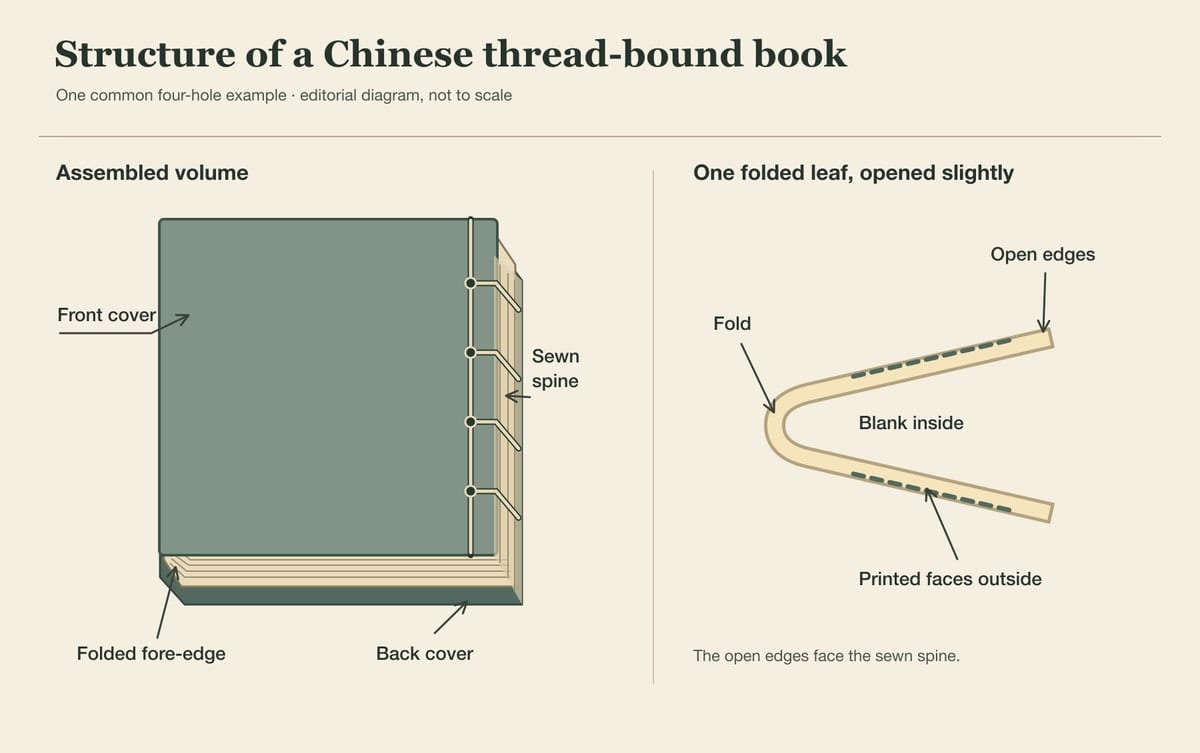
Original editorial diagram by Living Heritage China. One four-hole side-sewn arrangement is shown beside a folded-leaf cross section; this is a schematic illustration, not a historical book photograph. Resized for display.