Find the two heads and their support
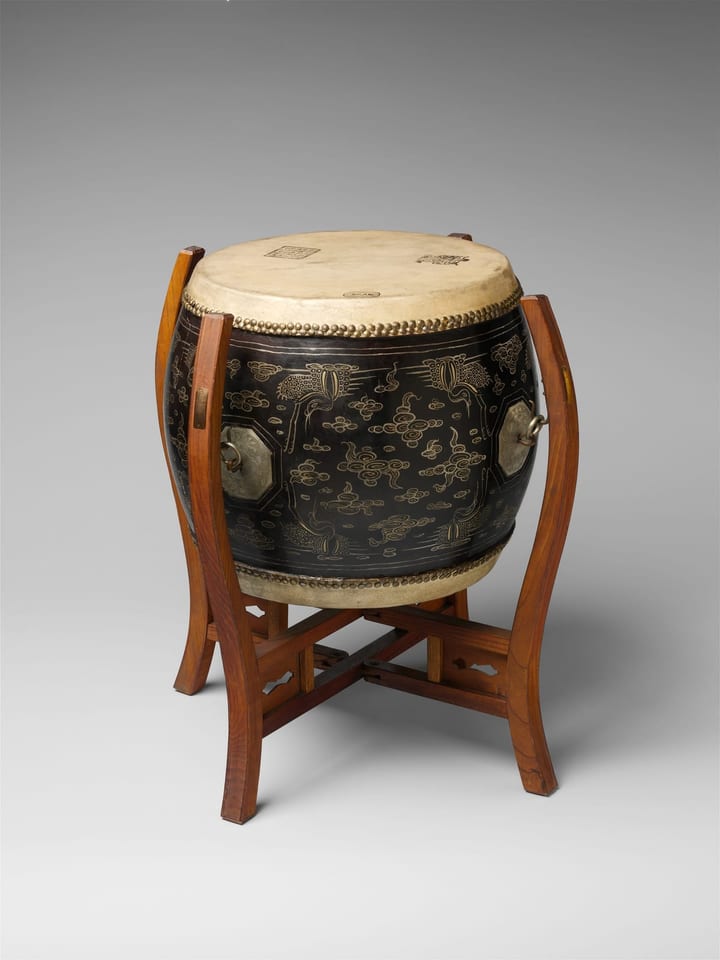
The Metropolitan Museum of Art dates the pictured drum to the nineteenth century. It credits the Elevated Tone Workshop in Guangzhou and separately lists Shanghai in the geography field. The photograph shows a dark decorated body held within a wooden frame. Look for the fasteners around the pale upper skin and the band of hide visible along the barrel’s lower edge. The second edge helps identify the other head even when its face is hidden.
The Horniman Museum’s tanggu, MT33-1995, is another documented drum with a stand. Its classification specifies a barrel with two skins and one skin used for playing. The catalogue gives an overall measurement of 410 by 590 millimetres. Compare those dimensions with the Met’s roughly 56-centimetre height and width for its own example, while keeping the scale of each museum’s measurement separate.
Read the drum through the playing surface
Grinnell College describes mounting its tanggu by four rings so one head faces up. The performer plays that membrane with two wooden sticks. The Met describes changes in tone and loudness depending on whether the player strikes nearer the middle or the edge. When watching a demonstration, compare two strokes with a similar force so the change in point of contact is easier to hear.
Grinnell gives a specific theatre use: tanggu can accompany a military scene in Beijing opera with suona, the double-reed wind instrument. Listen for the difference between a brief drum attack and the wind instrument’s continuing line. The related bangu has a different construction, with a small opening beneath its single head.
A drum from New York Chinatown preserves signs of playing
Conservator Devon Lee examined a separate tanggu from New York Chinatown’s Chinese Musical and Theatrical Association. Its barrel was assembled from 21 glued planks, and metal rivets held the rawhide heads. The drum came to the Museum of Chinese in America in 1989. Lee identified parallel dark marks across its upper head as wear from playing.
The treatment repaired tears in the hide and added padding to the metal stand where it could rub the painted barrel. Lee retained the wear marks. The museum’s report therefore gives two clues about this instrument’s working life: how the drum was supported, and which surface bore repeated strikes.
Follow the drum into an orchestral entrance
The Singapore Chinese Orchestra’s programme account of The General’s Command identifies tanggu and cymbals at the opening of Peng Xiuwen’s orchestral arrangement. The fast ensemble passage follows, with strings and winds building on a fanfare figure. The programme traces the piece to a percussion repertory used for theatre openings and military scenes. You can follow that theatrical idea in the concert version by hearing when the opening percussion yields to the full ensemble.
Hong Kong Chinese Orchestra’s instrumentation chart lists both large and small tanggu among its unpitched percussion. It lists bangu and the concert bass drum separately. When reading a programme or parts list, check which drum it names and what else plays with it. The parts tell you more than a size label on its own.
Images and credits
Tanggu by the Elevated Tone Workshop, nineteenth century. Wood, oxhide, lacquer, brass and teak. The Metropolitan Museum of Art, 89.4.28a, b, The Crosby Brown Collection of Musical Instruments, 1889. Public domain, CC0. Full photograph, resized for display.