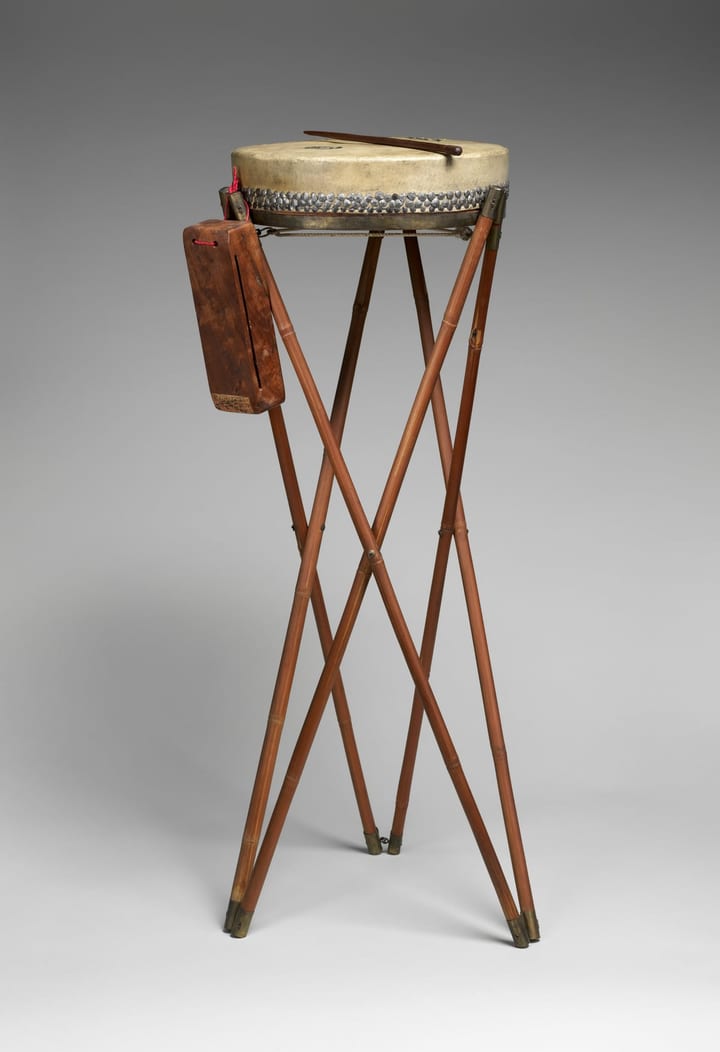
Read the hide, wedges and metal band
The Met credits the Elevated Tone Workshop in Guangzhou with making the nineteenth-century drum in the photograph. The drum body is 25.4 centimetres across. The catalogue describes six wooden wedges inside a brass band and identifies cowhide over the top. The musician can change the sound by moving the strike to a different spot.
The Hartenberger collection’s mid-twentieth-century bangu also has a hollow that narrows toward the top. Its description records three rows of tacks that secure the hide and a pair of sticks used to strike the head. The photos and object descriptions show how much of the wooden frame sits around the sounding opening.
Separate the beater from the hanging block
In the lead image you can see a beater resting across the top. The Horniman separately measures the width of its 287-millimetre wooden beater at 18 millimetres. Its record links that accessory to a Chinese single-membrane drum. When comparing museum measurements, check whether the label names the drum or a removable tool.
The Met’s image label also identifies a nanbanzi, the long wooden block hanging by the drum. In a separate collection entry the Met describes a nanbanzi as a wood percussion instrument with a slit. That record explains that an ensemble leader can play it while it hangs from a drum support.
Hear how a research team classified the sounds
Mi Tian and colleagues worked with professional musicians in a London studio to collect percussion samples. Their classification groups a wooden ban clapper and a two-stick drum called danpigu under the name bangu. When looking at their tables, read bangu as the label for that group. The same study reports that a nearby gong stroke can mask the group’s short attacks.
In a recording, start with a passage where the drums can be heard clearly. Mark a few strikes, then try to hear them again as the texture gets louder.
Follow the drum through a southern Jiangsu suite
Rong Shao’s analysis of Xia Xifeng places the bangu in a suite that uses melodic instruments alongside gongs and drums. The study identifies the drummer’s lead role but leaves open whether that player also handles a second instrument in the particular performance studied. A score and a recording give different kinds of clues about how many tasks a player takes on.
Images and credits
Bangu by Elevated Tone Workshop, Guangzhou, China, nineteenth century. Wood, skin and metal. The Metropolitan Museum of Art, 89.4.27, The Crosby Brown Collection of Musical Instruments, 1889. The photo also shows a nanbanzi woodblock. Public domain, CC0. Complete photograph resized for display.