Follow the shaft to its decorated end
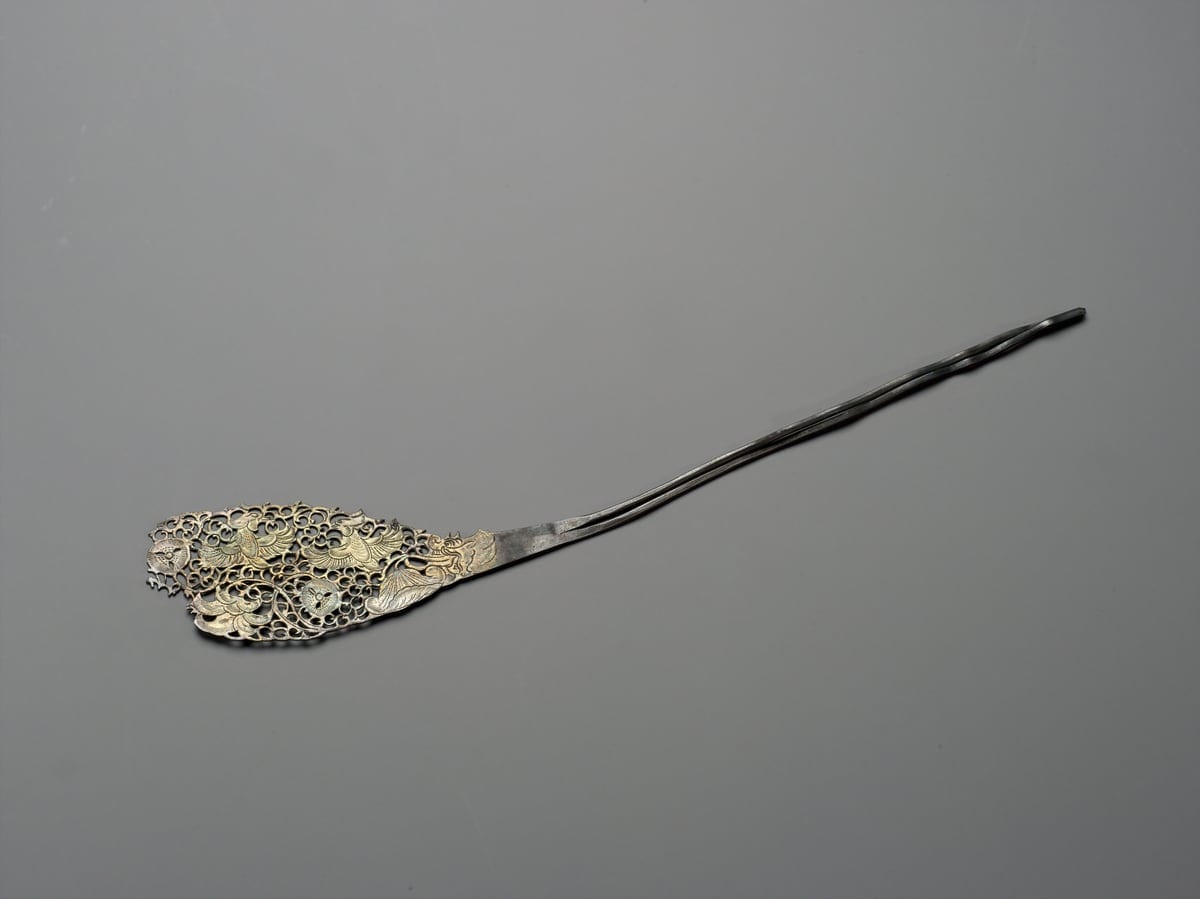
Princeton’s late eighth- to ninth-century hairpin has a finial depicting mandarin ducks and lotuses. The museum identifies beaten silver and gilding on the finial and records a total length of 28.5 centimeters. Its materials make the connection between the long metal part and the ornamental end a useful starting point for comparison.
The Met’s gilt-silver hairpin, accession 34.64.4, has a broad head within an overall height of 12.1 centimeters. Its date is recorded as the seventeenth century or earlier. Preserve that broad dating when comparing it with more tightly dated objects.
Added materials give heads different structures
The Met catalogues accession 1985.214.18 as silver inlaid with glass and dates it to the Tang dynasty or earlier. At 25.1 centimeters long, it offers another early example in which silver supports a different decorative material.
A Ming hairpin in the same museum, accession 26.191.2, combines gilt silver and pearl. Its 13.3-centimeter length is close to the other later Met pin, while its listed materials identify an additional element in the head. Reading both measurements and medium makes the comparison more precise.
A matched pair can have a layered flower head
Shanghai Museum’s Ming pair, excavated from the Gu Congli family tombs, has silver shafts tapering toward the points. Above each is a gold flower-and-leaf setting holding a carved jade flower, with red spinel at the center. Each pin measures 10.4 centimeters. The layered construction gives the small head several distinct materials to hold and display.
The museum explains that flower-headed pins were often worn as pairs. A Palace Museum publication describes Ming examples positioned on the two sides of the coiffure, where groups of small pins helped secure the hair. The whole set therefore provides context for an individual piece.
Excavated placement can explain a pin’s work
Another Ming silver-shaft hairpin in Shanghai Museum has a carved jade head. It was found inserted at the top of a gilded-silver hair covering in a Shanghai tomb. The museum discusses an interpretation that it fixed the covering in place, alongside scholarly discussion of the historical name. The recorded position supplies evidence beyond the shape of the pin alone.
Read forming and setting as separate craft tasks
In its 2021 account of Shanghai fine metalwork, the Chinese Arts and Crafts Society describes hammering to shape metal and the use of separate settings for other materials. It also discusses apprenticeship and tools made or adapted by craftspeople. These living workshop practices give readers a vocabulary for forming, finishing and setting as they examine historical jewelry.
Images and credits
Hairpin with Mandarin Ducks and Lotuses, China, Tang dynasty, late eighth–ninth century. Beaten silver with gilt finial. Princeton University Art Museum, y1966-86. Gift of J. Lionberger Davis, Class of 1900. Image courtesy of the Princeton University Art Museum. Public domain. Complete photograph, resized.