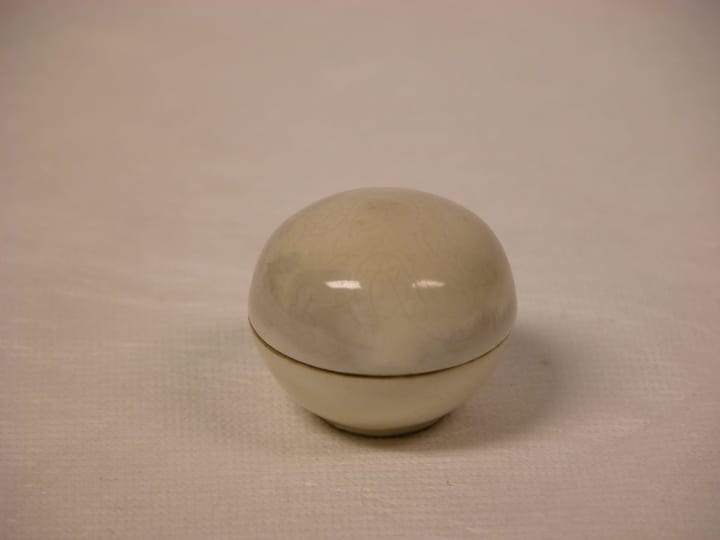
Chinese porcelain cosmetic boxes can be very small
The Met dates the illustrated rouge box to the eighteenth century. It measures just 3.3 centimeters across and closes with a rounded lid. A thin seam separates the domed cover from the lower bowl. The incised decoration is subtle in the photograph. The catalogue calls it a rouge box, and the photograph shows the exterior with the lid seated.
Matching edges make a lid sit in place
The Palace Museum’s Tang Ding box has straight sides, fairly thick walls and a slightly domed cover. White glaze coats both the inside and outside. The museum describes nested rims where the lid and body meet. This larger example shows how the shaping at the joint can matter as much as the visible silhouette.
If both parts are visible, look for the narrower edge that fits inside the wider receiving edge. With the lid down, their join is seen mostly as a line around the body.
Powder and an inscription give different clues
Shanghai Museum cites a Tang tomb at Long County, Baoji, where red powder survived inside a ceramic box. The museum presents cosmetic use as an interpretation of that find. A green inscription on the cover of its own Changsha box identifies that vessel with oil. The museum describes the vessel as a hair-oil container and connects the recessed rim to limiting spills.
These are separate objects. The reddish powder identifies something found inside one, while the inscription is evidence borne by the lid of the other.
Three compartments can organize several preparations
Dehua County’s account of a Song qingbai powder box from the Weilin kiln describes three small boxes arranged together. Four recovered fragments were used to restore the piece. The joined layout provides distinct spaces for different preparations. The account describes possible contents, and the restored shape shows how the three containers sit together.
A single decorative design could span different sizes
In the Tongzhi wedding group, the Palace Museum distinguishes the largest covered pieces from smaller powder containers and palm-sized rouge boxes. The family shares gold decoration against a red ground, with auspicious characters. The size categories come from the museum’s account of the ensemble.
The related covered jar guide considers larger containers and how a lid meets a jar. In cosmetic boxes the seated lid often leaves a similar join, while the size, interior and context can tell a more specific story.
Images and credits
Rouge box with cover, China, Qing dynasty, eighteenth century. Jingdezhen soft-paste porcelain with incised ornament. The Metropolitan Museum of Art, 24.170.12a, b. Fletcher Fund, 1924. Shown closed. Complete photograph, resized. Public Domain, CC0.