Locate the writing and its author
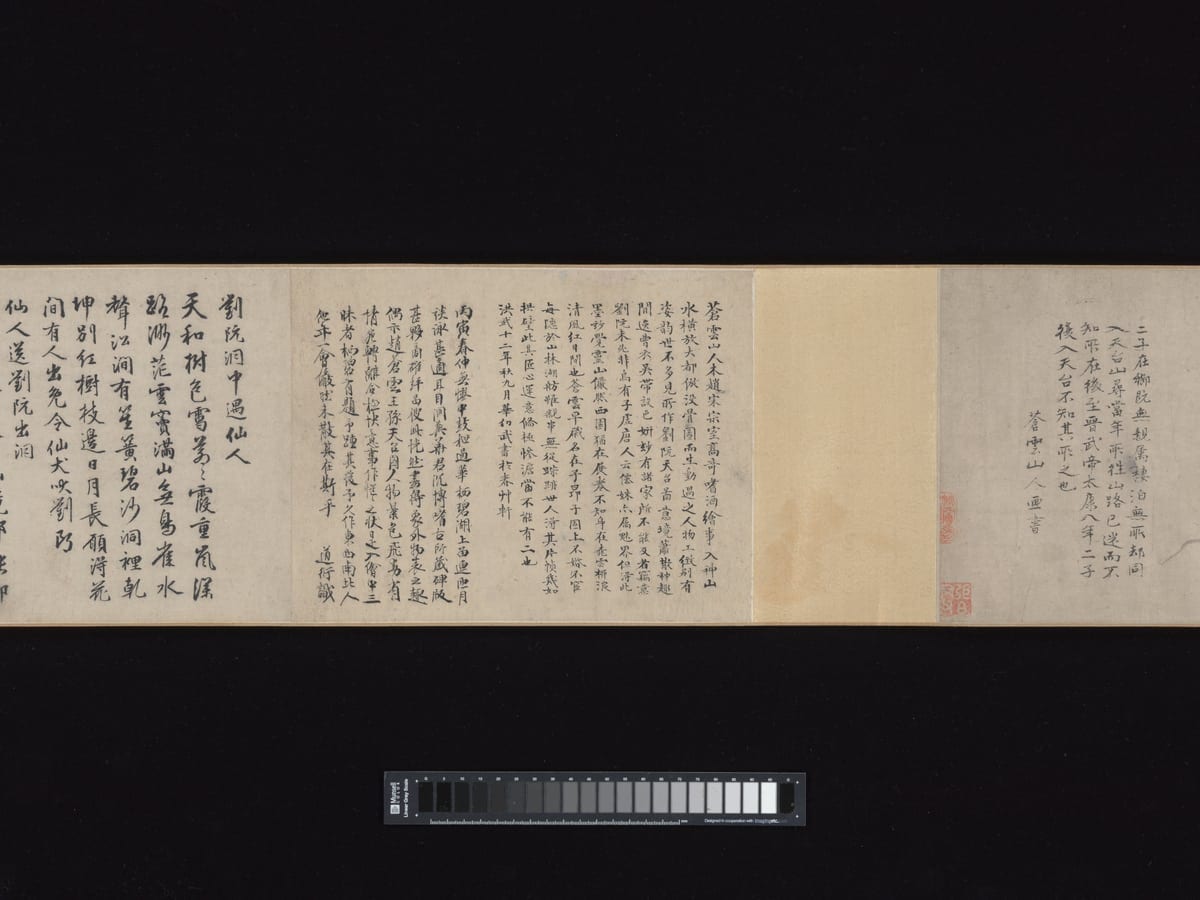
In the Met’s photograph of the Tiantai Mountains scroll, three handwritten blocks occupy joined papers. Their characters differ in size and spacing. The catalogue identifies the first colophon after the painting as Hua Youwu’s. It describes Zhao Cangyun’s skill in landscapes and figures and preserves information about an artist whose life is otherwise poorly documented.
Use the accession number to match a detail photograph to its whole work. Then consult the catalogue’s inscription section before assigning a writer’s name to a particular block of text. A partial image may begin midway through a longer sequence.
Ask what the writer is doing
The Smithsonian’s Nymph of the Luo River offers a different kind of response. Its first colophon is by Dong Qichang, who praises the painting and gives his opinion of its authenticity. The museum dates the surviving painted scroll to about 1150–1250, several centuries before Dong’s lifetime, 1555–1636. The picture and the written response therefore have separate dates.
For each passage, make a short note of its subject. Is it responding to the painted scene, discussing the painter or describing an encounter with the work? Keep the date beside that note when the catalogue supplies one.
Follow the circumstances of a gift
Wind and Snow in the Fir Pines, by Li Shan, carries a record of an imperial gift. The Smithsonian identifies Peng Qifeng as the recipient when the Qianlong emperor gave him the scroll in 1763. After Peng’s death, his son invited Wang Wenzhi to add a colophon, which Wang wrote on 6 May 1786. The later writing preserves a family’s continuing relationship with the painting.
Check where the words are mounted
In Landscape for Qiu Yuanwu, the Smithsonian records four colophons before the painted section and others after it. Its catalogue gives writers, scripts and dedications, including poems addressed to the recipient. Look through the whole digitized sequence before deciding that the first visible text is the painter’s own inscription.
A writer’s description can also make a collaborative painting easier to investigate. One colophon on this scroll discusses which artists contributed houses, boats, figures and landscape features. It supplies a way to compare the written account with details in the image.
Read an attribution as a claim to examine
Buddhist Temples amid Autumn Mountains at the Met carries colophons by fourteenth-century writers, including Ni Zan and Lu Guang. The painting has an older artist’s signature, but the museum considers it a fourteenth- or fifteenth-century copy. Its curators suggest that some colophons may have been written for another painting and attached later. Read the commentary alongside the museum’s present assessment and mounting history.
Images and credits
Colophon section following the Yuan-dynasty painting Liu Chen and Ruan Zhao Entering the Tiantai Mountains by Zhao Cangyun. Ink on paper. The Met, 2005.494.1, Gift of Oscar L. Tang Family, 2005. CC0. Complete museum photograph of this section, resized.