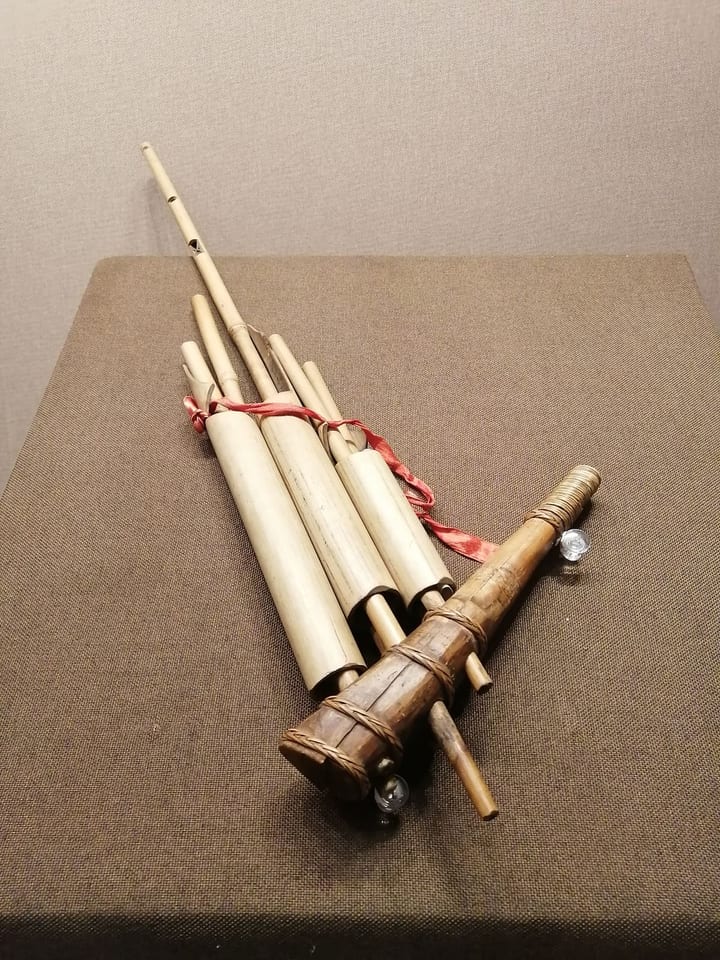
Trace the pipes from the chamber
The photograph shows an instrument from Guangxi photographed in a Beijing museum display in 2021. Look for the side-facing blowpipe, the bindings and the narrower tubes projecting from the wider ones. The museum at Academia Sinica records a separate Guizhou object from a Miao community, accession E00181, received in 1946. Its account explains that fingers on the holes select notes while air moves the reeds.
Reed work and tuning require repeated listening
A profile of Tongdao maker Yang Zhiguang follows the making of a single reed. He works copper into a thin sheet, cuts a tongue, listens and makes small adjustments. After fitting the reeds, he also compares instruments intended for the same group. The work continues from getting one note to sound to getting several players’ instruments to agree.
In Xinguang, the national register describes a six-pipe Miao form that uses a five-note scale. The entry treats the maker’s ear as part of the tuning process. It identifies a particular village practice and ties it to the documented making tradition in Kaili.
Follow the leading players in Danzhai and Tongdao
The Danzhai register describes one formation with three lusheng leading thirteen mangtong. The musicians play while moving in circles, with steps that sound alongside the instruments. The local account also distinguishes repertory by purpose. It names pieces for departure and farewell in funeral settings. Look up how the performance was recorded before applying the description to a clip.
In Tongdao, the register describes a group led by a high instrument and supported by other sizes, including lower parts. It also allows for different groupings. In a performance identified as Tongdao Dong music, try to follow the leader as other parts enter. Then watch for the moments when the playing and movement meet.
A maker and player can work with new materials
The Smithsonian Folklife Festival profiled Mo Ming of Paika in Guizhou in 2014. He demonstrated making and playing and had worked with bamboo and stainless steel in adapting a design. The same profile describes models with more than twenty pipes. A player’s name and instrument can tell you more about a demonstration than a pipe count alone.
Images and credits
Lusheng from Guangxi on display at the Cultural Palace of Nationalities, Beijing. Photograph by Yumeto, 26 December 2021, via Wikimedia Commons, CC BY-SA 4.0. The complete frame was resized and re-encoded for display. The 720- and 1200-pixel versions are available under the same CC BY-SA 4.0 licence.
