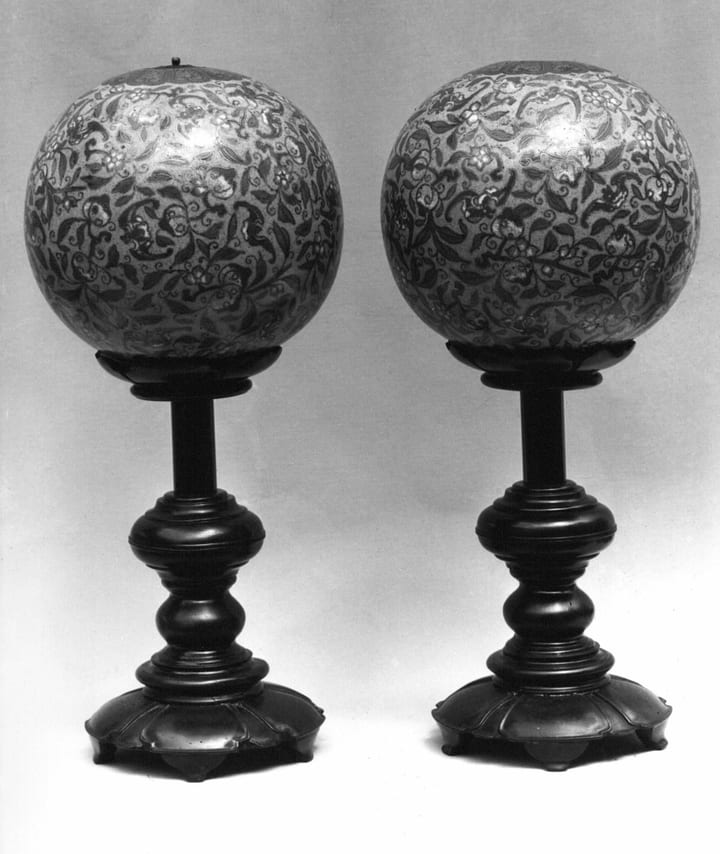
Chinese hat stands could have hollow tops
The Met’s pair dates to the eighteenth century. In the monochrome photograph, a shallow cradle connects each patterned globe to a tall wooden support. The museum records perforated lids and hollow interiors that could hold scent. Looking at the silhouette first helps distinguish the part that supports the hat from the base that raises it.
One porcelain stand resembles carved lacquer
The National Palace Museum’s Qianlong example is porcelain with a brick-red ground. Fine lines mark out a repeating pattern below raised ornament traced in gold. The combination creates an effect that the museum compares with carved lacquer. Look for the difference between the recessed ground and the raised ornament along the curve of the globe.
Imitation is a design choice. Read the recorded material first, then ask what features of the other medium the maker chose to evoke. The relief and gold on the porcelain present a different way to achieve a familiar look.
Openwork can occupy a small part of the dome
The Gulbenkian Museum’s mid-eighteenth-century porcelain stand has a pale, evenly glazed surface. Its catalogue describes a pierced flower at the top that released fragrance from the interior. Relief lotus scrolls decorate the sides. On this example the flower has a practical role as well as a place in the design.
On the Princessehof’s decorated porcelain stand, butterfly-shaped openings sit among lotus scrolls. The museum describes scent passing through both the top and sides. Openwork can therefore mark different parts of the globe.
A taller stand can resemble a vessel
The National Gallery of Victoria catalogues a four-lobed Canton stand dated 1821–1874. The object has petal-like openings and a tall profile reminiscent of a brush pot. Its body is copper with painted enamel. The material and use come from the catalogue and give context to the vessel-like outline.
SFO Museum exhibited a nineteenth-century porcelain stand from Jingdezhen with the Three Star Gods. Another stand was signed by Zhan Yishun and associated with the Lisheng Shop in Jiangxi. Those details tie particular supports to distinct decorations and workshops or places.
Compare the openings in two Qing furnishings
Our incense tool vase guide follows narrow mouths used to hold long implements. A hat stand presents a larger support, sometimes over a chamber with smaller openings. An object’s upper profile and the position of those openings give a useful starting point for reading its catalogue.
Images and credits
Pair of hat stands, China, Qing dynasty, eighteenth century. Cloisonné enamel tops on wood bases. The Metropolitan Museum of Art, 29.110.46a–c and 29.110.47a–c. Gift of Edward G. Kennedy, 1929. Complete monochrome photograph, resized. Public Domain, CC0.