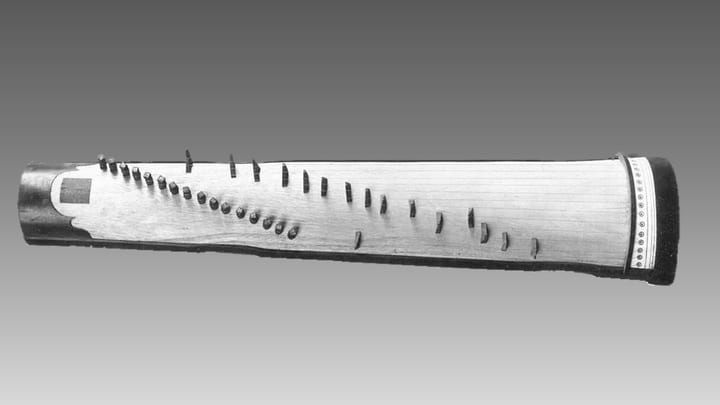
Read the pegs and bridges on the Chizhou zheng
The Met dates accession 89.4.48 to the nineteenth century and identifies its maker as the K’ai-Sheng Shop. It measures 99.1 centimetres long. In the photograph, a cluster of pegs and a spread of small bridges run across the top of the instrument. The pegs tune the metal strings on this model.
Use the picture to distinguish the point where each string is tensioned from the place where it meets its bridge. The Met contrasts the exposed pegs with a larger modern form whose pegs are covered at the head.
The Met also describes one Chaozhou technique. Picks on the right hand pluck the strings, while the bare fingertip serves for particular effects.
Set the open notes before shaping the phrase
Eastman’s programme notes describe a common twenty-one-string model tuned to a five-note scale. Each movable bridge passes the string’s vibration into the soundboard.
Yang Mu’s illustrated guide shows one common tuning for a twenty-one-string zheng. For a listening exercise, play through the open strings slowly and hear how the five-note pattern repeats across registers. Then pluck one string again while pressing the opposite side. Yang Mu explains the change in pitch through the change in tension.
One hand can bend or add a second line
Eastman describes the bend as a way to reach pitches between or outside the instrument’s open notes. Listen to when the player changes the pressure during a sustained sound. The same programme discusses modern writing in which the left hand also plucks, taking on an accompaniment pattern or a separate melodic line.
Henan’s opening pieces came from sung performance
The national record for the Zhongzhou school describes bantou qu as instrumental music linked to the opening of Henan dadiao quzi, a sung narrative tradition. It names Chen Xingyuan Goes to a Foreign Land among the examples. The school also has shorter tunes, some with lyrics, including Shanpo Yang.
The entry describes several kinds of sliding pressure and vibrato in the left hand. When listening to a credited Zhongzhou performance, notice whether the hand changes the pitch gradually or makes it fluctuate around a note. Those gestures help you hear why an open-string tuning alone tells only part of the story.
Shandong repertoire offers two listening starting points
The Shandong heritage entry names Heze and Linqing among the areas where the tradition is practised. It identifies Autumn Moonlight in the Palace as a piece in the more formally structured repertoire and Fengxiang Ge as a shorter piece associated with local song and storytelling.
Compare how a recording of each piece begins and closes its phrases. Write down where an ornament changes a sustained note and where another pluck starts a fresh one. Repeat the comparison with the performer and regional version identified.
Hear a named performer in the Smithsonian archive
The Smithsonian’s recording of Bing Xia’s 14 September 2000 concert gives a practical starting point. Autumn Moonlight in the Palace starts at 5:51, and Jackdaws Playing in the Water begins at 33:05. The event took place at the Freer and Sackler Galleries for an exhibition on music in the age of Confucius.
Images and credits
Chizhou Zheng by the K’ai-Sheng Shop, nineteenth century, Anhui, China. Wood. The Metropolitan Museum of Art, 89.4.48, The Crosby Brown Collection of Musical Instruments, 1889. Public domain, CC0. Complete photograph resized for display.