Read the bore and finger holes
The Met holds a guanzi from eastern China, catalogued as Qing dynasty and dated to the nineteenth century. It is 19.1 centimetres long. Yale’s example, dated around 1950, has hardwood carved to resemble bamboo and brass bands at the ends. The shape of the surface alone can give a misleading impression of the material.
Yale records a cylindrical bore, seven finger holes and one thumb hole on that later pipe. Check both sides when you look through a catalogue. A front photograph may leave the thumb hole out of view.
Listen for changes in the reed and breath
The Horniman describes a roughly 1960 pipe with a near-constant bore width. Its catalogue compares the sound with that of a Western oboe, which also uses a double reed but has a widening bore. Compare examples at a similar pitch before deciding what aspect of the sound you hear as more penetrating.
At Shengfang’s Northern Music Association, visiting researchers heard musicians play the tune Lao Baban in seven keys. The performers used two sizes of reed on the same pipe in combination with the fifteen-reed sheng. A musician there also recalled an earlier local pipe with two thumb holes. Write down the instrument and reed setup when comparing two recordings of that tune.
Follow the guanzi through an ensemble
In Nangao Luo, Hebei, Li Yongqiang began by studying gongche notation and percussion with his father in 1978. He later played guanzi as his main instrument in the village association. The provincial account describes the pipe in a leading role and emphasizes that the player’s airflow helps control pitch.
The Baiyunshan Daoist music account describes a 15.2-centimetre tin guanzi that leads with embellished phrases. In that ensemble the haidi carries sustained stretches of melody and the sheng supplies harmony. When listening, trace a phrase past its first entrance. The instrument that cues a turn and the one that carries the tune can be different.
Find the earlier reed pipes in the painting
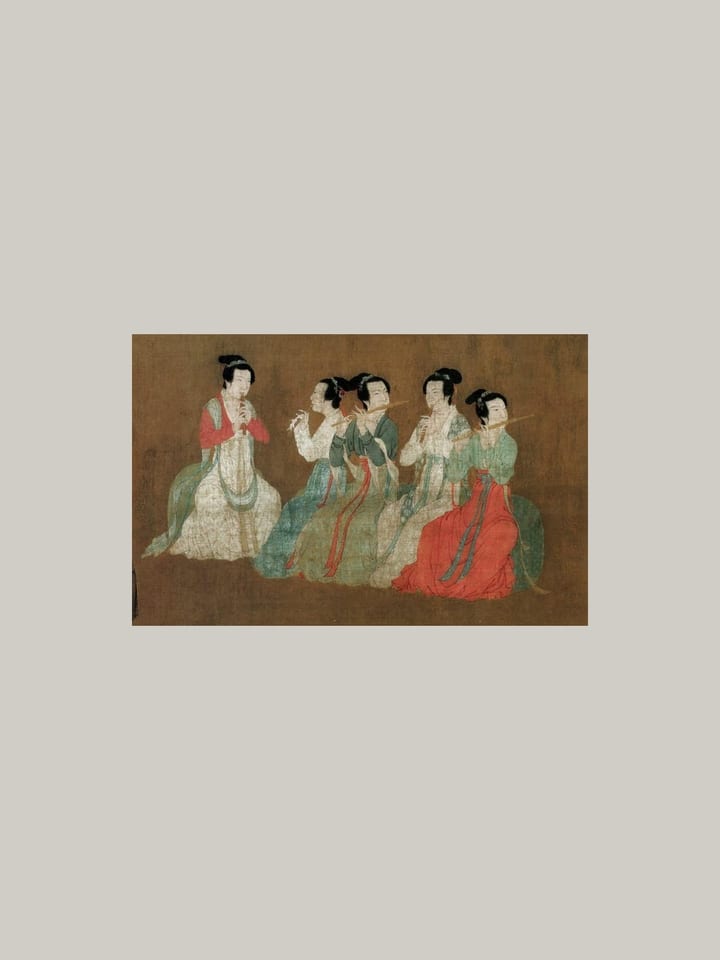
The Palace Museum identifies this passage as the fourth scene, known as Qingchui. Its scroll is a Southern Song copy after Gu Hongzhong. Music historian Xiu Hailin identifies three bili pipes and two transverse flutes in the group. The three short, upright pipes appear among the flutes held across the body. Use the painting to see how the two kinds of instrument sit together. Museum specimens give you measurements and a view of details that paint only suggests.
Images and credits
Wind ensemble detail from The Night Revels of Han Xizai, a Southern Song copy after Gu Hongzhong, dated 1163–1224 by the Palace Museum, Beijing. Public-domain reproduction via Wikimedia Commons. Detail cropped from the scroll and resized for display. Display adds a neutral border.
