Find the pitch column first
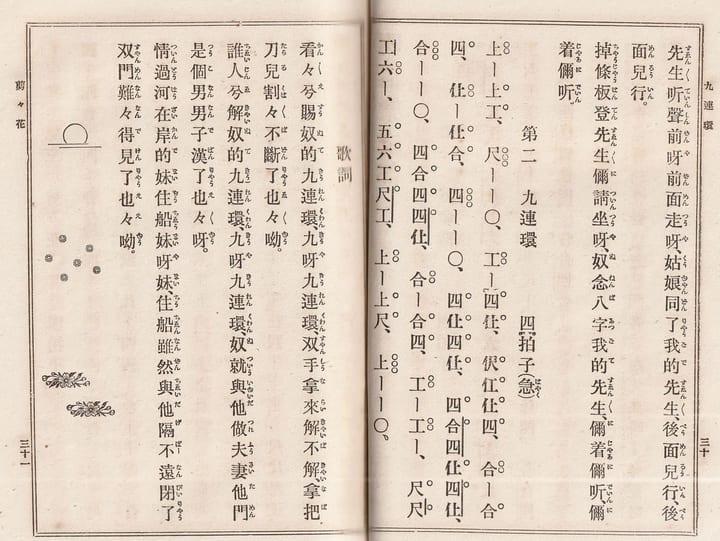
The photographed opening comes from a book by Noboru Momotari published by Hakubunkan in Tokyo in 1894. Look for 九連環 near the centre of the right-hand page. The columns immediately to its left include note signs such as 上, 尺 and 工. Small circles appear beside some of them, and the opposite page has words with small kana annotations.
Read the note signs down a short stretch of one column, then look back at the other marks. Write down separately what you can identify from the page and what you still need to check in an edition’s guide. Keep the score’s title beside your notes so the comparison can be revisited.
Use a key for the tradition you are reading
In the Hong Kong Education Bureau’s Cantonese opera chart, 上, 尺 and 工 correspond to do, re and mi within the chart’s scale. That gives you a way to sing a small group of notes. Use the chart for that opera convention and consult the relevant annotations before applying it to another edition.
A 2018 working-group proposal concerning Kunqu documented versions of certain characters with a short downward stroke. The proposal illustrates why a plain character and a closely related printed sign should be recorded separately when transcribing a page.
A score can preserve words, beats and phrase divisions
The Palace Museum describes the Jiugong Dacheng score collection as a court edition completed in 1746. Alongside the words and gongche pitch signs, its compilers marked banyan, a way of indicating beat positions, and identified breaks in the text and its rhyme scheme. The printed page carries several types of information a performer may need to follow.
Compare two ways of writing down a performance
Harvard’s Loeb Music Library identifies a passage from The Drunken Concubine in gongche notation. It appears in a 1930 selection of Mei Lanfang’s repertoire that credits Liu Tianhua with recording the music in Chinese and European notation. When comparing two representations, start by finding the same passage and identifying which markings record pitch, rhythm or words.
The national compilation announced by the Ministry of Culture in 2017 gathers source books from different traditions. When a score survives in more than one version, keep the name and edition with any passage you extract. That information lets another reader find the marks you used.
Images and credits
Jiulianhuan (九連環), printed in Noboru Momotari’s Minshingaku no shiori, Hakubunkan, Tokyo, 1894, pp. 30–31. Scan by Wiki Taro via Wikimedia Commons. Public domain, CC0. Complete scan resized for display.
