Count the plates in the frame
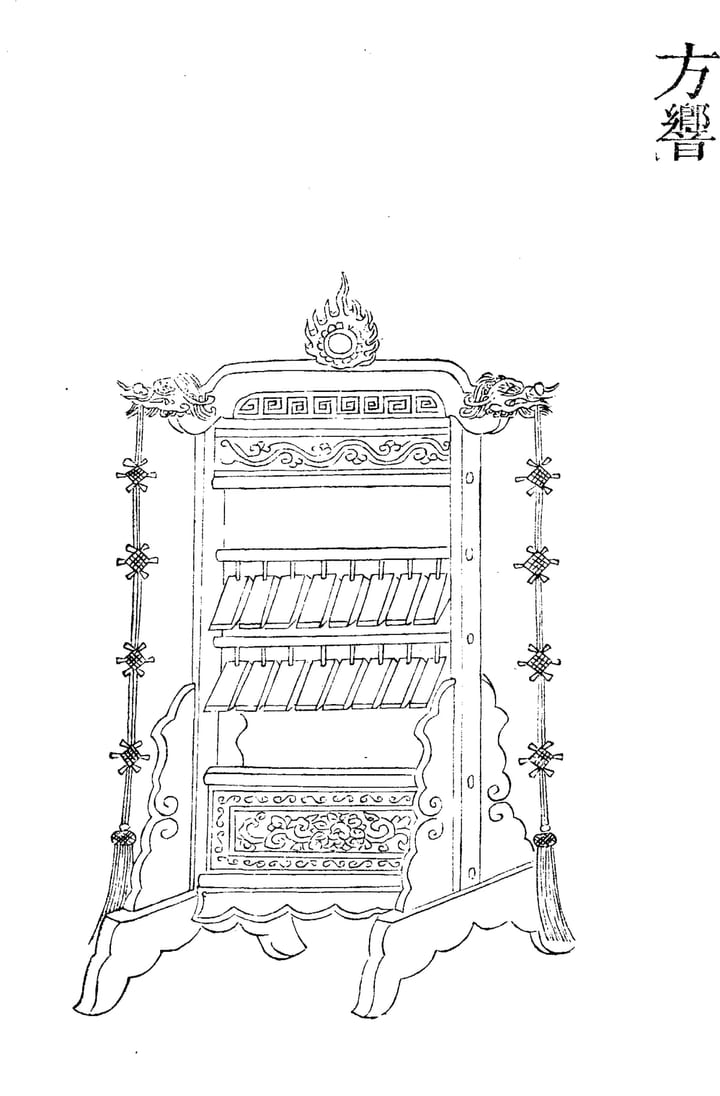
In the lead illustration, the heading 方響 names the instrument. The frame has two rows of eight rectangular plates. Above them, dragon-shaped ends flank the upper crosspiece. Cords, knots and tassels run down the outer sides. Follow a plate upwards to the point where it hangs, then compare that attachment with the supporting posts.
Make a sketch of the frame and note what the drawing allows you to count. Compare it with a measured specimen.
Similar sizes can carry different notes
The Qianlong-period fangxiang studied at the Palace Museum also has eight plates in each row. Each is 23.3 centimetres long and 5.4 centimetres wide. Their thicknesses vary for tuning. The study records the notes plate by plate, starting from the right in the upper row and from the left in the lower row.
The study also compares this suspended instrument with an earlier description in the Old Book of Tang, where the plates rest against a stand. Keep those documented arrangements beside their sources when comparing the instruments.
Place the part in its court ensemble
A Palace Museum study of the Hall of Imperial Supremacy lists fangxiang with large drums, cloud gongs, xiao, guan, dizi, sheng and zhanggu in Danbi Dayue. It cites an order for music at the hall and discusses how the ensemble and its instruments expressed the status of the ceremonial space.
For its 2005 court-music exhibition, the museum recorded sounds from surviving instruments, including fangxiang. It combined those sounds with scores and lyrics preserved in the Qianlong-era Yuzhi Lülü Zhengyi Houbian to make MIDI reconstructions. Check a recording’s production notes to learn how its sound was assembled.
Listen to a documented reconstruction
Henan Museum’s Huaxia Ancient Music Orchestra played at the Yellow Emperor ceremony in Xinzheng on 31 March 2025. The museum identifies the fangxiang there as a reconstruction based on an approximately fourteen-hundred-year-old form. Its report names Huangdi Song among the music performed and describes research and artistic arranging behind the presentation.
The museum’s profile of percussionist Lin Sen lists research projects on developing and bringing Song-period fangxiang into use. A separate interview describes his work copying instruments and exploring playing techniques with colleagues. Following the named performer helps connect a stage instrument with the practical work behind its part.
Compare sounds within the same recording
The orchestra’s 2025 account says its instruments were adjusted around a 440-hertz reference used for its bianzhong. That tuning belongs to the performing ensemble. When listening, follow a short fangxiang phrase through its attacks and pauses, then compare it with a phrase from another instrument in that performance. Keep the programme and performer credits with your notes.
Images and credits
Fangxiang illustration from Gujin Tushu Jicheng, Economic Compilation, Music section, juan 36. Public-domain image via Wikimedia Commons. Complete illustration resized for display.
