See the whole field of Chinese embroidered altar frontals
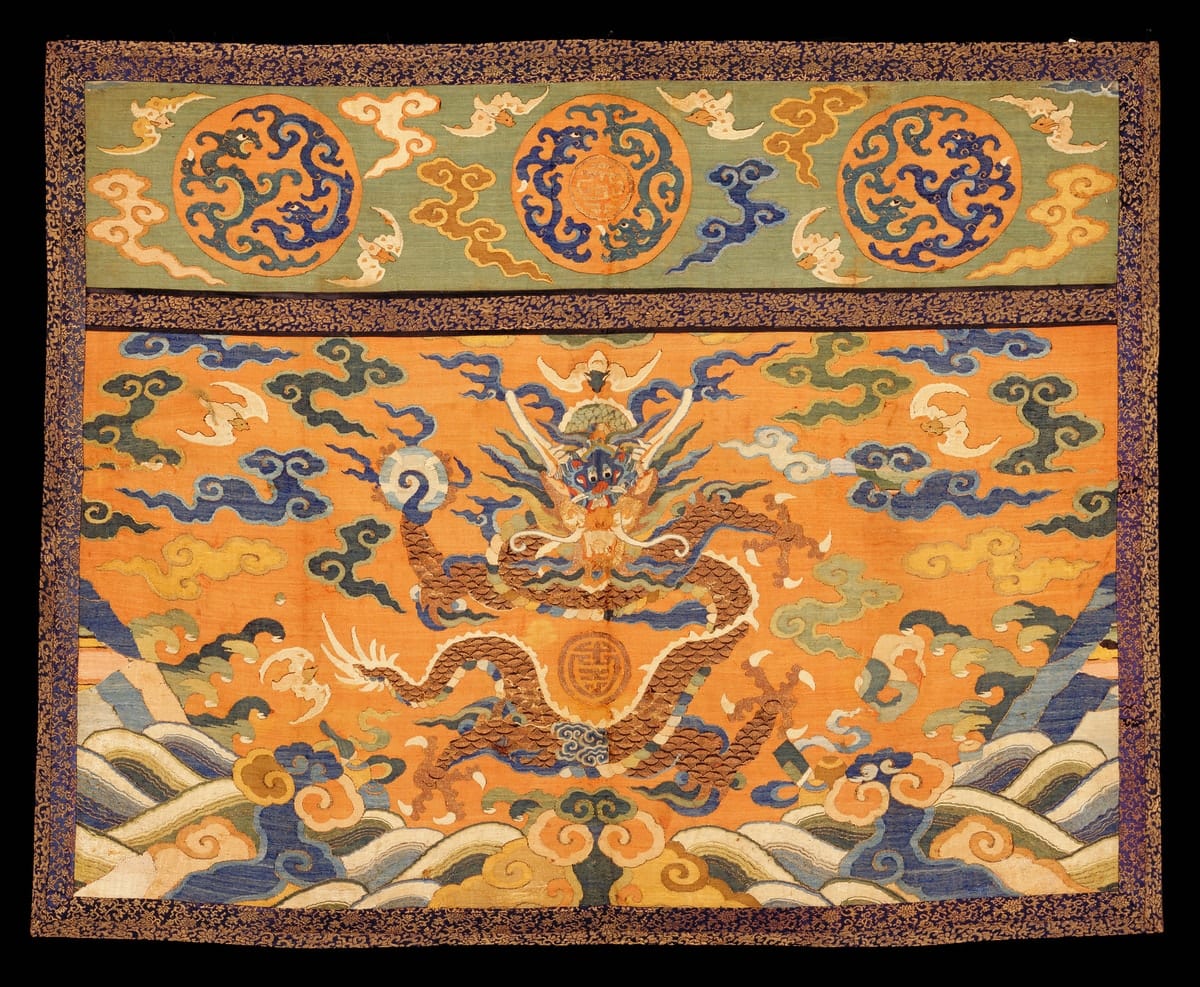
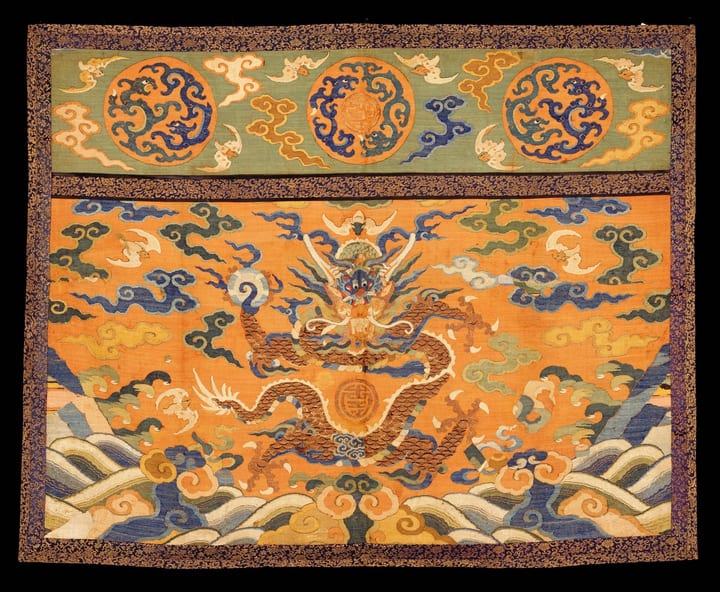
The Minneapolis Institute of Art’s Altar Frontal, 42.8.192, dates to the Kangxi period, 1662–1722. In the full photograph, a narrow upper section with roundels sits above a larger field dominated by a dragon. Dark patterned borders surround both sections. The work is photographed flat, without a table.
Start with the boundary between the upper and lower fields. Follow the center line down the textile, then move toward the edges. This makes the arrangement easier to compare with a frontal designed to turn around corners.
A flat textile can cover three sides of a table
Saint Louis’s eighteenth-century frontal 84:1923 is almost 244 centimeters wide when flat. Folded around the furniture, it covers a front just over 100 centimeters wide and two side faces. Its narrow valance has eleven roundels, arranged so that five face forward and three appear on each side.
The patterned surface extends around the corners. The gauze ground is completely covered in counted-stitch embroidery.
The back can have a different material
LACMA’s Chinese Table Frontal M.2003.172 has silk and metallic-thread embroidery on silk satin, with a bast-fiber lining. Its width is about 94 centimeters. The catalogue separates the material supporting the stitches from the material lining the textile.
That distinction helps when comparing records. Satin names a weave in the supporting cloth, while embroidery describes work added with thread. A front view is useful for the design, and a material description can supply information about layers behind it.
A ritual reading belongs to a particular work
RISD’s red satin Table Frontal 46.191A is dated to the late nineteenth or early twentieth century. Its label suggests a Taoist setting while retaining the possibility of ancestral use. Cranes carry counting sticks toward a pavilion by the sea, referring to sages who measured age in epochs. The scene gives longevity a narrative setting.
The same exhibition includes another frontal with dragon, mountain and water imagery alongside Taoist attributes and Buddhist emblems. Those combinations show why a particular label and setting matter when interpreting the textile.
Chinese making also served a European altar setting
Cooper Hewitt’s eighteenth-century example 1974-99-1 was made in China for a European market. Five embroidered silk panels form the frontal. The central one shows the Madonna and Child within a framed oval, supported by angels. Birds and flowering branches occupy the other panels, and metallic fringe runs around the edge.
Our Yue embroidery guide follows regional materials and an exported furnishing. The frontals here add another question to that comparison, asking how the textile was shaped for its furniture and intended setting.
Images and credits
Altar Frontal, China, Kangxi period, 1662–1722. Embroidered satin brocade. Minneapolis Institute of Art, 42.8.192, The John R. Van Derlip Fund. Complete institutional photograph, resized. Public Domain Mark 1.0.