The long tube separates into fitted sections
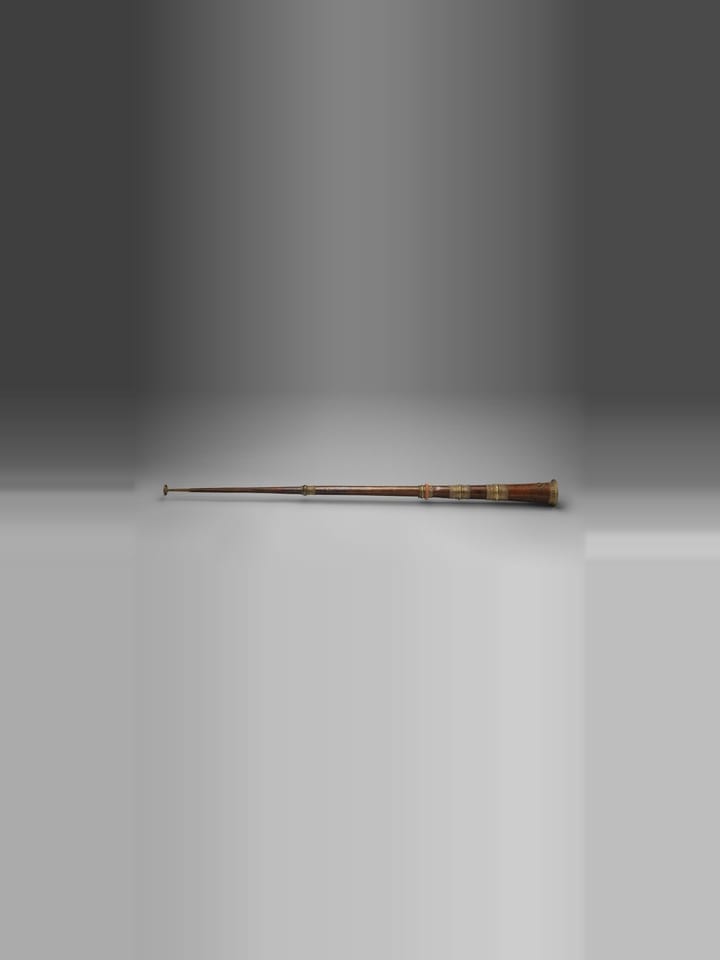
The Met labels the trumpet in the photograph as Tibetan, nineteenth century. It is 172.7 centimetres long. Trace the narrow end from the mouthpiece on the left to the large bell on the right. Bands visible along the tube help you see changes in width.
Würzburg’s two matching trumpets, Lo 74 and Lo 75, each measure 171 centimetres. The record describes copper tubes, brass fittings and three sections that slide into one another. Read the measured tube sections in the catalogue to see how a long trumpet can occupy less length when put away.
Look at the fittings and read the dimensions
The Horniman museum describes visible seams under two of the joints on its trumpet, with decorative bands around the sockets and bell rim. It also records a little metal shield fixed near the bell. An inventory description captures surface details that can be hard to see from one angle.
The Rubin Museum catalogues an early twentieth-century brass horn at 82 inches when open and gives Derge as a possible place of origin. Check that a measurement describes the open or closed instrument when comparing lengths.
Listen to the edges of a low note
The Met’s trumpet account describes changes in pitch and loudness as well as different shapes at the start and end of a note. Start with a sustained sound in a credited recording. Listen for how it starts, what happens in the middle and how the player lets it go.
Horniman calls the written trumpet repertories dung-tshig. Its account describes the three lowest available pitches as a usual focus in Tibetan performance and emphasizes articulation. A small set of pitches can still contain distinct musical patterns.
The same instrument has several places in a ceremony
The Musical Instruments Museum in Brussels describes pairs of long trumpets in ceremonial ensembles and a distinct repertory for monastery rooftops. It also describes settings with a larger pair and a smaller pair. When the source labels a recording, use the occasion and instrument list to guide what you listen for.
The Met also describes long trumpet sounds alternating with rgya-glings, a type of shawm, during morning or evening calls. Pay attention to changes between the two types of instrument across a whole passage.
Read the name on a museum label
In the Met’s separate essay on the rag-dung, curator J. Kenneth Moore explains dung-chen as large trumpet and rag-dung as brass trumpet. The essay discusses decorated Tibetan-style long trumpets made in China with dragon or lotus designs. Those objects have their own materials and records. Check each accession individually when comparing those horns to the example in the lead image.
Images and credits
Dung Chen, Tibet, nineteenth century. Metal. The Metropolitan Museum of Art, 89.4.2563, The Crosby Brown Collection of Musical Instruments, 1889. Public domain, CC0. Full photograph resized with added space around it for display.