Chinese ceramic lamps and stands have different working tops
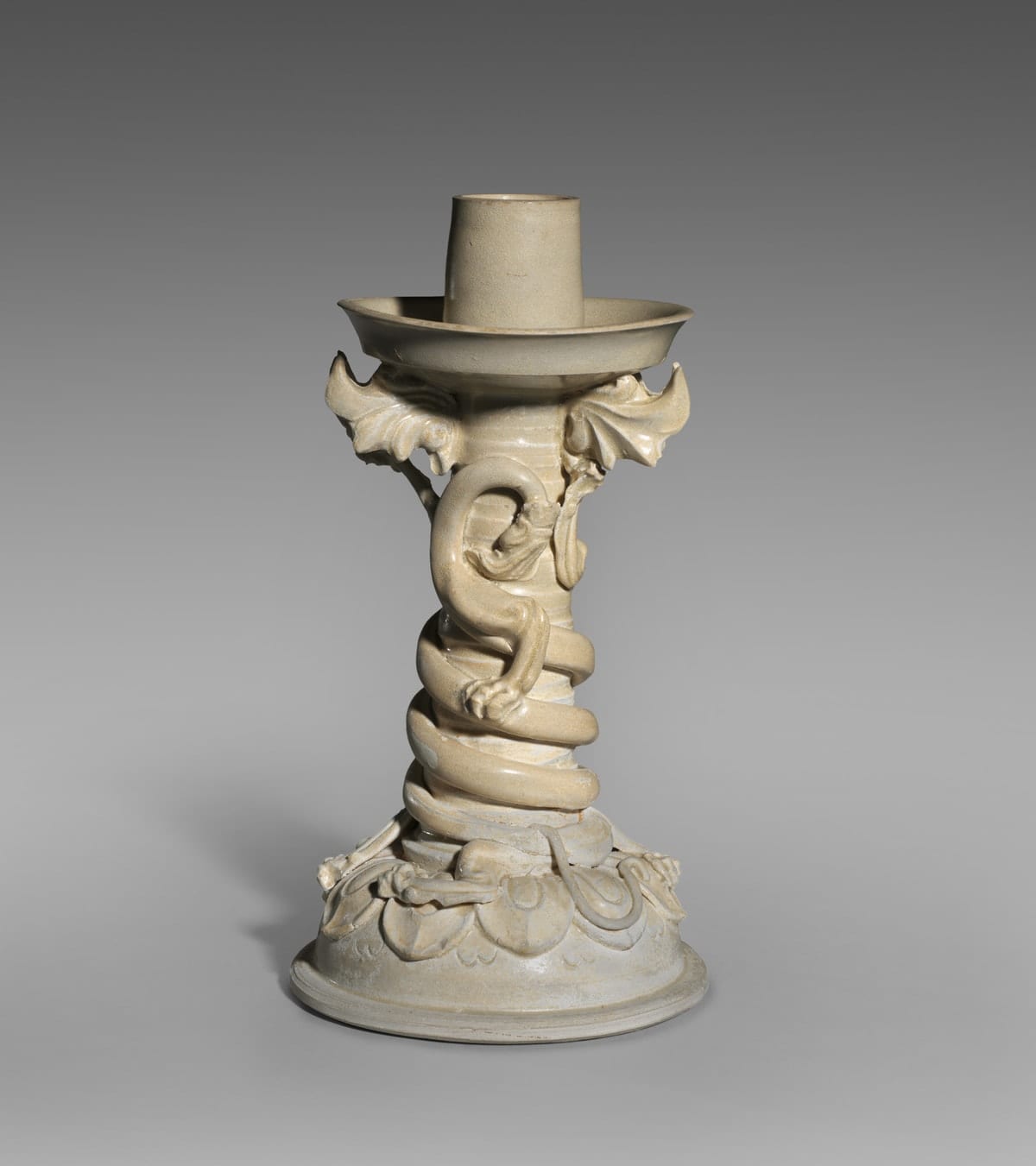
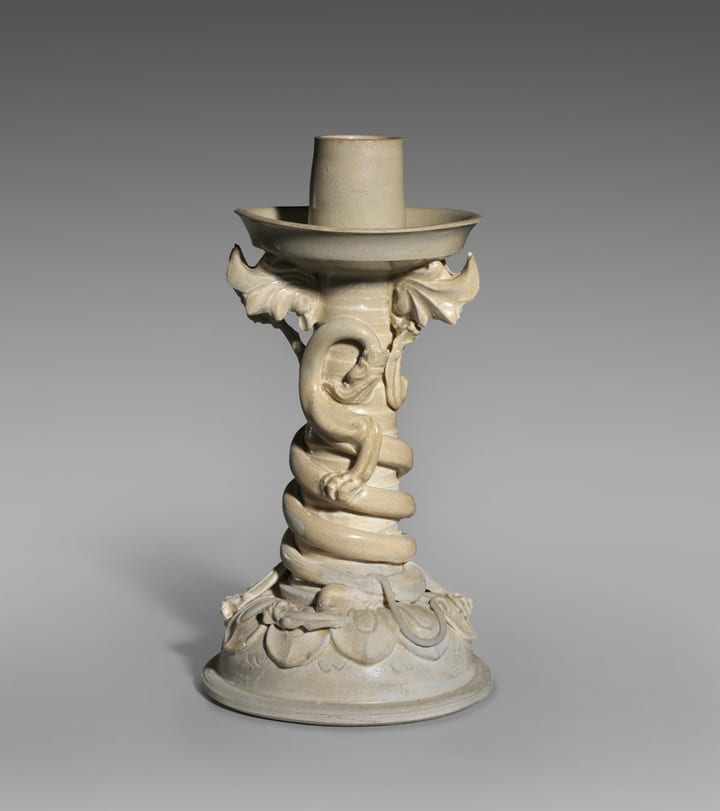
Cleveland’s seventh-century Candle Stand has a cylindrical holder rising from a shallow dish. Its catalogue calls it a candle or lamp stand. A column carries the dish above a lotus-shaped pedestal. The record gives its height as 29.8 centimeters and identifies dragons and palmettes among the applied and modeled ornament.
The photograph shows the entire stand. Look at the hollow cylinder and the dish around it, then follow the stem down to the spreading base. The top, supporting shaft and foot each have their own proportions.
A potter could combine throwing with raised decoration
LACMA’s Lamp Stand M.73.48.124 is dated 317–420 and tentatively assigned to Zhejiang. It is catalogued as Yue ware, with a wheel-thrown stoneware body, molded and applied decoration, green glaze and brown spots. The record brings several making operations together on a small furnishing.
Wheel throwing establishes rotating forms in clay. Molded and applied elements add another treatment to the surface. Reading the listed methods alongside the profile gives a firmer starting point than assigning the method from the glaze color alone.
Glaze can preserve differences from firing
The Smithsonian’s Yue oil lamp F1991.64 dates to the fourth or fifth century and is attributed to Zhejiang. Its label describes an uneven gray-green glaze. It connects the beige areas on this particular piece with difficulties controlling the kiln atmosphere.
An Ashmolean tripod lamp from Yue kiln sites has a green glaze, including its base and rim. Dated to the late fourth or early fifth century, it measures 15.2 centimeters high. Compare this catalogued three-footed form with the column and broad pedestal of the pictured stand.
A tall lamp gives glaze a long surface to travel
The Asian Art Museum’s Tang lamp B60P535 is low-fired earthenware with three-color decoration. A tray sits below its upper bowl, and the body widens toward the bottom. The museum explains that ribs running along the neck help control the glaze. It also reads pooling around circular areas on the base as suggesting a resist material.
Those observations concern the treatment of the surface. The museum discusses the lamp alongside other ceramic furnishings made for the tomb. That setting belongs beside its shape when considering what the object meant to those who commissioned it.
Read the function and the ceramic method together
Our celadon censer guide follows vessels made for incense, with handles, rims and feet suited to those documented forms. In the lighting examples, an upper holder or lamp bowl organizes the rest of the object. Compare the catalogue’s use term with the part that it names.
Keep the accession number with that description. It makes it possible to compare a complete museum photograph, a material record and a functional interpretation without transferring one piece’s history to another.
Images and credits
Candle Stand, China, seventh century, Sui to early Tang. White stoneware with modeled and applied decoration. Cleveland Museum of Art, 1930.322, Charles W. Harkness Endowment Fund. Complete institutional photograph, resized. CC0.