The raised studs on Chinese ceramic garden seats
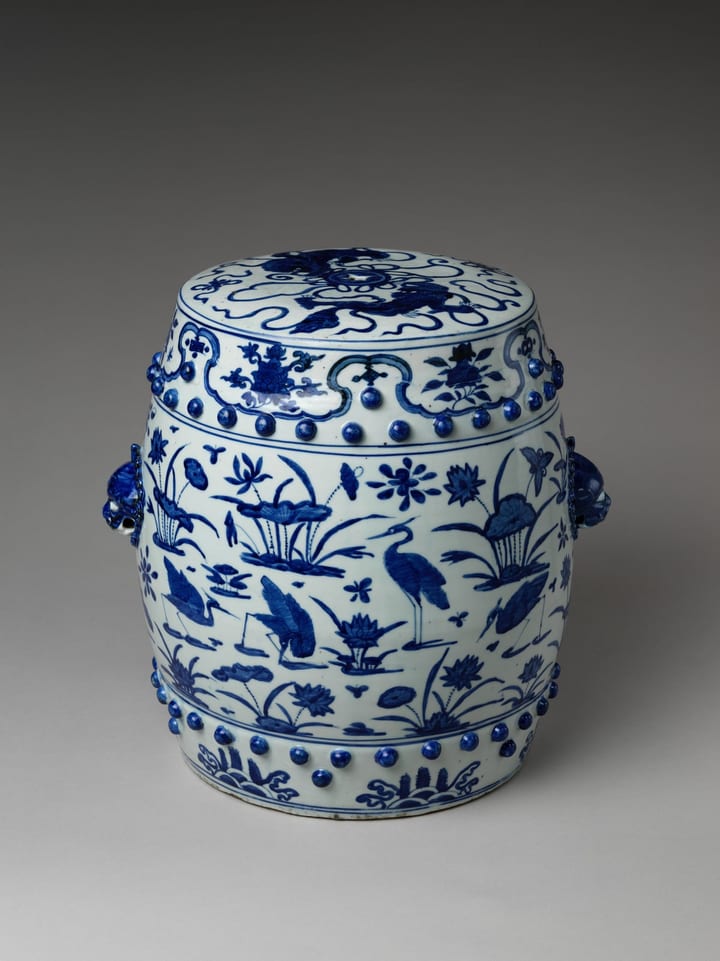
The Met’s sixteenth-century seat is 36.2 centimeters high. In the photograph, raised dots run in bands above and below a painted lotus pond. The museum connects the dots to fastenings on earlier seats that held a leather or fabric cover.
Viewed together, the top and the side show where the painter changed scale. One field is circular. The other wraps around the body and invites the eye to follow it around the seat.
The barrel profile also appears in wood
An early Qing wooden seat in the Palace Museum has a top built as a frame around an inset panel. Six oval openings interrupt the rounded sides. Zitan borders and inlays mark the edges, and bands of raised studs run around the body.
Our Chinese hardwood furniture joinery guide looks at how fitted members and panels form supports. The wooden stool offers a specific point of comparison with the external shape of a fired ceramic seat.
Openwork uses the thickness of a hollow wall
On the Palace Museum’s Chenghua-period stool, a peony is cut through the middle of the slightly raised sitting surface. Pierced birds and flowers fill much of the side wall. Two animal masks project from the sides. The museum describes a hollow drum body with raised studs near its upper and lower edges.
Look at the openings as well as the remaining pattern. They let the viewer see through parts of the stool and make the silhouettes of the branches legible against the empty space.
Molded ornament organizes a celadon example
Musée Cernuschi’s Ming garden stool M.C. 3431 is a Longquan stoneware example with celadon glaze. Its molded ornament alternates flowers and fruit in separate fields. The catalogue gives a height of 36.6 centimeters, close to the height of the illustrated porcelain stool, although its surface is treated differently.
Raised boundaries can separate several colors
Seattle Art Museum describes its fifteenth-century example as fahua-style biscuit porcelain with lead silicate glaze. The colored glazes occupy areas bounded by raised slip lines. Peonies and rocks fill the spaces between projecting masks. The record helps distinguish a raised boundary that shapes a color field from an opening that goes through the wall.
A later blue-and-white example at the University of Michigan Museum of Art presents birds and seasonal flowers in white against a cobalt ground. Here the relation between painting and background changes again. A dark field can define the white parts of the design on a curved surface.
Images and credits
Garden seat with scene of a lotus pond, China, Ming dynasty, sixteenth century. Jingdezhen porcelain with underglaze cobalt blue. The Metropolitan Museum of Art, 1993.386.33. Bequest of Marie-Louise Garbáty, 1993. Complete photograph, resized. Public Domain, CC0.