How to read Chinese calligraphy couplets
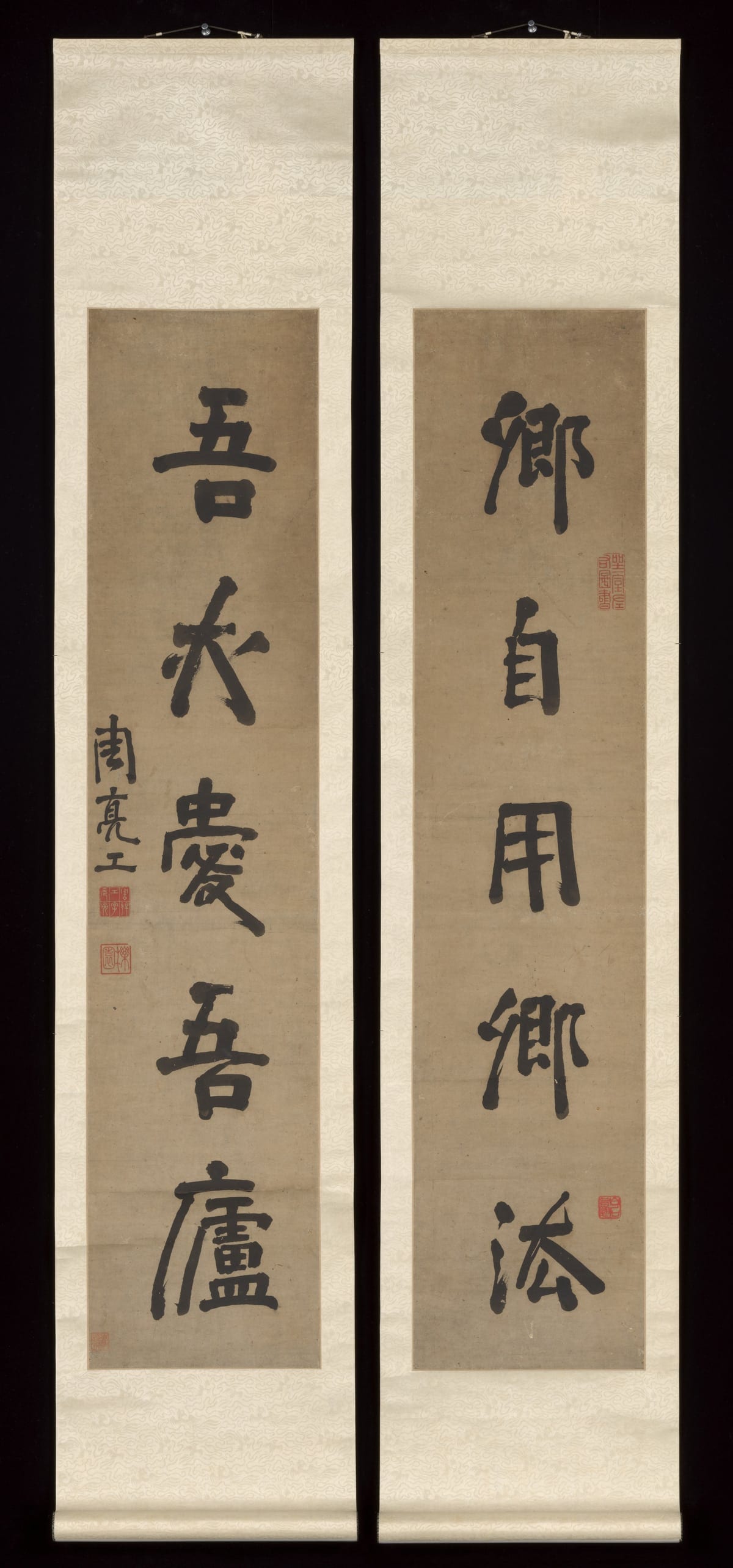
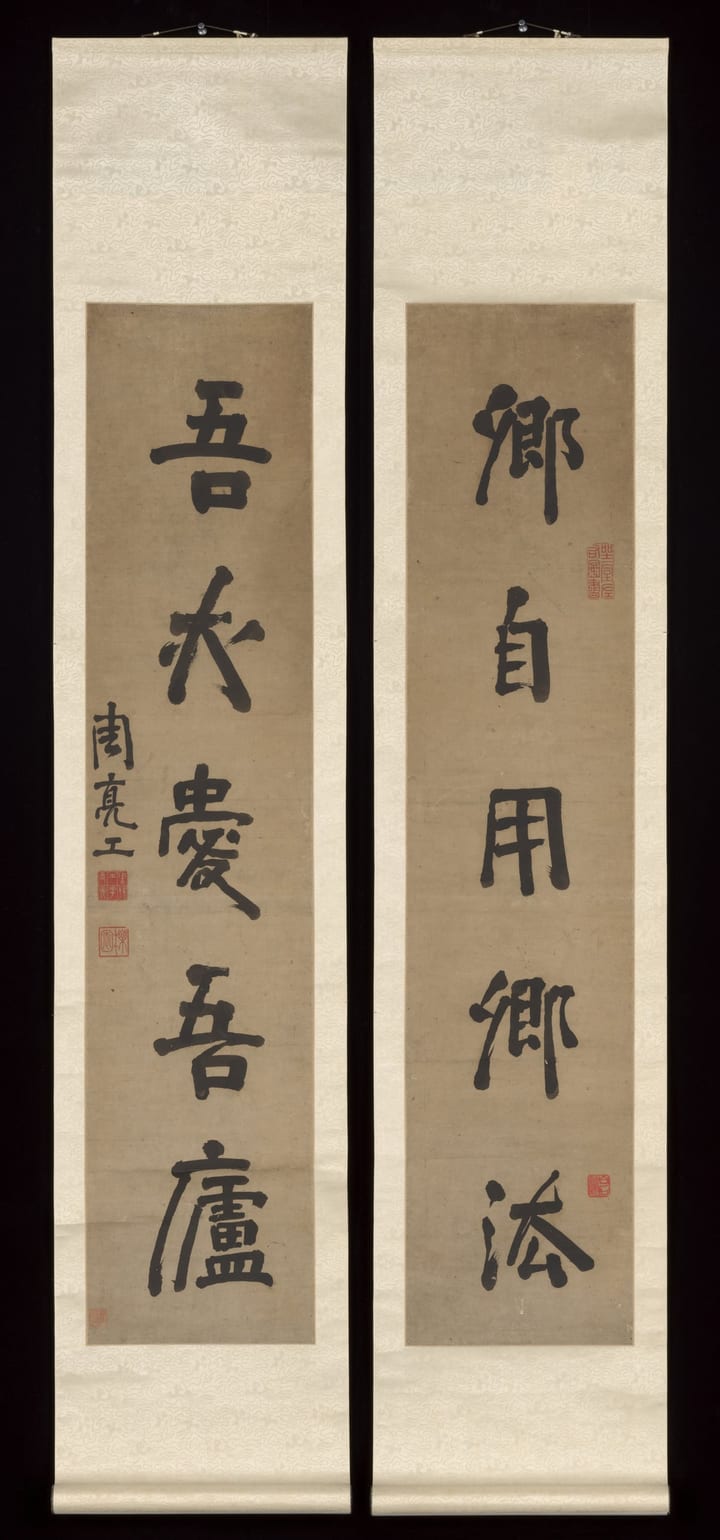
The photograph shows Zhou Lianggong’s mid-seventeenth-century couplet as two mounted hanging scrolls. Each has five large characters. The smaller writing and red seals occupy additional spaces beside the main text. The Met instructs viewers to read this work from right to left. Its verse voices Zhou’s attachment to a personal retreat.
Follow one large-character column before moving to the other. Note where the writing starts and ends within its mounting. Then find the signature and seals, keeping them separate from your count of the verse’s characters.
Look for a relationship between the phrases
The 2024 Education Bureau lecture explains that corresponding parts should match in grammatical role: a noun may answer a noun, or a verb a verb. Meaning matters as well. Two lines can complement one another, set ideas in opposition or carry one thought forward across the pair. The lecture also considers tonal patterns as part of composing a couplet.
With a museum transcription, align the two phrases in short groups. Mark words that refer to related people, things or actions. Read the whole thought again after this comparison; the relationship becomes clearer when the phrases are considered together.
Compare the main text with its dedication
Zhao Zhiqian’s couplet dated 1867 uses rounded seal-script forms for the principal verse. The Met identifies a different manner in the smaller dedication and signature, connecting their angular brushwork with Northern Wei stone inscriptions. The work lets you compare two kinds of writing within a single pair. Look at one smaller character beside a large one and trace how each begins, turns and finishes.
Scale changes the experience of the writing
The Smithsonian holds a matched pair by Fu Shan in large standard script, dated to the middle or later seventeenth century. Each written image measures 226 centimetres high and 45.5 centimetres wide. The museum describes individual characters occupying a square foot or more and relates their monumental presence to Yan Zhenqing’s stone inscriptions, which Fu studied.
View the whole pair before enlarging a detail. Compare the spacing around one character with the spacing around its neighbour. Keep the catalogue dimensions in view so a small screen image does not erase the work’s physical scale.
Compare two works by the same calligrapher
The Smithsonian also records a couplet by Zhao Zhiqian in standard script. Its discussion connects the writing with Northern Wei monuments and notes the upward inclination of individual characters and rounded finishing strokes. Set this record beside the Met’s seal-script pair. Compare the character structures and the distribution of dark ink across each line. Keep each work’s script designation with the comparison.
Images and credits
Zhou Lianggong, Couplet, mid-seventeenth century. Pair of hanging scrolls; ink on paper. The Met, 2020.73.2a, b. Gift of Julia and John Curtis, in honor of Hongnam Kim, and in celebration of the Museum’s 150th Anniversary, 2020. CC0. Complete mounted pair, resized for display.