Reading Chinese calligraphy copybooks as study material
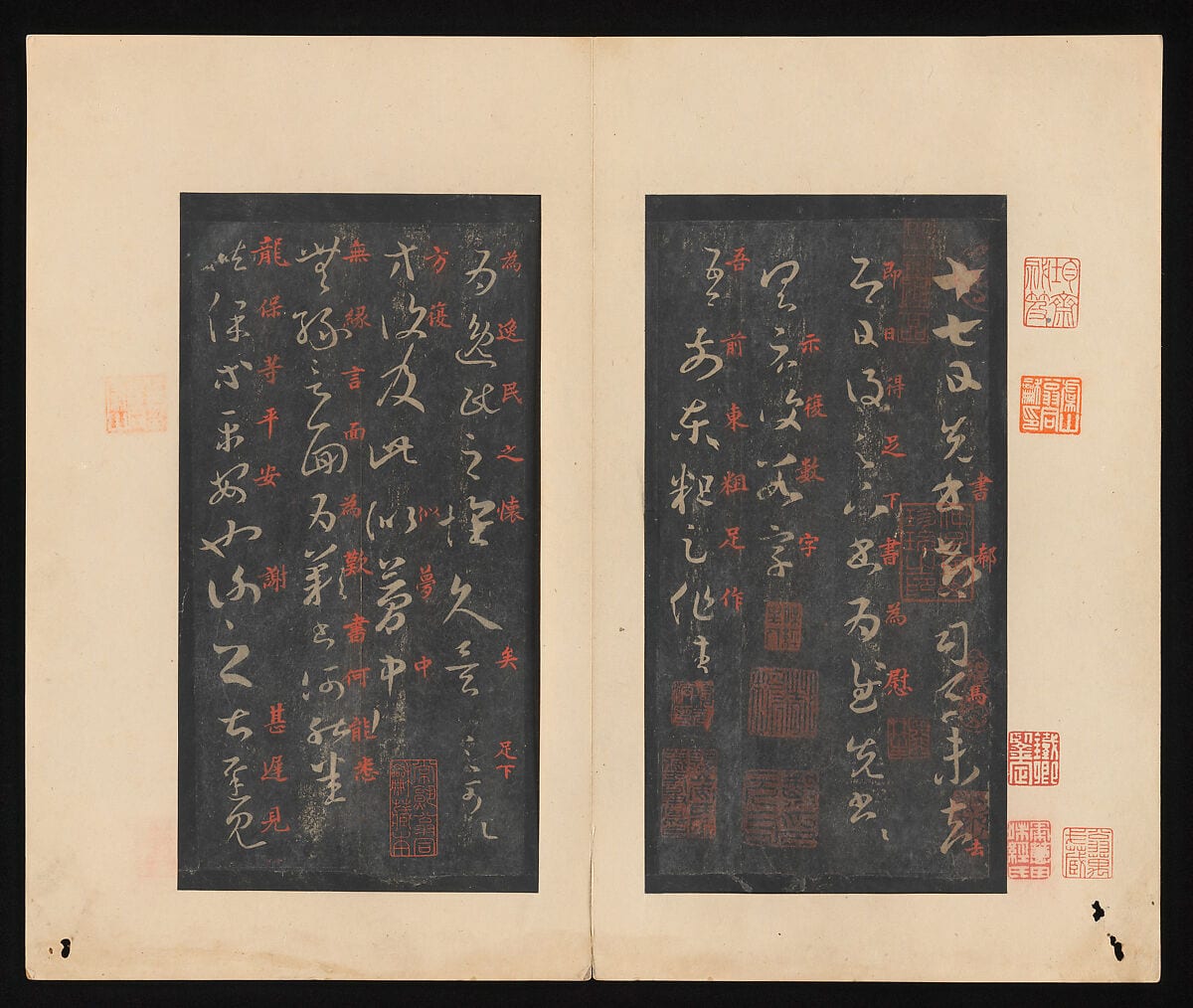
The pictured On the Seventeenth Day transmits letters associated with Wang Xizhi through a thirteenth-century rubbing. The collection comprises twenty-nine letters; its title comes from the opening characters of the first. The Met explains that rubbings helped students obtain classical writing models. This is an album to study, rather than Wang’s surviving handwritten original.
Begin with the collection record and a transcription. Identify a short passage before enlarging it. Follow the characters in that passage, then compare their relative sizes, spaces and connections. Keep the surrounding column visible so an isolated character does not become your only reference.
Tracing and looking beside the model
The Met’s Xie Zhiliu exhibition describes tracing as an early calligraphic discipline for learning movement and composition. It also documents a selective approach: Xie studied individual characters from Huaisu’s Autobiography through a rubbing instead of tracing the entire text. His study could concentrate on particular forms rather than reproducing every page.
For a comparison exercise, select one clearly reproduced character. First examine its outline closely. Then place your own attempt beside the model and mark one difference in proportion or spacing. Return to the full passage before trying again. This is a suggested looking exercise, not a claim that one routine suits every teacher or script.
A practice book records repeated effort
Wen C. Fong’s Calligraphy practice book, dated to the 1930s–40s, survives from his early training. The Met catalogues it as an ink-on-paper album lent by the Constance and Wen Fong Collection. Its account emphasizes sustained copying of established texts until their forms become familiar to the learner’s eye, mind and hand. A practice notebook is evidence of that work, distinct from the source being copied.
A model collection contains editorial choices
The eighteenth-century Hall of Three Rarities anthology drew upon calligraphy in the imperial collection. Its thirty-two albums gathered standard, running and cursive writing under Qianlong’s patronage. The final calligraphy includes Dong Qichang’s transcription after an earlier rendering by Chu Suiliang. A page can therefore lead through several writers, not simply from one master directly to a student.
Record which writer, script and version you are comparing. If two reproductions differ, consult their catalogues before deciding that one shows a mistake.
Copying can lead to a different result
The Met’s Embodied Image exhibition describes Wang Duo’s Calligraphy after Wang Xizhi of 1643 as a reconfiguration of earlier models. Learning from a predecessor did not require the finished work to remain a facsimile. Compare the model selected, the passage written and the resulting arrangement as separate questions.
Images and credits
On the Seventeenth Day, a thirteenth-century ink rubbing of fourth-century texts by Wang Xizhi. The Metropolitan Museum of Art, 1991.380. Gift of Mr. and Mrs. Wan-go H. C. Weng, 1991. Public domain/CC0. Complete institutional photograph, resized for display.